
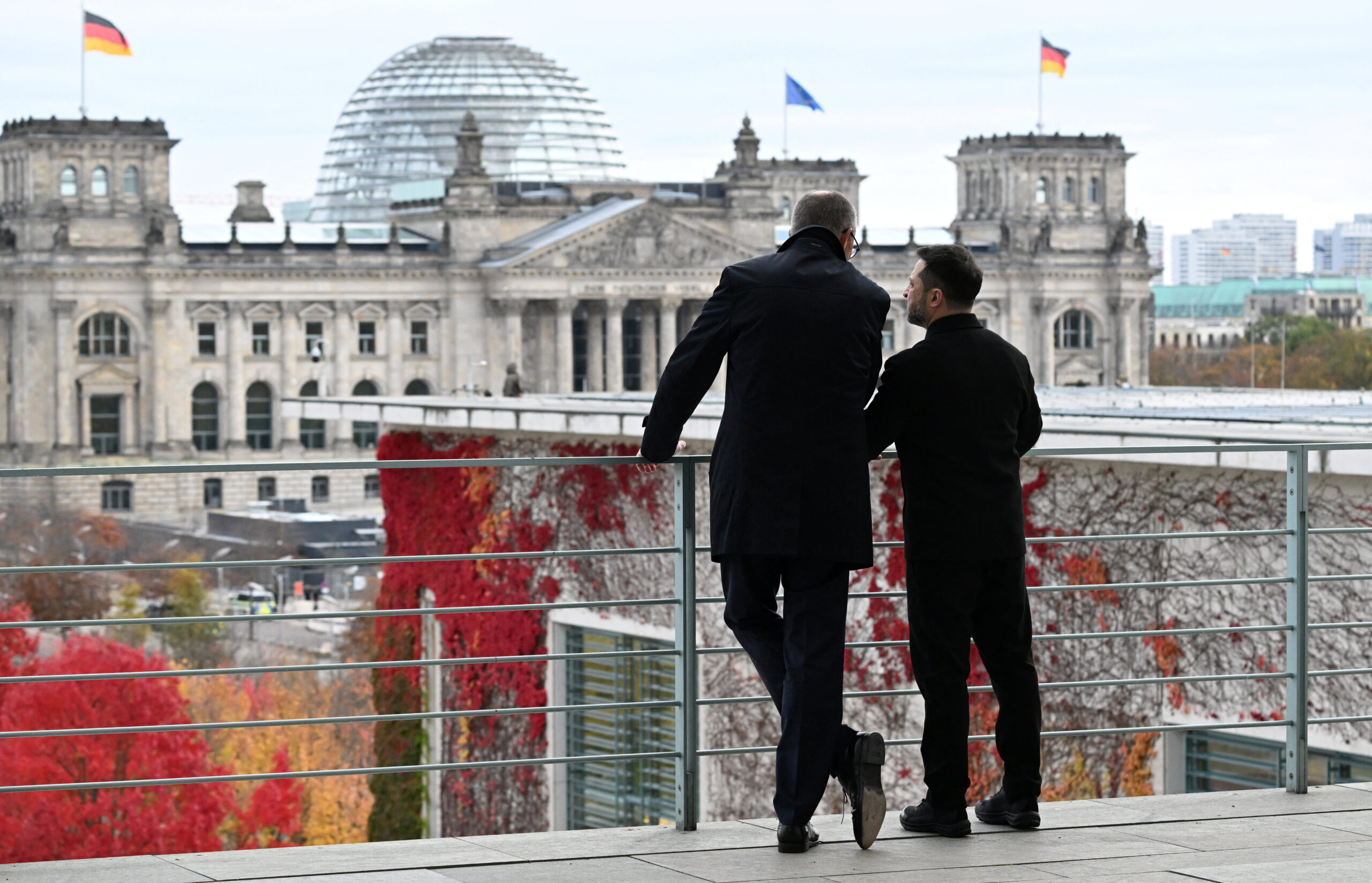
BERLIN—Like many Europeans, Germans have followed the US midterms with intense and astonishingly well-informed interest. We landed in Berlin early last Wednesday, the day after Americans voted. In the twenty-four hours that followed, Germans from parliament, government, think tanks, and random Berlin bars hammered us with questions about particular races and vote counts. Would Republicans in Congress now be more willing to break with the White House on certain policies? Would Abdul El-Sayed, the victorious Democratic candidate for Michigan’s Senate seat, oppose military aid to Ukraine as well as to Israel? (Judging by his writing and statements, we noted, El-Sayed supports Ukraine’s defense against Russian aggression.) And, of course, Germans asked what the Democratic Party’s win would mean for both the Trump administration’s immediate moves and the long-term direction of US foreign policy. Perhaps the most immediate question was whether the midterms would affect the Pentagon’s ongoing force posture review. Launched in July and expected to be published any day now, the review is widely expected to call for some reduction of US forces in Europe. A significant and quick reduction would put additional pressure on Europeans just as Russian aggression against the continent is ramping up. The Germans we spoke with wanted to know how to interpret the Trump administration’s eventual recommendations in light of the shift in Congress. US Army soldiers conduct sling load operations with a Chinook helicopter in Vilseck, Germany, on November 3, 2026. (US Army photo by Staff Sgt. Maxine Baen) In every meeting, Germans wondered about the Trump administration’s persistent pressure on Ukraine and economic offers to Russia. Hadn’t successive US administrations, including the first Trump administration, warned Europe and especially Germany about excessive economic reliance on Russian energy? Did Trump really think that economic inducements would convince the Kremlin to end its war against Ukraine? Such thinking had bedeviled German policy toward Russia for many years, our interlocutors noted, and Germany had finally wised up. When faced with Kremlin intransigence, the stick really might be better than the carrot, we kept hearing. Those German concerns grew sharper with the news that Jared Kushner and Steve Witkoff, the Trump administration’s Ukraine peace negotiators, were prepared to offer Russia general discussions about European security as part of a settlement of the Russia-Ukraine war. This has long been a Kremlin position. Before its full-scale invasion of Ukraine in February 2022, Russia essentially demanded that NATO withdraw military forces and infrastructure deployed to new member states since 1997, when Czechia, Hungary, and Poland were invited to begin accession talks. At the time, the United States and its European allies rejected this gambit while offering to negotiate European security in a more balanced manner. But the Trump administration’s recent announcements have raised concern in Europe that the White House is getting rolled by the Kremlin. Seasoned German security experts expressed astonishment that the administration, having failed to persuade the Kremlin to negotiate peace in Ukraine through economic incentives, appeared to be expanding its offer to include security concessions without getting anything in return. Many Germans we spoke with welcomed the possibility that the midterms might result in Congress acting as a check on those in the Trump administration who seemed too eager to provide relief to Russia at the expense of Ukrainian and European security. But they were alarmed by the immediate danger of a bad US deal with Moscow. They were also wrestling with a deeper realization: that transatlantic relations will not return to some “good old days,” when Germany could rest under a US security blanket. Trump has, they acknowledged, won a big argument: Europe in general and Germany in particular need to do more to provide for their own defense. The German foreign policy and strategic community, having accepted that reality, is now wrestling with what that means in practice. The good news is that German Chancellor Friedrich Merz has recognized that, however US foreign policy develops as the Trump era winds down and beyond, Europeans “must defend and assert our interests through our own strength” (“aus eigener Kraft,” in a telling phrase). He’s right, and Germany is doing a lot: rapidly building up its military, fielding a combat brigade in Lithuania to defend against possible Russian aggression, and stepping up as Ukraine’s biggest donor in Europe. Today, reports emerged that Merz is demanding that all twenty-seven EU members commit to funding for Ukraine as a condition for Germany, the EU’s biggest national contributor, to approve the bloc’s next budget. An increasing number of German leaders and experts are joining Merz in finally assessing the Russian threat accurately, without sentimentality, guilt, or fatuous hopes. German Army tank grenadiers take part in the “Freedom Shield 2026” combat exercise in Lithuania. (Kay Nietfeld/dpa via Reuters Connect) The bad news is that German public opinion may not have caught up with this strategic reassessment. Merz himself is unpopular, albeit largely for reasons unrelated to his support for a stronger German security role. The pro-Russia Alternative for Germany (AfD) party has surged in popularity, and Germans of a more pro-Western orientation can only hope its support has reached a ceiling. Russian aggression directed at Germany may be intended to intimidate German society into shying away from the leadership role that Merz has in mind. Nevertheless, German leadership will be needed. Of Europe’s larger states, the United Kingdom is inward-looking; France has a presidential election coming up, in which the pro-Russia nationalist Marine Le Pen might emerge the winner; and Poland, despite its rapidly growing economy and military and its strong strategic culture, is distracted by a debilitating fight between its president and its prime minister. US presidents have been seeking a more balanced US–German relationship since George H. W. Bush called for “partners in leadership” in 1989. The Berlin Wall fell months later, thirty-seven years ago today, but the vision of “partners in leadership” has for the most part remained out of reach. With a resurgent Russian threat and the US strategic role in Europe in flux, that time has come. German foreign policy thinkers and politicians seem to recognize it. Germany may not believe that it is ready. Neither did the United States in 1945.
Dispatch from Berlin: What Germans most want to know about the post-midterms United States
Full Article
Original Source
Read the full article at Atlanticcouncil →KhanList aggregates and links to publicly available news content. We do not host full articles from third-party sources. Always verify important information with original sources.