
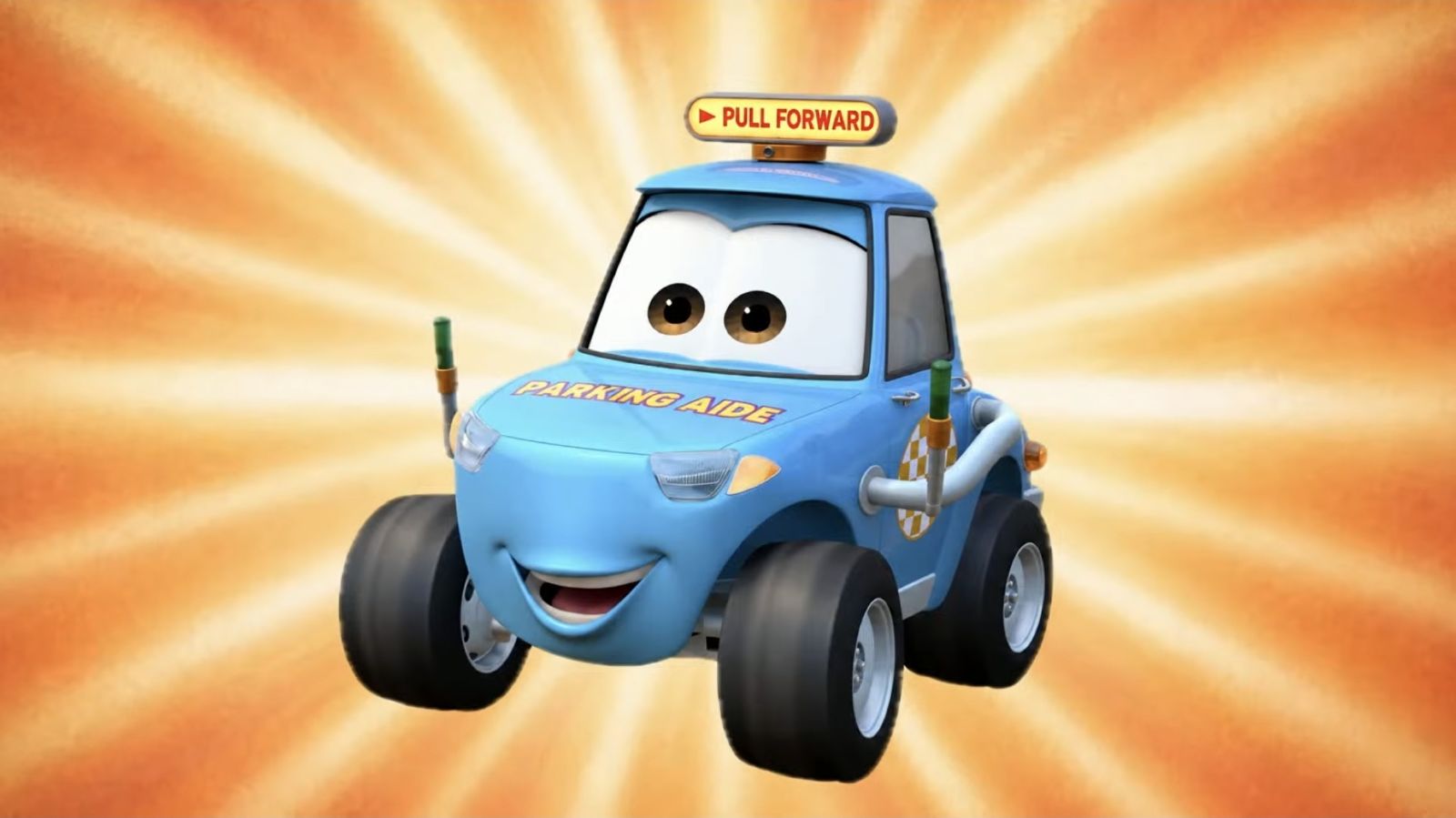
If you’ve ever driven to Disneyland, you know that parking is a challenge. When the parks open each morning, long lines clog the nearby streets as engines idle, families waiting anxiously to enter the parking structure so they can start their day at the parks. Parking attendants can only do so much to handle the tens of thousands of cars arriving every day at the Disneyland Resort. But what if a cutesy autonomous robot from Pixar’s Cars series could help direct traffic flow and guide you right into your parking spot? That’s a project being tested with FieldAI, a company that builds the AI brains for robots. In a demo video at the Disney Accelerator Demo Day on Tuesday, Disney and FieldAI showed footage of robots that would assist with guiding cars through the parking process. “Imagine if a character from Cars or robots from Wall-E direct you where to park when you arrive,” Gary Daniels, senior vice president of products and experiences at Disney Experiences Technology, said. “The work we are doing now is a great way to see how the robots function, and, as important, how people respond.” FieldAI is using AI to train autonomous robots to guide you in parking lots at Disneyland.Disney/Screenshot by CNET Other companies build the robots; FieldAI slaps its physical AI solution in a box on top of them, having worked so far with around 30 different robot types, shapes and sizes. The box is equipped with multiple cameras that serve as the robot’s “eyes and ears,” helping the AI model process what it’s experiencing in real time. The robots also collect data while operating. During the event at Walt Disney Studios, FieldAI showcased a Boston Dynamics robot dog and a miniature version of the BBX droids from The Mandalorian and Grogu that roam Star Wars: Galaxy’s Edge at Disneyland. FieldAI-enabled robots have already been deployed in Disneyland at Galaxy’s Edge on the BBX droids, though they hedged that this is in its early stages. “Our intelligence is on the bigger version and operating in the park already,” FieldAI CEO Ali Agha told reporters. FieldAI is using AI to enable autonomous droids to wander around Star Wars: Galaxy’s Edge at Disneyland without needing mapping, GPS or guiding.Disney/Screenshot by CNET David Min, vice president of Disney Innovation, told me it could also be used on characters that interact with guests at parks, naming Olaf and The Hulk as examples. Another project with Disney involves getting multiple robots to talk to each other to coordinate missions. Headquartered in Irvine, California, with offices in the San Francisco Bay Area, Boston and Pittsburgh, FieldAI primarily works in construction environments and energy facilities to complete tasks like inspections, material transport and supporting construction. But this is easily translated to a theme park environment, where paths and crowds are constantly changing, and autonomous robots need to account for that without needing mapping or GPS. “Our BBX proof of concept explores how to bring that navigation together with Disney character performance,” said Doug Fidaleo, lab director, Disney Research, Walt Disney Imagineering R&D. “That’s what drew us to FieldAI: deep experience deploying robots in demanding, unstructured environments with uneven terrain, changing layouts and unexpected obstacles.” Some of the use cases Agha gives include robots supporting security, perimeter patrols, helping cast members backstage and enabling more in-park experiences — even delivering items to people waiting in line for a ride. “This is a highly self-autonomous system that operates without a positioning system,” Agha said. A robot internship at Disneyland Physical Intelligence (Pi) is another company that builds AI brains for robots. Also showcased during Disney’s Accelerator Demo Day, Pi is focused less on roaming droids that can help or entertain guests and instead on robots helping Disney cast members with backstage tasks. Namely: picking up, folding, cleaning and sorting the 3D glasses used for rides like Toy Story Midway Mania and shows like Mickey’s PhilharMagic. It’s an unpleasant task that’s a major pain point for cast members who have to spend a long time in a small room completing it several times a day. It also requires “dexterous manipulation,” with Pi previously working on general-purpose robots that perform tasks like folding and stacking, using robots that have grippers rather than five-digit hands. Sourish Jasti, a technical staffer with Pi, said the company recently spent 12 days at Disneyland between midnight and 6 a.m. collecting data, testing logistics and moving its robots in and out of the park to see whether it could help with sorting the 3D glasses. “This was like a robot internship,” Jasti said, adding that physical AI is like a toddler, in that it learns from actually doing things. Pi AI-enabled robots pick up and stack 3D glasses behind the scenes at Disneyland.Disney/Screenshot by CNET The robots — which, much like FieldAI, Pi doesn’t build but instead installs the brains for — could be either a humanoid on wheels or just a mechanical arm. There are cameras on the base and cameras on the wrists to help the AI model “see” what it’s doing as it picks up and sorts the glasses. “We intend to have robots interning in many different spaces with Disney,” Jasti said, pointing to not only the theme parks but also Disney’s studios, hotel rooms and cruise liners, which he calls “mini cities.” For both Pi and FieldAI, Min said the benefit is that using AI can train the robots much faster to do the tasks Disney needs them to do — and that going to companies like these, which are already well-established in fields like construction and manufacturing, makes it easier to transfer those skills to the theme parks. Whether they’re roaming around parking structures or lands, or backstage helping workers, the AI-equipped autonomous robots are solving problems for Disney. FieldAI has many cameras on its system to help autonomous robots “see” and process the world around them.Corinne Reichert/CNET “The connection is through the core capabilities that we’re developing for our robots,” Fidaleo said. “Robots that can perceive the world around them, can act in the physical world and adapt when things change.” Disney is continuing to push technology from the audio-animatronic figures used on rides like Pirates of the Caribbean, making them more sophisticated to build an immersive experience. “From the expressive Na’vi shaman to a robotic Spider-Man flying through the air, to a walking baby Groot, each advance changes how we can experience a character in the physical world,” Fidaleo said. “The park of the future will be teeming with robot characters.” Corinne Reichert (she/her) grew up in Sydney, Australia and moved to California in 2019. She holds degrees in law and communications, and currently writes news, analysis and features for CNET across the topics of electric vehicles, broadband networks, mobile devices, big tech, artificial intelligence, home technology and entertainment. In her spare time, she watches soccer games and F1 races, and goes to Disneyland as often as possible. See full bio
Disneyland Is Training a Class of AI Robot Interns
Full Article
Original Source
Read the full article at Cnet →KhanList aggregates and links to publicly available news content. We do not host full articles from third-party sources. Always verify important information with original sources.