
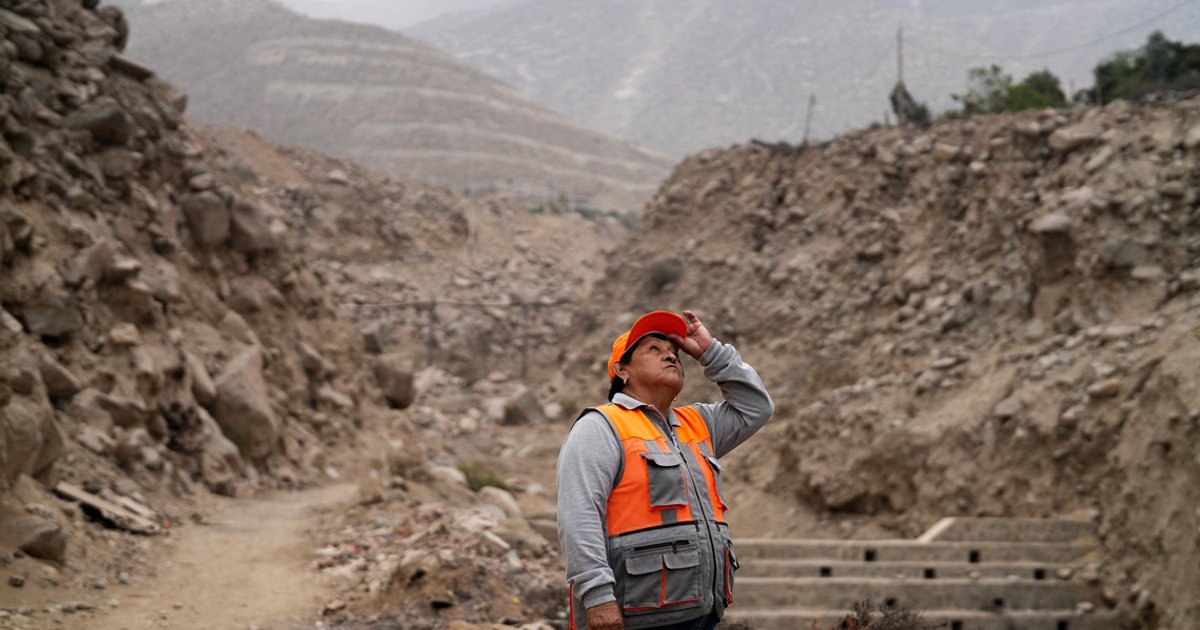
LIMA/KATHMANDU/ANTALYA, Turkey, Nov 11 - Twice a day during the rainy season, Raquel Izarra climbs to the roof of her home in the eastern Lima suburb of Santa Inés Bajo and measures how much rain has fallen using a homemade gauge, before sending the data to the authorities using WhatsApp.Together with more than 60 other volunteers, she is trying to ensure her community will have time to prepare should heavy rains trigger flooding and mudslides in the low-income area, as they did in 2017."Every year the rainfall situation has been getting worse," Izarra said. "Now, with this, we feel safer.""We know that when it rains for more than, I don't know, three, four or five days and it maintains a certain level, that means that the ravine above is going to give way, the ravine is going to activate. That means we start giving warnings."Global warming has increased the risk of extreme weather events and equipping communities such as Izarra's to cope will be one of the debates at the COP31 talks in Turkey, which end on November 20.A draft UN report seen by Reuters, which measured progress across risk knowledge; detection, monitoring and forecasting; warning dissemination; and preparedness and response, found gaps remained, especially around operational readiness and financing.The head of the UN's Office for Disaster Risk Reduction said a 2027 target of full coverage for everybody was unlikely to be met.More than two-thirds, or 136, of countries, have some early warning capacity. That represents a 143% increase since reporting began in 2015, but still only 64 of them had capability across all four pillars, the report found.Data from the Lloyd's Register Foundation's World Risk Poll cited in the UN report also showed that in low-income and lower-middle-income countries, fewer than half of those warned were able to act on the warning compared with three-quarters in upper-middle-income countries.REGIONAL WARNING GAPOf people surveyed in 2025 who said they had experienced a disaster in the previous five years, 80% had received at least one warning, the poll found, but the distribution varied. In East Asia, 95% of people had been warned, compared with 47% in Central and Western Africa.James Kinyangi, head of Climate and Policy at the African Development Bank, told Reuters the extra investment required in Africa ranged between $5 billion and $10 billion. He said the bank was working with more than 30 countries to develop systems, but more than 20 others needed financial and technical support to build infrastructure, capacity and early-warning services.The UN report said 38 countries have fully operational cell-broadcast warning systems and another 17 are in the final stages of developing them. It said $500 million would be enough to extend coverage to every country and maintain it for three years.ROCK AND ICE AVALANCHE IN NEPALA rock and ice avalanche and flood in Nepal in August that left thousands of people dead, injured or missing and caused almost $3 billion in damages showed that all systems have their limits.Monsoon flood warning systems were in place, but the scale and speed of a torrent caused by the collapse of a glacier meant many people were swept away before they could transmit data to trigger warnings.Phone call warnings from those further up the valley helped to save some lives, though, including at the Tribhuvan Trishuli Secondary School after headmaster Rajendra Dawadi decided to evacuate 900 pupils."We had no official alerts. If we had waited for the official alert we would all be killed. I would not be able to speak with you now," Dawadi said.In Peru, home to the world's largest number of tropical glacial lakes, including 528 considered at risk of overflowing, real-time monitoring was crucial, Paola Moschella, head of glacier research at the National Institute for Research on Glaciers and Mountain Ecosystems, said."Information is updated minute by minute because in these types of events, if a debris flow begins, authorities need to evacuate people immediately, as the response window is only 15 to 20 minutes," she said in the aftermath of the Nepal flood.The UN report said more support was needed for community preparedness. In Lima, Raquel Izarra said help to cover basic costs was especially necessary in poorer areas, where even paying the monthly phone bill — vital to almost any warning system — can be difficult."Sometimes people stop monitoring for economic reasons because they have to work to support themselves and their families," she said. REUTERS
Disaster warning systems race to keep pace with galloping climate risks
Full Article
Original Source
Read the full article at Straitstimes →KhanList aggregates and links to publicly available news content. We do not host full articles from third-party sources. Always verify important information with original sources.