
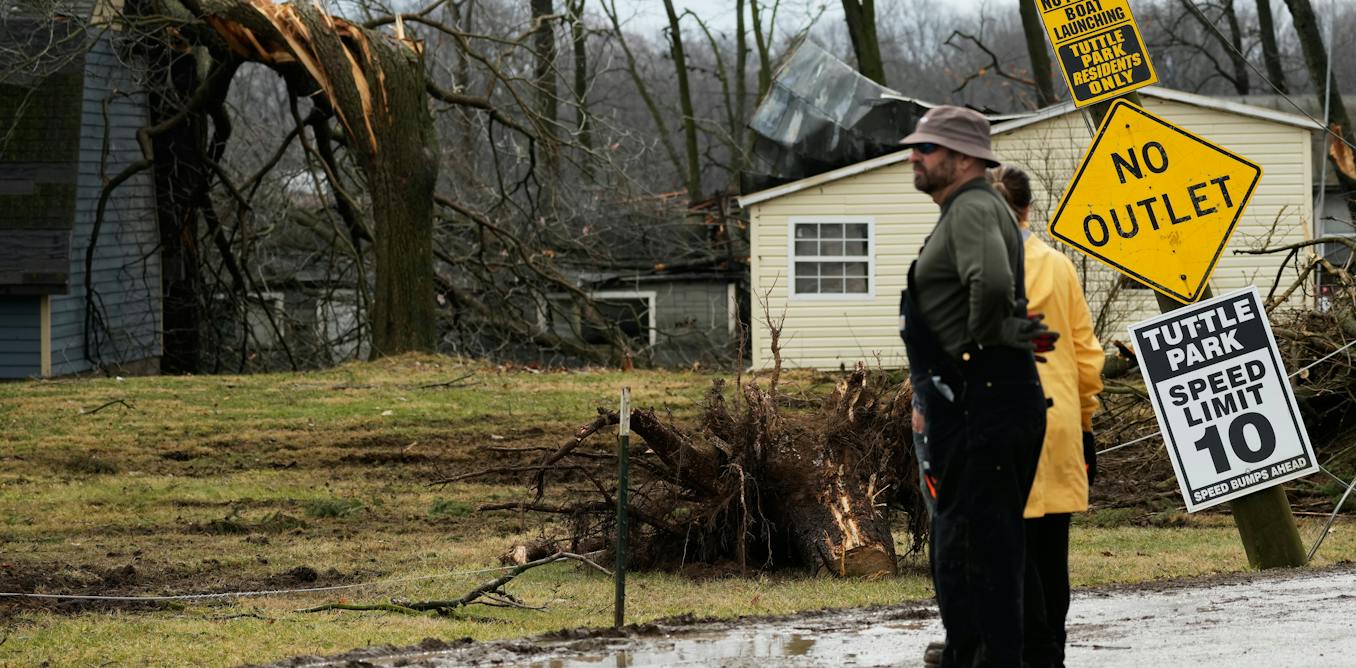
Four tornadoes tore across southwest Michigan in early March 2026, killing four people. They were the state’s deadliest natural hazards in decades. Gov. Gretchen Whitmer asked the Federal Emergency Management Agency for assistance to cover uninsured and underinsured losses. FEMA said no. She appealed. FEMA said no again. I study how communities prepare for and recover from disasters. As Dean’s Professor of Resilience at Northeastern University, I have written six books on the topic, including the forthcoming “Beyond Common Ground.” The fact that Michigan was repeatedly denied aid reflects a broader shift, one that is putting more weight on the ties between neighbors and the places where they meet. Federal help is less predictable The Trump administration denied 26% of major disaster declarations in 2025, more than double the rate of the year before and well above the 15% denial average of the past two decades. Denials have not fallen evenly. One study looked at some 2,500 disaster declarations since FEMA’s creation in 1979 in states where the governor and U.S. senators were all Republican or all Democrat. In his second term, Trump approved nearly 90% of requests from all-Republican states while approving only 23% of those from all-Democratic states. Colorado, an all-Democratic state, had both of its 2025 appeals for disaster rejected. They were Colorado’s first denials since the 1980s. Florida, an all-Republican state, fared differently. In June, Trump announced US$416 million for the state’s disasters without specifying which one, adding that much of it would go to the Panhandle, one of his “favorite places.” There, a January 2025 snowstorm was linked to 13 deaths and caused approximately $200 million in damages. Nationally, an analysis of FEMA data by Andrew Rumbach, a senior fellow at the Urban Institute, found that about 84% of requests from states Trump won in 2024 were approved during his second term, compared with about 42% from states he lost. While the White House has denied that politics plays a role in who receives aid after shocks, local communities are now shouldering more of the cost of preparing for, responding to and recovering from disasters than they did before 2025. FEMA owes local governments almost $10 billion in reimbursements for recovery work that cities and towns have already paid for. When a declaration is denied, towns can be left covering costs as high as 15% of their annual budget. Philanthropies and aid groups such as Team Rubicon are expanding their roles to fill the gaps. Nonprofits and community organizations cannot replace federal funding, but they can build cooperation, trust and collective action, which can better prepare neighborhoods and accelerate recovery. What connected places do In Union City, Michigan, help arrived within hours of the EF3 tornado that killed three people in March 2026. It came not from Washington but from neighbors. School administrators turned the local high school into a shelter the night of the storm, volunteers arrived with food and supplies, and the local United Way opened a relief fund. That is typical: Local residents are almost always the first responders after disasters strike. What was different is that federal help never followed. Donations poured into the local high school, and the superintendent said staff worked out how to get supplies to the people who needed them. A local church, damaged in the storm, started a disaster fund to help residents pay their insurance deductibles. Research on U.S. disasters shows how places such as schools, faith-based organizations and libraries can keep communities knit together. After Hurricane Katrina in August 2005, floodwaters as high as 12 feet (3.6 meters) covered the low-income neighborhood around the Mary Queen of Vietnam Church in east New Orleans. Yet by summer 2007, about 90% of its residents had returned to their homes. For the city as a whole, the figure hit only 45%. The difference was likely the leadership of the Rev. Vien Nguyen, who coordinated supplies, organized volunteers and kept scattered residents in touch even as they evacuated to other states. In 2005, Bishop Dominic Loung returned home from Houston, Texas, to Mary Queen of Vietnam Church in New Orleans to survey damage from Hurricane Katrina. Rick Loomis/Los Angeles Times via Getty Images My lab’s research during the COVID-19 pandemic found a similar pattern. We compared U.S. counties that were alike in many ways but differed in their social ties. After accounting for politics, governance, healthcare quality and demographics, our study found that two kinds of ties reduced the pandemic’s toll: bonding ties and linking ties. Bonding ties connect neighbors and family. Linking ties connect residents to officials. Those ties are often built through spaces designed for connection, such as libraries and faith-based organizations like Nguyen’s church in New Orleans. Libraries continue to safeguard our most vulnerable. In 2025, 44.7% of U.S. public libraries served as cooling or warming centers during extreme temperatures, up 8.2% from 2022. Many could do more. In a national survey, 84% of library directors agreed that libraries have a critical role in disaster response. Yet only 36% knew that federal law allows libraries to seek FEMA relocation funding to move to safer ground, and just 51% had an emergency preparedness plan. A low-cost layer of protection In my new book, I show that more than 90% of federal disaster funds went to roads, utilities and other standard infrastructure in the early 21st century, and less than 10% to libraries, parks, schools, places of worship and community centers, where neighbors check on one another and organize recovery. Federal aid may go to rebuild some of these spaces, but it rarely pays to keep them open and running when communities need them most. In another study, I found that Japanese communities with higher density of social infrastructure had half the number of deaths from a catastrophic tsunami in March 2011 compared to similar communities with fewer gathering spaces. In my assessment, as federal aid becomes less predictable, these kinds of places people frequent often will have to carry us into the future. The communities that recover best from the next disaster may be the ones that kept their libraries open, their civic halls full of volunteers and their parks full of residents.
Disaster aid has become a political lottery – libraries, schools and places of worship are stepping into the breach
Full Article
Original Source
Read the full article at Theconversation →KhanList aggregates and links to publicly available news content. We do not host full articles from third-party sources. Always verify important information with original sources.