
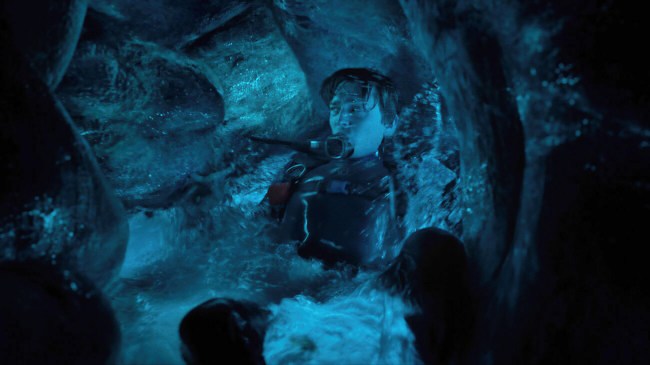
Director Brian Duffield is a cinephile who watches a lot of movies, but when the time came to direct his adventure film “Whalefall” he was dismayed to realize he couldn’t think of a single film he could look to as a model. “It was a nightmare for that reason,” Duffield told IndieWire’s Filmmaker Toolkit podcast. “It also the joy of it, having a room full of amazingly gifted artists all starting from this place of real befuddlement.” In the movie, Austin Abrams plays a scuba diver who gets swallowed by a sperm whale and has only an hour of oxygen to keep him alive while he tries to escape; it’s a premise that posed multiple challenges for Duffield and his team, starting with the question of how exactly to build the stomach that Abrams would be trapped inside for the majority of the film — and how to shoot those scenes. “It wasn’t normal coverage,” Duffield said. “Even a shot of Austin just sitting in the stomach required months of preparation and planning — every shot of him in the stomach is, by its nature, a stunt.” The ultimate effect onscreen is terrifying, but on set Duffield says the stomach scenes looked more than a little ridiculous. “The set looked crazy. From the outside it’s this black weird bag, and then it’s on a gimbal so it’s moving, and it’s full of water.” To give the impression of the stomach chewing, Duffield’s crew found an old-school, practical solution. “When the stomach chews, it compresses,” Duffield said. “The way we did that is we just had burly men jump onto it. Austin’s inside, and there’s a guy with a camera, and I can’t fit in the stomach so I’m just watching these New Zealanders leap and compress, then I’m hearing Austin scream.” Although Duffield planned his shots meticulously, he often found that the stomach had a mind of its own and required swift adaptation from the crew. “There’s water in the stomach, and we would drain it every night,” Duffield said. “The material that the stomach was made of would change shape overnight, and we’d come back to resume a scene, and our set would be a different set — we’d fill it with water, and it would all lay different.” Doors also contracted due to humidity and other conditions. “By the end of the shoot, there were so many jagged doors that we’d cut for cameras.” Ultimately, all of Duffield’s storyboards “went out the window” because the stomach kept changing shape, and Abrams couldn’t roll in the planned directions. “The stomach was kind of directing the movie,” Duffield said. “Austin and I had to sync up and figure out how, with this new environment every day, to get the shots that tell the story as cleanly as possible.” That was no easy task, especially since the set’s very nature made it hard to acclimate the audience geographically. “It sounds ridiculous, but we had so many conversations about trying to get an audience to see that ‘that sphincter leads to the throat,’ or ‘that sphincter leads to the second stomach,'” Duffield said, adding that he constantly had to think about how one shot would connect to another to let the audience know where Abrams was inside the whale. “Austin’s moving around the whole time, and the stomach goes in every direction. Bit by bit, shot by shot, every shot is its own unique challenge.” Visual effects supervisor Guillaume Rocheron worked with Duffield and the camera team to come up with visual cues that could help the audience follow Abrams’ journey through the whale, but the task was further complicated by the fact that the audience was sharing his point of view — and for long portions of the story, Abrams’ character was supposed to be confused. “Austin’s character doesn’t have a lot of information about what is happening to him,” Duffield said. “You want the audience to have the same information as him, but not get so lost and confused that they’re out of the movie.” Duffield knew that striking that balance would be tricky throughout production and editing. “It’s hard to have a character in a situation he doesn’t know anything about and then have an audience get invested,” Duffield said, adding that the usual test screening questions were useless here. “It’s the classic test screening thing: ‘Is there anything that’s confusing to you?'” Luckily, Duffield worked with master editor Pietro Scalia, who worked with the director to find the most straightforward way to connect the audience to the material. “We eventually concluded, just focus on Austin,” Duffield said. “Austin is dynamite, and he’s carrying you, and the more you’re in lockstep with Austin, you’re going to be okay.” The key, Duffield felt, was to preserve the illusion of reality at every possible moment. “ When we were editing and sound designing, it was just like, ‘How do we keep trying to make it feel real?’ I’m a very pro-CG guy, but even if there’s some stitching from a stuntman or a digital double to Austin, Austin’s in every shot of the scene. I think some of the things that people think is a digital double are not a digital double — it’s Austin just getting yanked around and fighting for his life.” Though Duffield is sure Abrams wouldn’t want to return for a sequel, he said his lead actor was as up for the physical demands of the role as the department heads were for the mental and logistical challenges — challenges unlike any they had ever faced. “Nothing any of us had done before applied to this project,” Duffield said, adding that nothing they learned would apply to future projects given the singular nature of “Whalefall.” “It was really challenging, but I was looking for that kind of filmmaking challenge. It was the hardest shoot I’ll probably ever have, but everyone was also giddy about it.” To hear the entire conversation with Brian Duffield and make sure you don’t miss a single episode of Filmmaker Toolkit, subscribe to the podcast on Apple, Spotify, or your favorite podcast platform.
Director Brian Duffield Had to Find a New Form of Visual Storytelling for ‘Whalefall’
Full Article
Original Source
Read the full article at Indiewire →KhanList aggregates and links to publicly available news content. We do not host full articles from third-party sources. Always verify important information with original sources.