
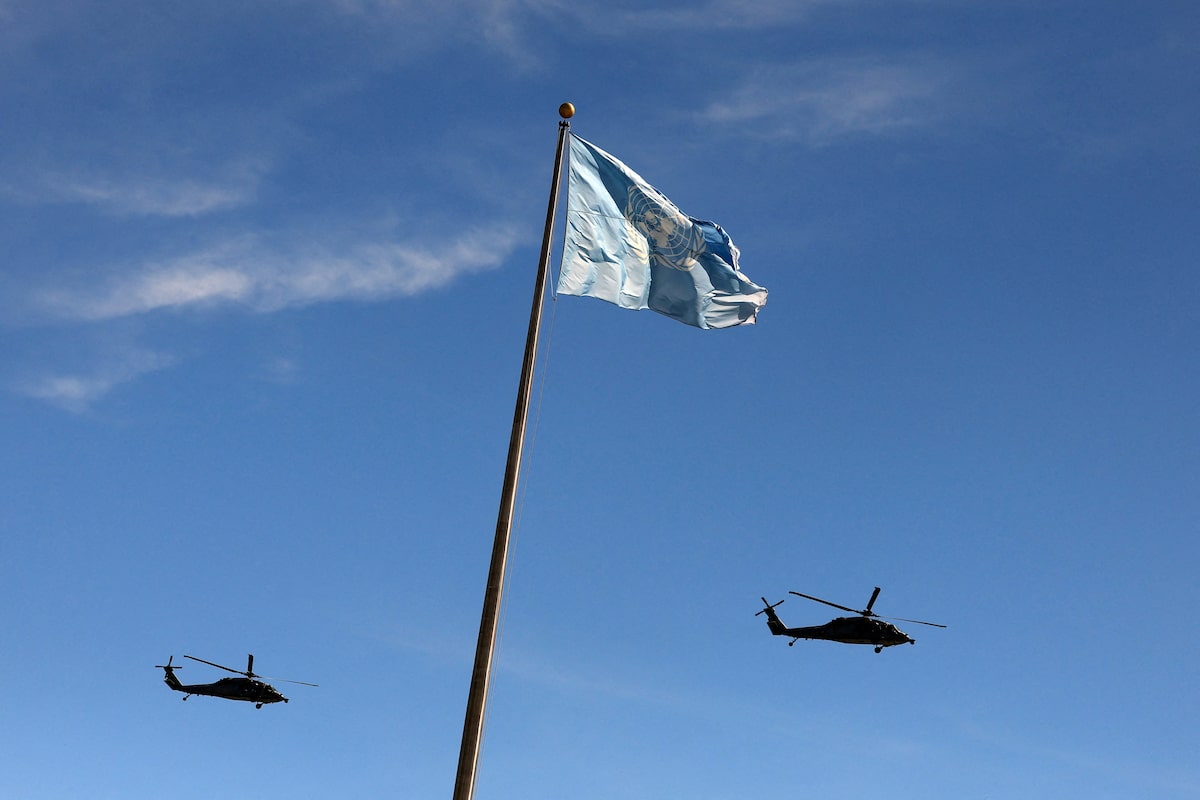
Open this photo in gallery:Military helicopters fly over the United Nations plaza as the United Nations prepares for world leaders to convene for the 81st United Nations General Assembly in New York City, Monday.Brendan McDermid/ReutersThere is not much that diplomats can agree on these days. But if asked about the state of the world ahead of the annual meeting at the UN General Assembly, heads of state and government and ministers alike will describe a globe in massive turmoil.With two escalating wars raging in Europe and the Middle East, a global economy in flux, and a shifting world order, international leaders are arriving in New York on Tuesday to an outlook that is massively different from this time last year. The theme of this year’s Assembly is “Restoring trust, managing transformation: A United Nations that delivers for all.”Prime Minister Mark Carney – who has emerged in recent weeks as a key global leader defending multilateralism in the face of Trump’s attacks – is expected to attend the opening of the General Assembly on Tuesday. “World leaders will be gathering at the United Nations in an era of deep uncertainty,” UN Secretary-General António Guterres told reporters recently. “At the same time, power is shifting. The world is changing. And our institutions must change with it.”The last nine months alone saw the audacious U.S. military operation that plucked Venezuelan leader Nicolás Maduro from power before a deadly crackdown took place in Iran after tens of thousands of pro-government demonstrators took to the streets to challenge the country’s theocracy. Shortly after, the U.S. and Israel launched a joint attack against Tehran, kicking off an ongoing and spiralling conflict, now involving nearly every country in the region, which has since resulted in the effective closure of a critical waterway. Meanwhile, the more than four-year war between Russia and Ukraine shows no end in sight as both sides have only ramped up military attacks in recent days while numerous diplomatic efforts to end the conflict have failed to break through.In May, an outbreak of Ebola in the Democratic Republic of the Congo and Uganda raised further questions about the lack of international preparedness for the next pandemic. Deadly earthquakes in Venezuela and Colombia, as well as massive flash floods in Nepal and Tibet, highlighted the worsening impact of human-caused global warming on communities around the world. In interviews leading up to the annual meeting, current and former ministers, ambassadors and officials from across the world painted a stark picture of the crises plaguing the international community and whether the UN and its 193 member states can address them. They spoke to the Associated Press on the condition of anonymity to speak freely about international concerns. “It is a critical time to try to see if some of these issues can be resolved diplomatically,” former U.S. Ambassador Robert Wood, who served at the U.S. Mission to the United Nations under Republican and Democratic leaders, told The Associated Press. “The UN is really at an inflection point. There’s no doubt about it. It was bad last year. It’s not much better this year.”One European diplomat and another official echoed that sentiment, saying that the world is not in a better place than it was this time last year and that things have become even more unstable. The diplomat and the officials, who were granted anonymity to speak freely about concerns, cited the various attacks on international law, the breakdown or lack of mediation efforts, and the continued failure to find global consensus on issues like climate and peace and security. Beyond closely mining the speeches from headliners like U.S. President Donald Trump, Ukraine’s President Volodymyr Zelensky and Iran’s President Masoud Pezeshkian, officials are hoping to use the annual gathering to meet with adversaries and allies on the sidelines, seeking to break the logjam on issues like maritime security in the Strait of Hormuz and runaway artificial intelligence, among others. Asked what they hoped to take away from the week of meetings, one Gulf official said it would be great to go back to a level of predictability on the world stage.“In international relations, everything is changing: the friendships are changing, and alliances are changing,” Tone Kajzer, Slovenia’s foreign minister, said. “But what remains constant is the interests and how to align those interests so that we live in peace and not in a permanent conflict.”With a report from The Canadian Press
Diplomats describe a world in turmoil as UN opens annual meeting
Full Article
Original Source
Read the full article at Theglobeandmail →KhanList aggregates and links to publicly available news content. We do not host full articles from third-party sources. Always verify important information with original sources.