
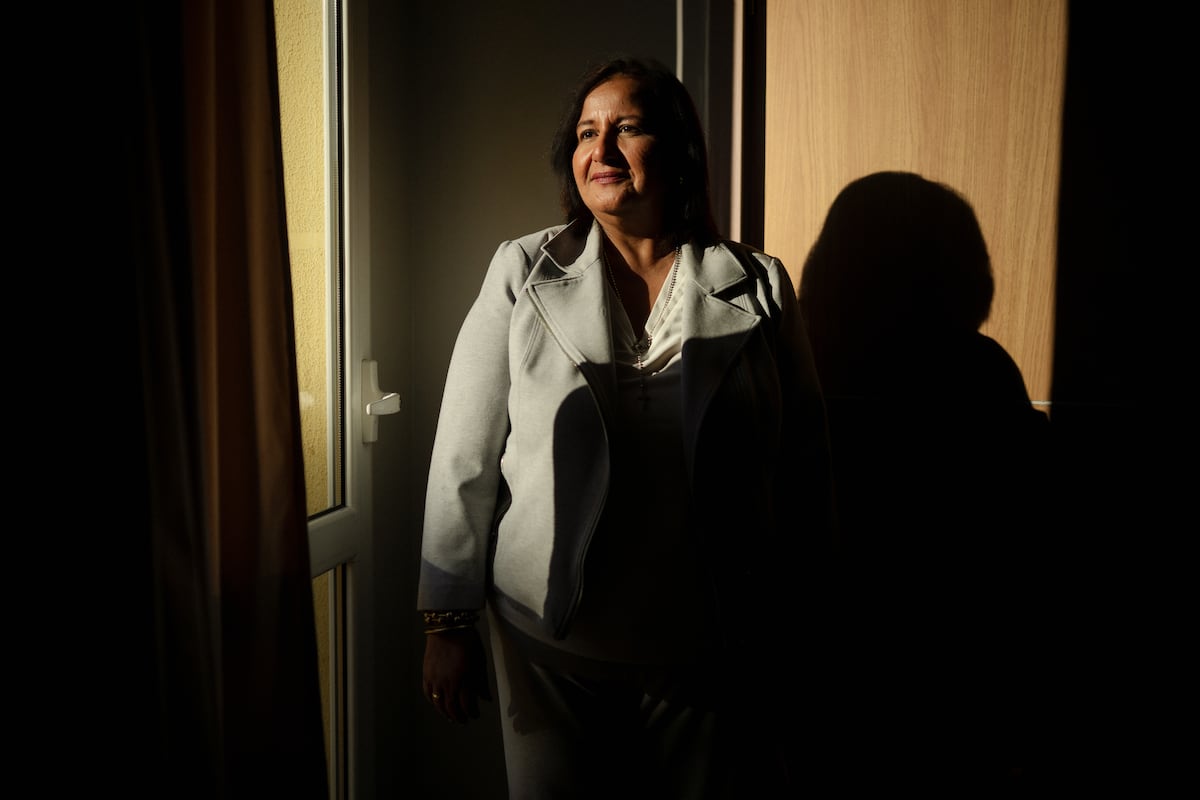
The first time that Dinorah Figuera sat across from Jorge Rodríguez in Caracas on June 18, she said: “I am not afraid of you.” Rodríguez, who is head of the Chavista-controlled National Assembly, negotiator-in-chief for the government, and brother to the interim president of Venezuela, Delcy Rodríguez, had a reputation for having liquidated all previous negotiation attempts with his political and psychological skills. Figuera, 65, is a doctor by training and was chosen head of the National Assembly that was elected in 2015 —the last one that the opposition and Washington consider to be legitimate. For eight years she had been living in exile in Spain, caring for elderly people. “I didn’t come alone, I came holding the hand of the United States,” she recalls about the way she was tapped to return to Venezuela and lead the negotiation effort on behalf of the opposition. She wasn’t there for confrontation, she notes, but she wasn’t going to bow her head, either. Since August, Figuera has been leading a democratic negotiation effort as part of a roadmap designed by Washington and which, as she likes to reiterate, would never have existed without the capture of former president Nicolás Maduro on January 3. “The State Department chose me because I represented institutionality,” she says. Her re-emergence on the scene came as a surprise in a country where many believed that the transition effort would be led by the most high-profile opposition leader, María Corina Machado. “Nobody wanted to sit at this table, and once I sat down, everybody wanted to as well,” says Figuera, adding that she tried to get Machado to participate in the process. Since then, they have neither seen each other nor spoken, even though they both live in Caracas. “I didn’t come here to take anyone’s leadership away. I don’t have any electoral ambitions,” she says. Regarding the state of the Venezuelan opposition after 27 years of Chavismo, her summary is: “We are picking up the broken glass pieces.”Figuera and Chavismo must sit down to renew the Supreme Court of Justice and the National Electoral Council, and to agree on civil, political, and freedom of speech guarantees. And all that before calling elections. But there are still no clear dates or steps.She and Jorge Rodríguez respect each other, but they also clash. “You might think Jorge Rodríguez influences me,” she warns. “But no, this is not a romantic table: it’s a table for marking territory and winning positions.” And in case there was any doubt: “And it’s not an equal table either: they still hold power, although negotiation and support from the United States prevail. I think some positions seek to slow down the process, but the quality of the discussion wins.” Figuera and her team’s internal meetings have taken place for months at the Marriott hotel, which until recently was the informal seat of the U.S. embassy in Caracas. Now she welcomes EL PAÍS to another hotel in Caracas, brighter, smaller, with much less heavy energy. In her suite, a couple of donated printers are about to be inaugurated, with which they will finally be able to print their own documents.Four rounds after that first meeting with Jorge Rodríguez, the last one ended this Monday in Caracas; the Supreme Court is still half-renewed and electoral power remains intact. “This is a very complex process, but there have been many achievements,” she asserts. “Among other things, access for many media outlets has been loosened and there is more freedom of speech.” Transitions, she adds, take time. “We have studied other cases, for example, Chile. As they say here, they had to ‘swallow a toad.’ (…) They kept Pinochet as Minister of Defense for a while.”—Does anyone on the U.S. side review your statements or messages on social media before publishing them? —No, we draft our own statements. —And when something goes wrong, what happens? —I can pick up the phone and ask that procedures be followed. —Who are you calling? —The advisors who accompany us throughout the process.She doesn’t say who. The United States is omnipresent in Venezuela. It controls oil deals and even small domestic policy decisions. Last week, U.S. Defense Secretary Pete Hegseth, the same person who led the operation to capture Maduro, joked with Delcy Rodríguez and went running through a military complex in Caracas wearing a T-shirt that read: “This is war.”—Is the tutelage going too far? —After Maduro’s departure, Venezuela has received aid that now allows you to interview me and for me to give you statements without fear of being arrested. We had 27 years of Chinese and communist interference in Venezuela. The Cubans controlled the electoral register. We lost our sovereignty when Cuban officials were more in charge than Venezuelans. Sovereignty, she asserts, is rescued through elections. “Some may criticize the events of January 3, but for us it meant part of our salvation.”The negotiation is not tackling, at least not officially, the release of the hundreds of political prisoners—many military personnel—who still remain locked up. Figuera acknowledges that she has had to tone down her confrontational tone on issues like this one, and change strategy. “I think that in this negotiation process more pressure is needed for the political prisoners to be released.” And she leaves it to the government of Delcy Rodríguez: “The interim government holds the upper hand. They can make decisions so that, finally, they are free.”Her meeting with the interim president on October 22, she says, was the hardest thing she has done in recent months. “The hardest moment in this round of talks was sitting down with Delcy Rodríguez. I knew what those who might think you have sold your conscience would say,” she recalls. “Besides, we have serious differences about what leadership in the country should be like. It was difficult and uncomfortable.”Was that meeting necessary? “Of course. These are perfectly necessary meetings in the transition processes of countries, as we have seen historically. Both sides have to sit down to resolve their differences. We have sat down with all of them. We don’t have to kill each other to prove that maybe we are not all the same. Nor will we trample on anyone: we cannot become what we condemn.”“Honorable” judgesThe priority now is to renew the Supreme Court of Justice. On the table there are are 1,343 nominations open for challenge until December 5. The list of candidates, several of them closely linked to the Chavista apparatus, has generated controversy. “I criticize certain magistrates who are running for office. I don’t want to go into details, but it generates distrust.” Figuera hopes that some of those challenged candidates will be filtered out in the ongoing evaluation process.No one knows yet whether the new judges will be independent or tokens of each side. Figuera has one wish: that the court be left in the hands of “honorable” judges. The elections, meanwhile, remain without a date. —Are they viable in 2027? —It would be irresponsible of me to say so, because it is the National Electoral Council’s responsibility to call the elections.—Would you bet on their going beyond 2028? —No, we are working to hold them as soon as possible. [U.S. State Secretary] Marco Rubio thinks the same. He is truly committed. Figuera assures that this round of talks will not end like the previous ones. Negotiators from other times “were completely different.” This delegation, he says, “was formed, in part, with people whose human rights were violated.”She herself left Venezuela when she was a deputy in the Assembly, after denouncing the death of councilman Fernando Albán, godfather of her daughter. Albán was detained and died in police custody in October 2018. She first took refuge in the French embassy and then fled to Spain, where she went to work as a caregiver for the elderly. Her house was taken away years later. —Have you ever thought about getting up and walking away from the table? —Several times. —Is there a red line that would make you do it? —The red line is that they try to buy me or my conscience.Sign up for our weekly newsletter to get more English-language news coverage from EL PAÍS USA Edition
Dinorah Figuera, negotiator of the transition in Venezuela: ‘This is not a romantic table’
Full Article
Original Source
Read the full article at English →KhanList aggregates and links to publicly available news content. We do not host full articles from third-party sources. Always verify important information with original sources.