
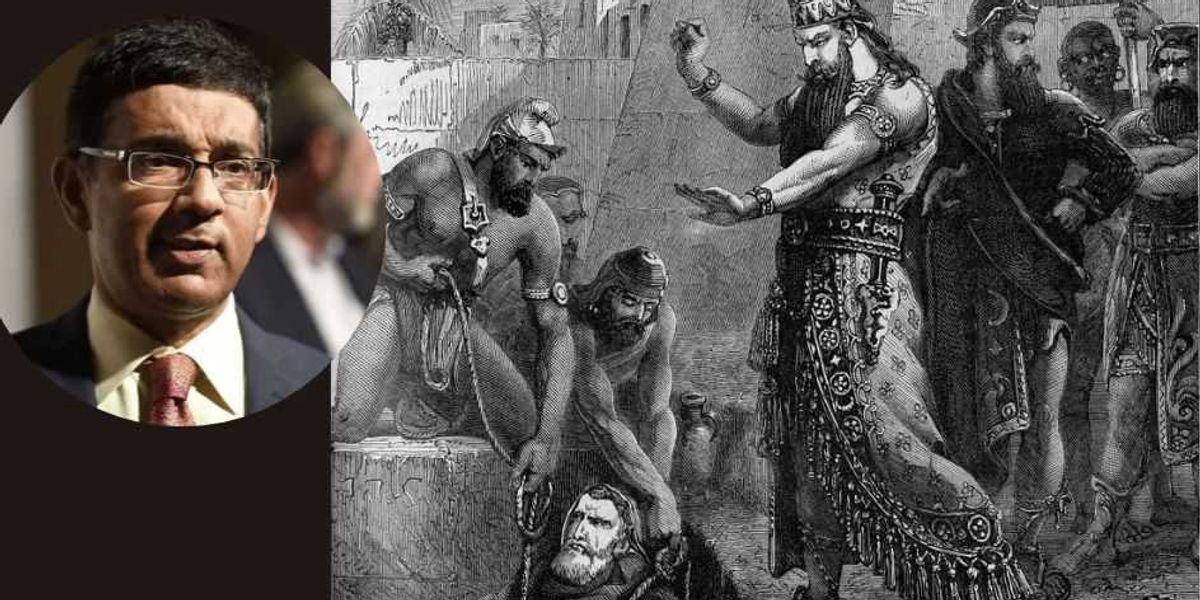
Dinesh D'Souza has spent much of his career defending Christianity against its critics. But there was one argument he wasn't entirely comfortable making: that the Bible could be trusted as history.The conservative author and filmmaker says his exposure to biblical higher criticism in college left him with the impression that Scripture contained a mixture of historical fact, legend, and error. He accepted that its human authors were divinely inspired, but assumed they might have gotten some of the history wrong.'In this kind of latter secular age that we live in, God has sort of decided to start speaking a second language.'"I sort of had this view of the Bible in which you couldn't defend the Bible like line by line," D'Souza recalled during a recent appearance on the "Daily Dose of Wisdom" podcast, where he discussed his new book, "The Stones Cry Out: Biblical Archaeology, Prophecy, and the Last Days."Then, during a visit to Israel in 2022, he encountered archaeological evidence that made him reconsider.The missing argumentD'Souza was no newcomer to Christian apologetics. His 2007 best-seller "What's So Great About Christianity" challenged prominent atheists on questions of science, philosophy, evolution, and the existence of God.In a 2007 interview with theologian Albert Mohler, he recalled how the intellectual atmosphere at Dartmouth had shaken his childhood faith."I really couldn't defend my faith, so I found myself drifting away," he said.He eventually regained his confidence in Christianity and spent several years debating its critics. But the historical reliability of the Bible remained something of a blind spot.In Israel, D'Souza encountered archaeological evidence for events he knew from Scripture, including the Assyrian invasion of Israel and the Babylonian destruction of Jerusalem. More surprising were the discoveries involving minor biblical figures, some mentioned only in passing."I was a little startled by all this," he said.He decided to investigate further, spending the next several years studying biblical archaeology. The result was "The Stones Cry Out," published in October.RELATED: The ancient ‘throne of Satan’ that inspired Hitler returns in 2027 Library of Congress/Wolfgang Kaheler/Getty ImagesTwo men from JeremiahConsider the case of Jehucal, son of Shelemiah, and Gedaliah, son of Pashhur.Unless you have spent considerable time with the book of Jeremiah, those names probably mean nothing to you. They were officials serving King Zedekiah during the final days of the kingdom of Judah.Jeremiah had been warning that Jerusalem would fall to the Babylonians. His preaching infuriated the king's officials, who accused the prophet of undermining the city's defenders. In Jeremiah 38, the two men join other officials in persuading Zedekiah to let them silence him.They lower Jeremiah into a cistern, where he sinks into the mud. Another court official eventually persuades the king to rescue him. Jehucal and Gedaliah then disappear from the story.More than 2,500 years later, their names turned up again. In 2005, archaeologists excavating Jerusalem discovered a clay seal impression bearing the name Jehucal, son of Shelemiah. Three years later, they found another bearing the name Gedaliah, son of Pashhur.The discoveries are documented in a 2024 study published in the Jerusalem Journal of Archaeology.The small clay objects, known as bullae, were used to seal documents. The documents themselves have long since disappeared, but the hardened clay preserved the names impressed upon them."Suddenly these two, you could call them biblical extras, jump into the pages of history via the pathway of archaeology," D'Souza said.The seals do not tell us whether the two men actually persecuted Jeremiah or helped throw him into the cistern. But they provide independent evidence that men bearing those names lived in Jerusalem during the period described in the biblical account.D'Souza finds the specificity remarkable. If Jeremiah was composed centuries after the events it describes, how would its author have known the names of two relatively insignificant officials?Earlier written sources or surviving traditions could account for that knowledge. The seals cannot establish when the book was written. Still, they give D'Souza reason to question assumptions he once accepted about the Bible's historical reliability.The quiet language of the dirtNot every biblical event has left such tangible evidence. D'Souza acknowledges that archaeological evidence for the Exodus remains scarce, while scholars continue to disagree about the locations and dates of other biblical events.But he argues that the accumulation of discoveries — inscriptions, seals, buildings, records of ancient rulers — makes it increasingly difficult to dismiss the Bible's historical narratives as legend.He has even come to see archaeology as a kind of divine accommodation to the modern skeptical mind."In this kind of latter secular age that we live in, God has sort of decided to start speaking a second language," he said. "Not just the thunderous language of revelation, but the quiet language of the dirt."
Dinesh D'Souza spent years defending a Bible he didn't entirely trust. Then he went to Israel.
Full Article
Original Source
Read the full article at Theblaze →KhanList aggregates and links to publicly available news content. We do not host full articles from third-party sources. Always verify important information with original sources.