
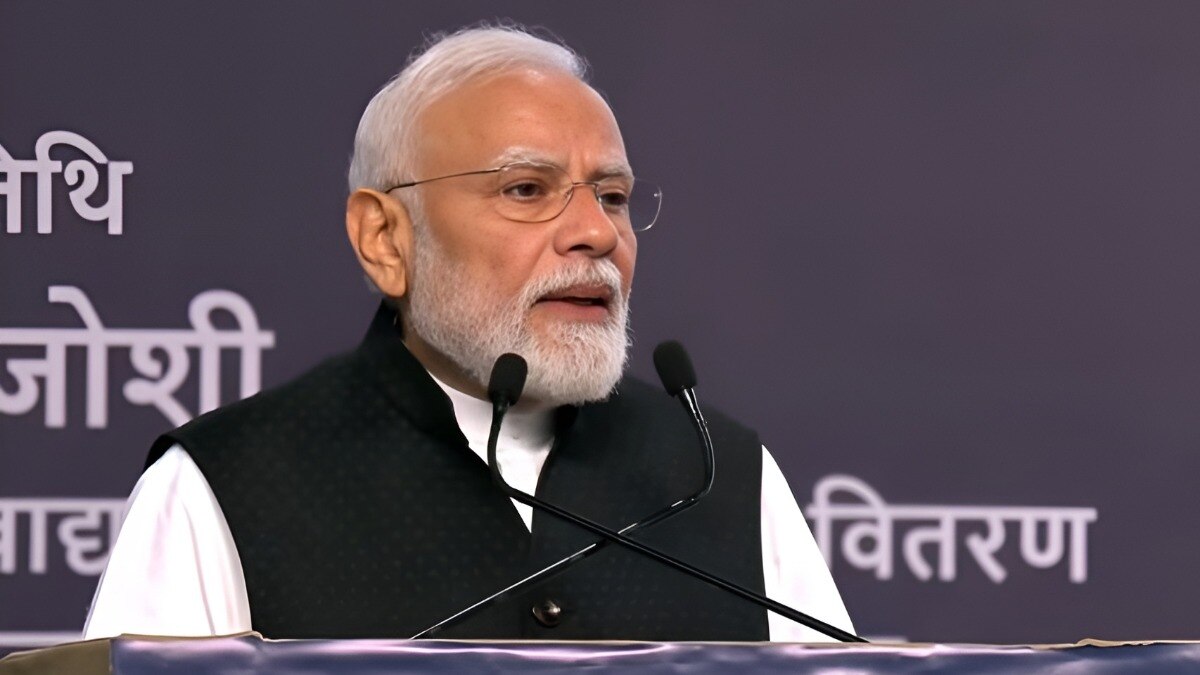
Prime Minister Narendra Modi on Saturday launched a sharp attack on his critics, saying his “Dimagi Naxal” homeopathic pill had prompted those promoting what he called an “illness” to reveal themselves one after another.Speaking at the centenary celebrations of Shri Ram College of Commerce (SRCC), PM Modi referred to his use of the term “Dimagi Naxal” during his Independence Day address from the Red Fort. He claimed the reaction to the expression had exposed those promoting such a mindset.“You may have heard my speech from the Red Fort. I gave a homeopathic pill from the Red Fort, ‘Dimagi Naxal’,” the Prime Minister said.Drawing an analogy with homeopathic treatment, he said an illness initially appeared to worsen after treatment began. “Similarly, as soon as I gave the ‘Dimagi Naxal’ homeopathic pill, all the ‘Dimagi Naxals’ started coming out one after another,” he said.He did not name any individual but used the term as part of his broader attack on people he accused of opposing India’s development and wanting the country to fail.‘THEY THOUGHT PM MODI WAS TRAPPED’ PM Modi said India had faced several major crises in recent years, including the Covid-19 pandemic, the Russia-Ukraine war, disruptions to global trade and supply chains, and the conflict in West Asia.“Every time, people said, ‘Now India will not survive’,” he said.In a sarcastic reference to his critics as his “biggest admirers”, the PM alleged that they had welcomed each crisis in the hope that his government would be cornered.“They were happy, thinking, ‘Now Modi is trapped. Now Modi has fallen. Now they will crush him’,” he said.PM Modi said the support of the people had frustrated those expectations and helped India continue to move forward despite successive global shocks.‘NARAZ FUFA’ AND HABITUAL OPPOSITIONPM Modi also targeted what he described as a tendency to oppose every government initiative.He told students that they would encounter two kinds of people outside the campus. One group, he said, would channel the strength of society towards nation-building. The other would oppose every initiative and repeatedly ask, “What is the need for this?”He described the second group as “Naraz Fufas”, or perpetually disgruntled uncles.PM Modi cited the Statue of Unity, high-speed rail, UPI, the new Parliament building and a memorial for fallen military personnel as initiatives whose necessity had repeatedly been questioned.“But India gave an answer to all these ‘Fufas’,” he said. “No one can stop India from doing what is necessary for the country.”The Prime Minister also contrasted his government’s response to recent crises with the handling of earlier emergencies.Recalling the 2013 Kedarnath disaster, he alleged that the government at the time was shaken and did not know how to respond.Referring to the 2008 global financial crisis, PM Modi accused the then government of hiding behind the global situation instead of confronting problems within India’s banking system. He also invoked the 2008 Mumbai terror attacks and alleged that the government lacked the courage to respond firmly to Pakistan.‘WORK THAT TOOK DECADES NOW TAKES YEARS’PM Modi cited railway electrification to argue that the pace of development had accelerated under his government.He noted that India’s first electric train ran in 1925, a year before SRCC was established. However, he said, less than 30 per cent of the country’s railway network had been electrified by 2014.“In just 12 years, we have brought railway line electrification to nearly 100 per cent,” PM Modi said.He said the faster pace of policymaking and decision-making was being recognised internationally, encouraging other countries to expand their partnerships with India and creating new opportunities for Indian youth.- EndsPublished By: Aprameya RaoPublished On: Sep 5, 2026 21:40 IST
'Dimagi Naxal' pill made critics come out, says PM Modi at SRCC
Full Article
Original Source
Read the full article at Indiatoday →KhanList aggregates and links to publicly available news content. We do not host full articles from third-party sources. Always verify important information with original sources.