
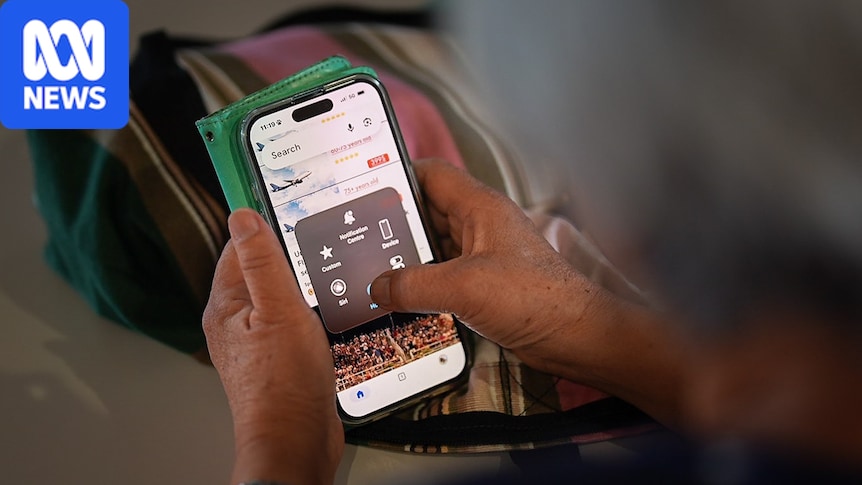
Older Australians say they are struggling to maintain their independence as everyday services shift online and out of their reach.The digital divide means the responsibility is falling to loved ones, neighbours, and retirement village staff to bridge the gap.It's an experience familiar to 72-year-old Wendy Trow, who neighbours her 85-year-old sister Majorie Jones in the small Western Australian town Balingup."My sister is a very smart lady, but she's never used computers in her life and so she just goes into a shell when she's required to do something," she said.Many older Australians struggle to access or operate technology, meaning friends or relatives have become their digital navigators. (ABC News: Scott Kyle)Ms Trow has taken on the role of digital navigator, helping her older sister access online government aged care services and banking."When the bank said that they were no longer going to use cheques, that was the final straw for her," she said."Her children are fantastic, but they don't live in Balingup, so it's fallen to me to do that," Ms Trow said."Suddenly she had to give up her financial independence and trust me to do the right thing."Digital divide has isolated older AustraliansPatricia Sparrow is the chief executive on the Council on the Ageing Australia, the peak body for older Australians.She said the divide between those who comfortably access online services and those who cannot, had isolated some older people."It makes people feel that they can't cope. It makes people feel stupid. It discourages people from engaging," she said."If you can't go to the bank and do a transaction or talk to people locally in the community, you may feel quite isolated and excluded."Ms Sparrow said digital exclusion was not an issue that would disappear with changing generations. (ABC News: Darryl Torpy)Ms Jones, who was formerly a nurse, said she would be in an aged care home if not for her sister."I managed my life really well without computers, and I just don't seem to be able to switch onto the same wavelength as computers," she said."I start getting nervous and I feel stupid because I don't understand — we don't seem to speak the same language."Nearly three hours-drive south east of Perth, Balingup's median age is 58, two decades older than the rest of Australia.In addition to helping her sister, Ms Trow has put together a small group of volunteers to help older community members who have had trouble accessing the government's My Aged Care services on their own."It is an absolutely massive [responsibility], and what if we get it wrong?" she said."We've had no training, we're just using our common sense."Marjorie Jones and Wendy Trow (ABC News: Gabrielle Mellet)She believes her small town is one example of a broader national issue."It will particularly be small, rural areas, but also in the cities, there'll be people that are just falling through the cracks because it's too hard," she said.Services 'can't be digital only'Decades into the transition from paper to digital, research shows a majority of older Australians are struggling to access online platforms.Data compiled by the Australian Digital Inclusion Index — which tracks people's ability to access, afford and benefit from digital technologies — found more than 65 per cent of people aged over 75 were digitally excluded.Although the 2025 study found an improvement in access and digital ability over the previous two years, certain Australians are still more vulnerable to digital exclusion.Access for Aboriginal and Torres Strait Islander people, those living in regional and remote locations, people with a disability and public housing residents remained below the national average.Data compiled by the Australian Digital Inclusion Index found more than 65 per cent of people aged over 75 were digitally excluded. (ABC News: Scott Kyle)Ms Sparrow said the issue of digital exclusion won't disappear as generations shift."I don't think you can just say this is a time-limited implementation issue that will resolve over generations," Ms Sparrow said."There are some people who will always have difficulty accessing and using digital platforms."Ms Sparrow said there had to be support for older Australians who could not rely on relatives to manage their online services."We have to acknowledge that things are moving increasingly to being digital first, but they can't be digital only," she said."Everybody wants to be as independent as possible. We all want to be able to run our own lives."Some retirement villages are introducing digital literacy programs to combat online scams. (ABC News: Scott Kyle)Seminars instilling confidenceStaff at Brisbane's Bolton Clarke retirement villages introduced a digital literacy program three years ago after increasing numbers of residents fell for scams."We decided we needed more education to avoid this, but also to keep [the residents] using technology … because they needed to," said Joe Griffiths, who runs the seminars across 27 villages.The program shows residents how to search online, what to look for in a scam, and artificial intelligence.Resident Joann Rose said these were topics that otherwise overwhelmed her."I'm not tech savvy at all. It's just changing too fast, it's hard to keep up," she said."So these information sessions are really good."Brisbane retirement village resident Carmen Love likes being shown how technology works. (ABC News: Scott Kyle)Mr Griffiths said it was particularly useful for people without loved ones around to help them understand new technologies."A lot of the families are excellent, and then some of the people don't have families," he said."So this is a place they can become part of a family, and ask the questions."Carmen Love said she liked learning face-to-face."I like getting into technology now, but instead of reading about it, I like to be shown, then I remember it," she said.In Balingup, Ms Trow said although she's happy to support her sister, all vulnerable residents should have access to in-person help with banking and government support."They need to be available in each community so that people can go and talk to them, sit down in a room and talk to them face-to-face," she said."I fear what changes are going to happen in the future for me. In another 10 years time, am I going to be in her situation?"Want to have your say? Go to www.abc.net.au/yoursay
Digital navigators bridge divide for older Australians
Full Article
Original Source
Read the full article at Abc →KhanList aggregates and links to publicly available news content. We do not host full articles from third-party sources. Always verify important information with original sources.