
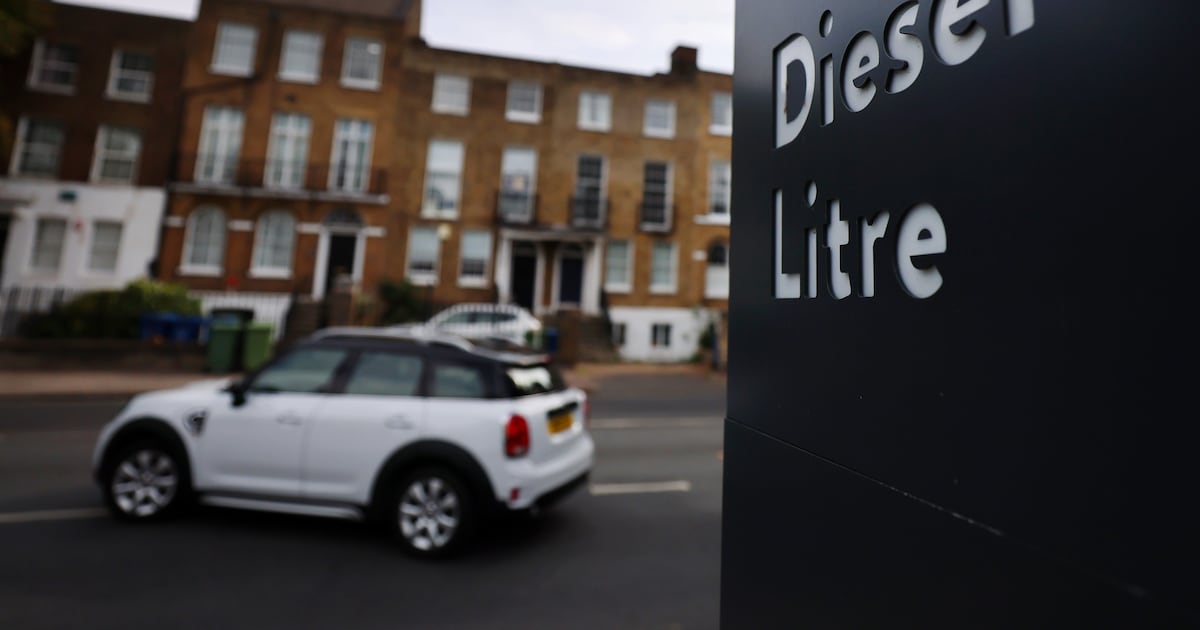
The price of diesel in Europe fell sharply on Friday morning as European countries considered releasing 50 million barrels of diesel in response to days of political pressure from the Trump administration.The continent’s benchmark diesel futures contract fell as low as $1,364 a tonne, the equivalent of around $185 a barrel, in a near 6 per cent drop, as traders anticipated that European leaders would take action following a G7 leaders meeting on Friday afternoon.If passed on, that would see prices at the pump fall by around eight cent a litre.Trump has asked Europe to release at least 100 million barrels of diesel to the markets, according to two diplomats familiar with EU discussions, and threatened to ban US diesel exports if the Continent does not comply.READ MOREThe EU is considering a French counterproposal in which European countries release 50 million barrels of diesel, the diplomats added. Members of the International Energy Agency (IEA) would also release an additional 50 million barrels of crude.Trump’s insistence that Europe unlock its diesel reserves comes as he faces increasing political pressure to bring down high prices for US motorists in the run-up to November’s midterm elections, which will determine control of Congress.Trump said he was considering banning US refineries from selling diesel overseas.In March, Europe committed to release 73 million barrels of refined fuels as part of a 400 million barrel strategic stock draw co-ordinated by the IEA in response to the conflict in the Middle East.The US has largely completed its share of that programme, but some European countries have not yet met their obligations, according to Fatih Birol, the head of the IEA.[ Trump weighs diesel export ban as US fuel crisis deepensOpens in new window ]Releasing diesel reserves could be a “short-term buffer” against soaring prices, but risks limiting protection against future shocks, experts have said.Jonathan Owens, an operations and supply chain expert for the University of Salford, said emergency stocks were “effectively an insurance policy”, adding: “Using them now reduces protection against future disruption until those stocks are replenished.”G7 leaders were holding a call on Friday afternoon to discuss the US demands, according to multiple diplomats and officials. European leaders are wary of releasing stocks when the duration of the conflict with Iran remains uncertain and they are reluctant to be forced into a decision.“We fully reject a [US] ban on diesel. A ban would not be beneficial to anyone. It would undermine our trust in the US as a reliable partner,” said Anna-Kaisa Itkonen, a European Commission spokeswoman. She declined to comment on the French proposals. Diesel prices have been trading above $200 a barrel in the US, Europe and Asia for several weeks because of several shocks to the world’s refineries, including from the Iran war, Russia’s conflict with Ukraine and China’s decision to limit fuel exports.The price of diesel in the UK surpassed £2 per litre on Friday for the first time. In the Republic, the fuel is trading at around €2.13.On Thursday it emerged that Beijing had not granted its biggest refineries any quotas to export fuel in October, except to Hong Kong and Macau. In Paris, an Élysée official said on Friday that French president Emmanuel Macron has called for a remote meeting of G7 countries as soon as possible to discuss a co-ordinated response.Macron spoke with Trump overnight, urging the need to work together to fight rising petrol costs and to ensure the availability of refined products worldwide. “[Macron] underscored that G7 nations had a common interest in acting in a concerted manner, without restricting exports,” in his exchange with Trump, the Élysée official added. The call comes after a crisis meeting of EU energy officials on Friday morning, at which member state representatives were in “shock over the blackmail” of Trump’s demands, according to one diplomat.Member state energy officials may meet for a second meeting of the EU’s so-called energy union taskforce this afternoon, according to one of the diplomats, as Europe seeks to build a co-ordinated response to the US threats. – Copyright The Financial Times Limited 2026
Diesel falls sharply as EU considers releasing 50m barrels under Trump pressure
Full Article
Original Source
Read the full article at Irishtimes →KhanList aggregates and links to publicly available news content. We do not host full articles from third-party sources. Always verify important information with original sources.