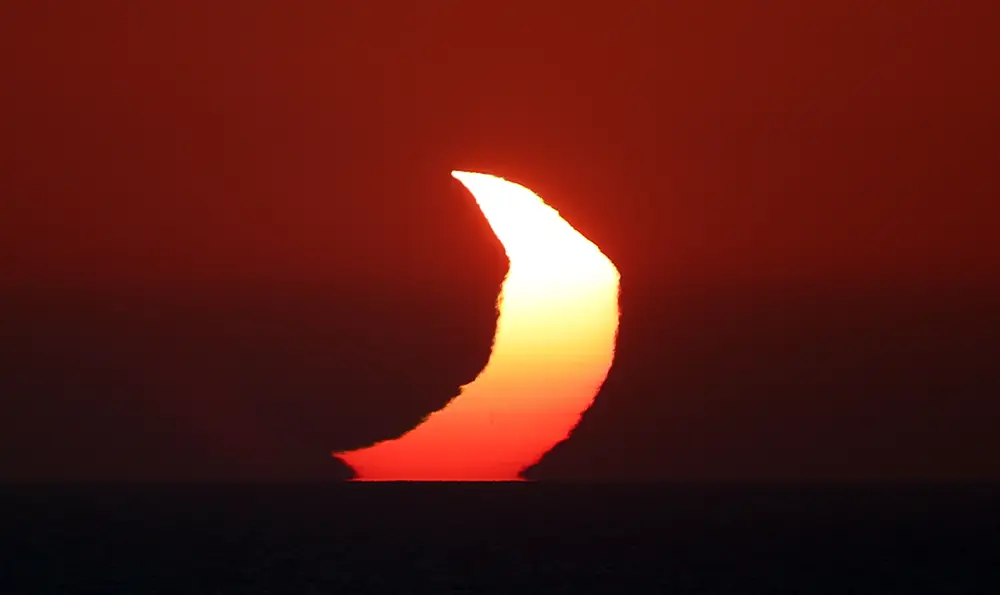
Sky & Telescope editors traveled the world, both literally and figuratively, to see the solar eclipse that darkened the world in the most magical way on August 12, 2026. Here are some of their stories. Sky & Telescope editors traveled the world, both literally and figuratively, to see the solar eclipse that darkened the world in the most magical way on August 12, 2026. Here are some of their stories. Clouds and Eclipse Over Mallorca Bob King traveled with a Sky & Telescope tour on Mallorca, Spain. This is his account: We watched the eclipse from the Jumeirah Hotel in Mallorca perched on a cliff overlooking the Balearic Sea. The day's skies were pristine and our group of 65 people felt confident we'd see the entire eclipse under ideal conditions. But a low line of clouds near the western horizon threatened. Mere seconds before totality, clouds claimed the Sun. Yet we witnessed a dramatic and moving (and I really mean moving!) sight: the massive shadow of the Moon. It seemed to roll above the water like an enormous dark tornado. Few of us had ever witnessed anything like it. The Moon's shadow appeared like a dark tornado as it approached onlookers.Bob King As the shadow dashed off to the east at more than 12,500 miles per hour, and light slowly returned, a narrow slice of hazy but clear sky became apparent at the horizon. When the growing crescent finally reached the gap, atmospheric refraction twisted it into an incredible variety of delightful and grotesque shapes including a shark's fin that slowly sank out of view. Prominences off the solar limb and sunlight from the slim crescent of solar disk pierce the cloud cover.Bob King Despite not seeing totality, the feel of the Moon's shadow across our faces made us shiver like some dark wind from Mordor. The quirky crescent during the second half of the show ended the event on a high note. The partially eclipsed Sun sets into the Atlantic Ocean.Bob King S&T Editor Sean Walker, too, watched from off the coast of Mallorca, on the the Insight Cruises / Sky & Telescope tour aboard the cruise ship Oosterdam. That group likewise had no luck at the moment of totality. Observers watch the partial phases of the solar eclipse aboard the Oosterdam.Sean Walker "The day started well with fair-weather clouds," he continues, "which dissipated as we headed northeast towards our rendezvous with the centerline of totality off the coast of Mallorca Island. We witnessed first contact through low clouds forming off the mainland coast near València. The partial phases of the eclipse came through incoming cloud cover.Sean Walker "But the clouds continued to thicken, and the thinning crescent slowly faded from view as totality approached. All views were lost only minutes before second contact. We watched in silence as the Moon's shadow passed over the low clouds. Just a minute or so following third contact, the thin, orange crescent emerged below the offending band of moisture. We were treated to the consolation prize of a thick crescent Sun descending into the Mediterranean Sea some 15 minutes later." Elsewhere in Spain S&T contributing editor Govert Schilling accompanied a group of 45 Dutch eclipse tourists near Soria, Spain. At the foot of a castle ruin on a hilltop, they enjoyed 1 minute and 43 seconds of "magic realism," together with dozens of inhabitants of local villages. "The low altitude made this event very special, as the eclipsed Sun looked impressively large, mystically hovering above the landscape," Schilling says. Intense twilight colors on the horizon added to the surreal spectacle, and the setting of the still partially eclipsed Sun provided a grand finale. The Fulfilling Partial View from Massachusetts At the Sky & Telescope offices in Cambridge, Mass., we saw a partial eclipse, with the Moon covering 16% of the Sun at maximum. Those of us left in town (most editors are out traversing the globe) took a solar telescope, solar binoculars, and solar eclipse glasses outside the editorial offices near Harvard Square. Passers-by — including visitors from China, Britain, Ireland, France, Spain, Hungary, Brazil, the Netherlands, and Africa — were instantly intrigued. Some knew the eclipse was happening but thought it was only visible on the other side of the Atlantic; others didn't know why we were looking at the Sun but were curious enough to come over and ask. Children and adults alike shared surprise and delight at the Moon taking a “bite” out of the Sun. The solar telescope offered a deeper view, revealing “freckles” on the Sun's surface. A French teenager commented to his father that the paired Sun and Moon looked like a croissant. Most touchingly, an enthusiastic boy pulled a chair up to the solar telescope so that his grandmother could also take a look.
Did You See the Solar Eclipse? Here's What We Saw, from Around the World
Full Article
Original Source
Read the full article at Skyandtelescope →KhanList aggregates and links to publicly available news content. We do not host full articles from third-party sources. Always verify important information with original sources.