
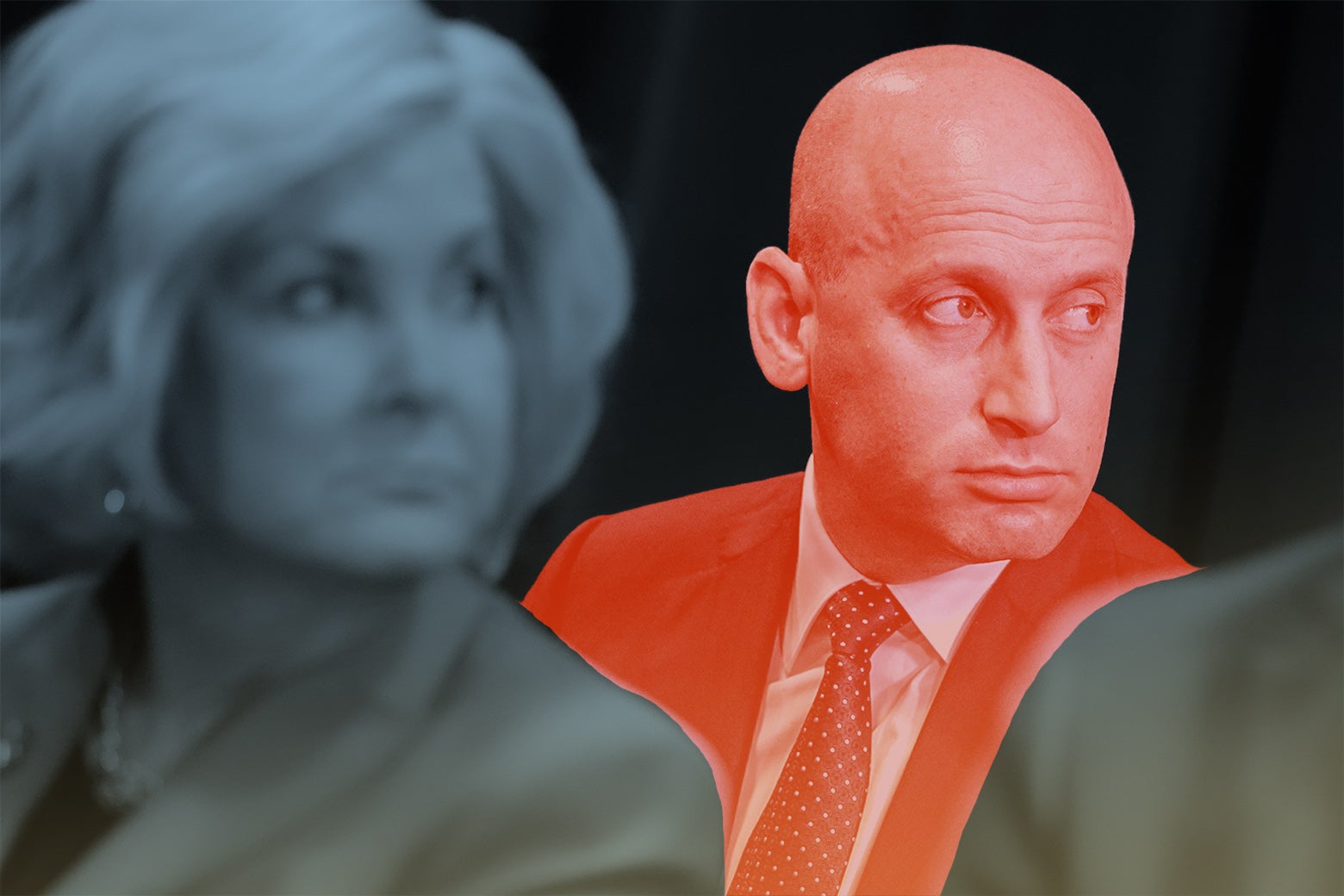
The Slatest A rage-driven president has picked an even angrier chief of staff. Photo illustration by Slate. Photo by Chip Somodevilla/Getty Images. This story is adapted from the Slatest newsletter. You can sign up here to get it in your inbox every day. After suffering a historic rebuke in this week’s midterms, the infamously brash Donald Trump sounded almost chastened. “We’ll, you know, look forward to working with them,” he said of Democrats in a subdued election-night phone call with the New York Times. “We’ll probably work something out.” Even as Trump emphasized his power to veto legislation, his postelection comments led some to imagine that a humbled dealmaker in chief might really be willing to play ball. “Donald Trump may be a bit crazy, but he is not stupid, and he is a good politician,” Sen. Bernie Sanders said on MSNBC, suggesting the president might even be open to signing a Medicare for All bill into law. In the end, Trump’s conciliatory tone lasted less than three days. On Friday afternoon, the president announced that he was elevating Stephen Miller, an anti-immigrant hawk who has been with him since the 2016 campaign, to be his next White House chief of staff, describing Miller as “one of my most trusted advisors.” Democrats, including some who previously sounded hopeful about persuading Trump to back legislation that would lower costs for inflation-pinched Americans, reacted with fury. “Stephen Miller is a dangerous xenophobe and reckless extremist who has American blood on his hands,” wrote Rep. Hakeem Jeffries, the likely next House speaker. “His presence in government should be eradicated like a malignant tumor. Fire him today.” It isn’t unusual for presidents to reshuffle the org chart after a midterm drubbing. But those personnel changes are usually a tacit admission that something has gone wrong, a public hitting of the reset button. After Republicans flipped the House in 2010, Barack Obama replaced Rahm Emanuel, his feisty chief of staff, with Bill Daley, a pragmatic centrist whom Obama hoped could help him work across the aisle. In the wake of a brutal loss, letting certain heads roll can look like a politically savvy sop to the will of the voters. But Trump, who infamously tried to overturn his 2020 election defeat, has never cared much for the will of the voters. And promoting Miller, who is among the administration’s most despised figures, is the opposite of what most presidents would do after an overwhelming electoral beatdown. Even among Trump aides, Miller has an unusually long history of bigotry. In high school, he criticized administrators for allowing Spanish-language announcements and once reportedly jumped into a girls’ track race in an apparent attempt to prove the athletic superiority of men. In college, he wrote columns for Duke’s student newspaper that criticized feminism and argued that “Christianity is embedded in the very soul of our nation.” As an aide to an Alabama senator, Miller promoted white-supremacist talking points, including the racist “great replacement” conspiracy theory. After arriving at the White House, he zealously defended separating migrant families at the border. In the president’s second term, Miller helped architect Operation Metro Surge, the January immigration-enforcement blitz in Minneapolis that killed two American citizens whom Miller falsely branded domestic terrorists and assassins. At first glance, doubling down on Miller now looks like a strange choice even for Trump. The president appears to be well aware of how extreme his adviser’s views are. As the Wall Street Journal reported this week in a midterms postmortem, Trump has privately admitted that Miller’s zeal for deportations had “gone too far.” The evidence suggests that backlash to those efforts helped sweep Republicans out of power across the country this week, particularly among Latino voters. But promoting Miller starts to make more sense when you consider who Trump is at his core: a confrontational man who managed to get elected president twice in large part by stoking divisions over immigration. Ever in search of a scapegoat for his own failures, Trump has reportedly blamed Republicans’ hefty midterm losses on Susie Wiles, whom Miller is set to replace as chief of staff. And rather than confront the reality of defeat, Trump appears to be seeking succor among his core supporters. “Prominent MAGA figures I talked to this week cited Stephen Miller as their dream choice for chief of staff,” the Daily Mail reporter Charlie Spiering posted after the news broke. “This pick really re-energizes a gloomy base.” The president also prizes loyalty, and Miller spent the years between Trump’s terms laying the groundwork for a “spectacular migration crackdown.” We’ve also lived through a version of this before. In 2018, after Democrats retook the House, Trump sounded similar notes of conciliation. “We have a lot of things in common on infrastructure,” he said the day after the election. “We want to do something on healthcare, they want to do something on healthcare, there are a lot of great things we could do together.” None of it ended up happening. Instead, the president soon found himself in a standoff with Democrats over his demand that a government funding bill include money for his southern border wall, an impasse that yielded what was then the longest government shutdown in U.S. history. A repeat performance may already be in the offing. The federal government will run out of money next month, and elevating Miller isn’t the only sign that Trump plans to keep immigration at the forefront. “Deportations will continue,” Homeland Security Secretary Markwayne Mullin posted after Democrats won the House and Senate. Even Vice President J.D. Vance, who on Wednesday published a 600-word X post blaming the war in Iran for Republicans’ dismal midterm, showed little interest in finding common ground over immigration. “I’m open to the idea that we should change enforcement—by focusing more on businesses that hire illegal labor, for instance,” Vance wrote. “But anyone pushing amnesty is lying to you.” On Friday, Vance put out a statement congratulating Miller on his promotion. Elevating Miller isn’t the only sign that Trump plans to spend the last two years of his second term the same way he spent the first two. Democrats won key races by casting the president as an out-of-touch billionaire more interested in beautifying Washington than in making groceries cheaper, but Trump is already hitting the gas on finishing his White House ballroom and erecting a triumphal arch near the Lincoln Memorial. After an election in which many voters rejected building data centers to power artificial intelligence, Trump reiterated in a Friday post on Truth Social that “only foolish leadership will say ‘NO’ to the riches they bring!” And even as key Trump allies seem to want the president to make Defense Secretary Pete Hegseth the fall guy for Iran, some reporters think replacing Wiles with Miller could save Hegseth’s job. But the core issue of Miller’s promotion is immigration, the subject of the incoming chief of staff’s overriding obsession. For nearly two years now, this administration’s deportation policies have brought death, violence, and misery to communities across the country. With Miller at the helm, it would be a surprise if the next two years turn out much better. Tolga Akdoğan On that cheery end-of-week note, let’s pivot to my colleagues’ suggestions about how to get your weekend off to a happier start: Take stock of election week: It has been a truly wild week in politics, one that we’ll be making sense of for months and even years to come. Need some help? Tomorrow, the Surge—Slate’s weekly political analysis newsletter—will send out its postelection edition. We got an early look, and it’s a great one. You’ll want to sign up here. A school staple gets revisited: Millions of students had to read the coming-of-age wilderness survival novel Hatchet in English class. It turns out that there’s a reason the book was inescapable for so many kids. Luke Winkie gets to the bottom of its unexpectedly controversial reputation. A highly anticipated sequel falls flat: Romantasy fans have been waiting for more than five years for the latest installment in Sarah J. Maas’ A Court of Thorns and Roses series. Now that A Court of Splintered Harmony is finally here, it feels frustratingly incomplete. Nadira Goffe explains why some fans feel shortchanged by this sequel. A quintessential American author gets his due: There are countless American writers who have shaped the country’s literary landscape, but one famous figure rarely gets mentioned in the conversation. Laura Miller makes the case that Edgar Allan Poe—whose work deliberately eschews many of the essential themes of American literature—is actually the most influential American writer of them all. A time-traveling sequel arrives: The Time Traveler’s Wife was a blockbuster hit in 2003. Now, more than 20 years later, a sequel has arrived. Ironically, the inventive time-travel tale feels of a totally different era from its predecessor. Rebecca Onion assesses some of the book’s mind-bending challenges for readers. Congratulations on making it to Friday! You’ve earned a break from the news, but I promise we’ll be back in your inbox on Monday with more. Enjoy the weekend.
Did Trump Learn Anything From the Midterms? We Already Have Our Answer.
Full Article
Original Source
Read the full article at Slate →KhanList aggregates and links to publicly available news content. We do not host full articles from third-party sources. Always verify important information with original sources.