
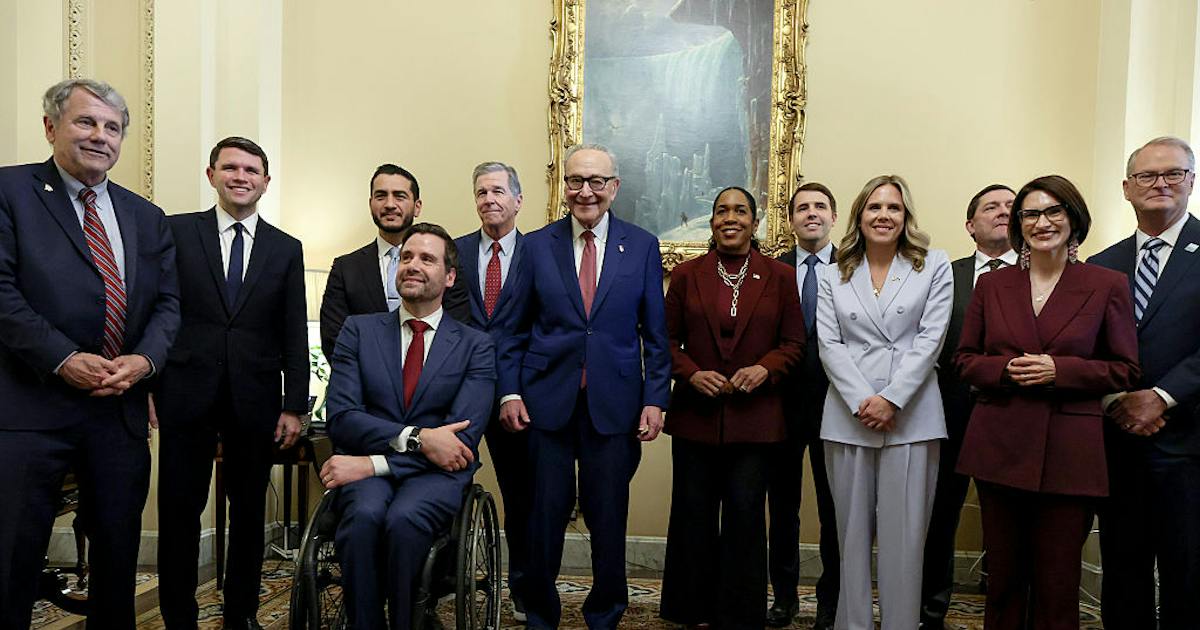
You’re reading The TNR Blue Book. Get daily scoops, strategy, and developments inside the liberal ideas factory delivered right to your inbox. Sign up for free.Inside Washington Senators were skittish on Tuesday when asked if they would support Senator Chuck Schumer for majority leader. Large sections of the Democratic base say they want Schumer out. But alternative plans are scarce, and most Dems won’t do more than hint at them, even when asked outright.Two potential challenges appear to be brewing: one from Senator Chris Van Hollen of Maryland and perhaps one from Elissa Slotkin of Michigan. Van Hollen hasn’t outright announced a bid for the role, but he told reporters on Monday: “I’m in listening mode and haven’t shut the door.” On Tuesday, Slotkin appeared with Senator Bernie Sanders to call for a new approach to leadership. Sanders, an independent who caucuses with Democrats, said he is a “no” on Schumer. Slotkin said she is a “no” until she sees a plan for governance. “Whoever wants to run this caucus should come forward with a plan on how they’re going to govern differently, what they’re going to do in the first 100 days to put money in people’s pockets, and then in particular how they’re going to communicate differently.”Slotkin on Tuesday denied that she is gunning for the role. “I am not actively seeking this job. I am seeking change,” she told reporters. But when I asked specifically if she would ever consider seeking the role, she didn’t give a clear answer.A number of the newly elected senators, on their way to their first caucus lunch on Tuesday, avoided supporting Schumer outright. “We’re all very clear about the urgency of this moment. How this translates into leadership conversations, that I’m not totally clear on,” said Peggy Flanagan, the senator-elect from Minnesota.Flanagan beat Schumer-backed Representative Angie Craig in Minnesota’s Democratic primary. Craig wasn’t the only Schumer pick that ultimately lost their race. He also backed Alex Vindman in Florida, who lost to Angie Nixon, and supported Maine Governor Janet Mills, who dropped out of her race. Most disastrous of all was his support for Representative Haley Stevens, who lost her primary to Abdul El-Sayed and underwent a public, multiday crashout before ultimately endorsing the Republican candidate just three days before the general election. Schumer has based much of his argument for reelection on Democrats’ monumental pickups on Tuesday, despite those four airballs.Van Hollen addressed that issue on Tuesday: “We have two members in that room, newly elected senators, who would not be there if Schumer and the DSCC had had their way,” he told Ali Vitali of MS Now. “Schumer and the DSCC sided with the crypto industry and AIPAC against these candidates.” Others have criticized Schumer for his lack of support for other candidates, like Nixon in Florida and Jamie Davis in Louisiana.Flanagan didn’t comment specifically on Schumer’s unsuccessful Senate picks, but she did hint at support for Van Hollen. “I really respect Chris Van Hollen, and I’m a big fan of his leadership. And so, we’ll see who decided to step in. But I think Chris Van Hollen is fantastic,” she said.El-Sayed threw his support behind Van Hollen early on and reiterated it to me today. “It’s an evolving conversation, and I’ve been very clear. I think Senator Van Hollen would be a phenomenal leader.” I asked if he’s been hearing more support for Van Hollen from other members. “A lot of excitement there,” he said.Even though Schumer is projecting confidence, Murshed Zaheed, a former senior leadership aide to former Majority Leader Harry Reid, noted that he can’t recall a situation like this one, where more than double-digit members of the incoming caucus have shown an eagerness to defect from their Senate leader. He attributes senators’ enthusiasm for Van Hollen in part to Van Hollen’s leadership during some of the darkest days of the second Trump administration.“The first visible opposition to Trump was Chris Van Hollen’s trip to El Salvador” in April 2025 to meet with Kilmar Abrego Garcia, who the Trump administration deported in violation of court orders. “Until then, the Democrats were completely cowered in their offices in D.C.,” Zaheed said.When I asked them about leadership, some senators were coy—and didn’t explicitly say they’d support Schumer. “I’m just excited for our first caucus lunch and [to] hear from folks and understand what our options are going to be,” said newly-elected Annie Andrews. Senator Alex Padilla of California merely said that he is “looking forward to our conversation today at lunch.”—Emma JanssenOutside WashingtonThe first place where Democrats’ new power in state governments may be felt? Medicaid. A few stories to watch: In Iowa, Democratic Governor-elect Rob Sand has put reversing the 2016 decision to privatize the state Medicaid program at the top of his agenda. Then there’s Medicaid expansion—an option under the Affordable Care Act that allows state Medicaid programs to cover people earning up to 138 percent of the federal poverty level. In Georgia, Keisha Lance-Bottoms winning the gubernatorial race and Dems winning a narrow majority in the state House has put full expansion on the table (Georgia implemented a partial expansion in 2023). Stateline’s Anna Claire Vollers noted last week that the same could happen in Wisconsin (new Democratic trifecta starting in January), Texas (Gina Hinojosa in the governor’s chair and Dems controlling the House), and Kansas (vote count ongoing, but Cindy Holscher is ahead in the governor’s race, and Dems have broken the GOP’s supermajority in the House). It’s far from a sure thing, though. The Milwaukee Journal Sentinel’s Sarah Volpenhein reports that in Wisconsin, Democrats might not push for expansion right away. Georgia Dems will have to work with a Republican-controlled Senate, as will Hinojosa and her House allies in Texas. Some politicians are pumped, though—on Monday, Texas state Representative John Bucy III pre-filed House Bills 101 and 102 to tee things up.A tally you may have missed: Despite many conservatives’ attempts to portray public transit as a socialist plot that real people hate, voters in this election approved a striking 22 out of 27 public transit ballot measures. (If you’re interested in this topic, it’s always a good time to read Liza Featherstone’s classic, insightful piece about why public transit serves as a high-stakes testing ground for competing visions of the role of government in modern society.)—Heather Souvaine HornThe Ideas FactoryThe Roosevelt Institute has published a useful rundown from Asad Ramzanali of the Vanderbilt Policy Accelerator, Andrea Dehlendorf of Democracy Takes Work, Molly Kinder of the Breakwater Initiative, and Brian McGrail of Encode on what Anthropic’s upcoming IPO “means for the economy.” Several members of the panel insist, unsurprisingly, that there’s an urgent need for government oversight and regulation. “I fear,” McGrail writes, “that going public will only make it harder for Anthropic to choose safe technology over short-term shareholder interests.”On Thursday at 10 a.m., the Center for Strategic and International Studies will hold an online discussion on “Israel’s Elections and the Future of the Middle East.” Mona Yacoubian will moderate a conversation between former U.S. ambassador Michael Ratney, Paul Salem, and Celine Touboul.—Heather Souvaine HornIn ClosingBook of the Week: Department of Fate: The Promise, the Power, and the Collapse of America’s Most Consequential InstitutionBy Nathaniel PhilbrickTHE GIST: “As goes DOJ, so goes the republic.” That’s the longtime MS Now host’s basic argument, in a book that is “both a diagnosis and a prescription” for the Department of Justice. The book traces the institution from its origin in the Reconstruction era—when it was created to fight the Ku Klux Klan—to the present, when Attorney General Todd Blanche insists that he is the personal attorney for the president.PRAISE: Department of Fate has no blurbs—a power move if ever there was one—but Kirkus was laudatory. “Written with a novelist’s skill for revelatory detail and a historian’s sharp eye for continuities, the book both infuriates and inspires. The moral indignation seething through Maddow’s account culminates in her conclusion, in which she calls on Congress to beef up the DOJ’s Office of the Inspector General and reminds us of the department’s long-forgotten purpose: ‘to fight for everyone in America to have the protections of the U.S. Constitution, including against their own government.’”CRUISING THE INDEX: This is not just a polemic, it’s also a history covering some of the department’s less widely recognized roles, from Reconstruction roots to union busting later in the Gilded Age, to the rise of J. Edgar Hoover in the early 20th century, to the Civil Rights Movement.TNR’S QUICK CRITICAL ASSESSMENT: Maddow’s witty and biting lineup of attorney generals reminds us that there is nothing new about a Department of Justice awash with corruption scandals or attorney generals who see their role primarily as protecting the interests of the powerful. But this also strengthens Maddow’s argument that the Trump era represents a departure even from the DOJ’s often sordid history. This is not a good moment for the DOJ. Maddow presents a compelling case for how to fix it.—Alex ShephardPolitical Trivia Question of the Day Who was the last Cabinet official to be impeached by the House? Hint: It was quite recent! (Sign up for The TNR Blue Book to find the answer in tomorrow’s newsletter.)—Michael TomaskyYou’re reading The TNR Blue Book. Get daily scoops, strategy, and developments inside the liberal ideas factory delivered right to your inbox. Sign up for free.Inside Washington “LAWYER UP.” That was the election night message from Representative Robert Garcia, ranking member of the House Oversight Committee. In January, one of Democrats’ top priorities will be oversight of the Trump administration, corporate America, and Immigration and Customs Enforcement (ICE). With so many potential targets for subpoenas and hearings, the only question left is: Where will Democrats start?“The malfeasance list is so large that ranking is a little bit like choosing amongst your children,” said Lisa Gilbert, co-president of Public Citizen, when I asked how she’d like Democrats to prioritize their oversight efforts. She has some ideas, though: “Pick corporate villains but not just corporate villains in a vacuum,” she said. “Those that really help connect Trump corruption to tangible harms regular people are experiencing.” To start, she suggested tech billionaires Elon Musk, Jeff Bezos, and Mark Zuckerberg.Some incoming House Democrats, in town for their new member orientation, shared their priorities on Monday, which often mirrored their districts or experiences. They also pointed to opportunities to tie accountability to other concerns, like immigration and affordability, that drove voters to the polls last Tuesday.“I was the mayor of a community that was under federal occupation,” said Representative-elect Daniel Biss, who was previously the mayor of Evanston, a suburb just north of Chicago. “I watched my constituents [get] abducted off the streets because of the color of their skin, where their entire community was terrorized and traumatized, and I just feel deeply compelled to hold ICE and the entire DHS process accountable.”Randy Villegas, who was elected to represent a majority-Latino district in California’s Central Valley, also has his sights set on ICE. “I very much want to visit the detention center within my district, both Mesa Verde in Bakersfield, California, as well as the extension in McFarland,” he said. “Ultimately, I don’t believe any private corporation should be benefiting off the separation of our families. So I’ll definitely make immigration one of my top priorities.” Both of the facilities he mentioned are operated by the GEO Group, a private prison company contracted with ICE.Adam Hamawy, a physician who was elected to represent New Jersey’s 12th congressional district, pointed to corporate corruption as his main priority. “Health care insurance has always been an issue, but really, it’s all the big mega corporations,” he said.Many outside experts and advocates also have their eyes on investigating corporate misdeeds and pay-to-play schemes. “We’ve been following the Trump crypto conflicts of interest since he took office,” said Virginia Canter, chief counsel for ethics and anti-corruption at Democracy Defenders Fund. She also pointed to Musk’s contracts with the federal government and the ties between the Starlink system and the war in Ukraine. Musk reportedly ordered the slowdown of a Starlink system that Ukraine relied upon, blindsiding the Ukrainian government. “Should a private individual have the power to use technology in a fashion that could undermine U.S. national security interests?” Canter asked.Legal scholar Melissa Murray, a professor at NYU Law, wants Congress to closely scrutinize potential ethics breaches in the court system, including the Supreme Court, and to consider specific reforms. “Real attention to recusal rules. Maybe questions about the court’s docket, its use of the shadow docket,” she suggested. After all, anything Democrats do in Congress “with regard to policymaking is going to be challenged, and it’ll ultimately end up in a federal court, probably the Supreme Court,” she said.Democrats will have no shortage of people and corporations to investigate beginning in January. But it has to be a two-pronged effort, Gilbert said. Democrats will need “to tell the story, both with oversight, substantive investigations, and hearings that hold up and show accountability for these bad actors,” while also coupling those hearings with “substantive policy that lays out an agenda for fixing the systemic corruption we’re seeing,” she said. “It’s really going to be that one-two punch.”—Emma JanssenOutside WashingtonAs Stephen Miller, Trump’s immigration strategy architect, starts his new job as White House chief of staff, The New York Times published a brutal account of how the Trump administration’s policy of deporting court-protected asylum-seekers to third countries has resulted in “many of them being pushed back to the very countries where the Trump administration itself cannot legally send them,” where they face “torture, sexual abuse or persecution.” The Times’ Megha Rajagopalan, Edward Wong, Ruth Maclean, and Hamed Aleaziz have identified 110 individuals sent back to their origin countries in this way. Human rights groups say that’s “almost certainly an undercount.”The 31st United Nations climate summit (COP31) is underway in Turkey this week. Like last year, there will be no official U.S. representatives there, but a number of non-federal politicians are attending. Among those politicians are 19 members of Congress, all of them Democrats, with Representative Sean Casten of Illinois so far leading the charge in terms of talking to the press. As the summit opened, the U.N.’s World Meteorological Organization issued a dire global climate update. University College London professor emeritus Bill McGuire tells The Guardian that “the latest research suggests we will cross the 1.5C limit permanently in 2028, and with the planet now heating at an extraordinary rate of 0.4C a decade, we can expect to smash through 2C in the late 2030s.” The takeaway? Democrats who kept quiet about climate change on the campaign trail may want to add it back to the to-do list—particularly given climate change’s well-documented contributions to the affordability crisis.—Heather Souvaine HornThe Ideas FactoryThe Open Markets Institute published a troubling new report on how top tech companies (you know the ones) “could leverage their control over cloud computing, foundation models, operating systems, browsers, online search, and digital platforms to dominate AI agents, exclude competitors, and extend their power even further across the economy and society.” One of the report’s top recommendations: U.S. and European policymakers should “require interoperability and data portability,” authors Max von Thun, Courtney C. Radsch, George Colville, and Dora Wierzbicka write, to reduce top companies’ ability to suppress competition.In case you missed it: At the Center for American Progress, Damian Murphy recently penned a guide for how Democrats can end the war on Iran. His top step is to “cut off funding for the war effort in an appropriations package.” A war powers resolution would be good, too, he writes, but “the single most powerful tool Congress has at its disposal to bring about an end to the war is the power of the purse.”The Natural Resources Defense Council is among numerous groups continuing to oppose the permitting reform bill titled the Bipartisan American Affordability and Jobs Act of 2026—even with its recent modifications. “We support the elements of the legislation that help accelerate needed transmission, clean energy deployment, and grid modernization; but the current package goes too far in weakening essential environmental safeguards and public participation requirements,” said Manish Bapna, NRDC president, in a statement published on the organization’s website on Sunday. In his newsletter called The Crucial Years, environmentalist Bill McKibben has a user-friendly rundown of the reasons why environmental and some accountability advocates are opposing this bill.—Heather Souvaine HornIn ClosingPolitical Trivia Question of the Day Who was the first defense secretary, nominated by Harry Truman in 1947 after the modern Defense Department was created? (Sign up for The TNR Blue Book to find the answer in tomorrow’s newsletter.)—Michael TomaskyYou’re reading The TNR Blue Book. Get daily scoops, strategy, and developments inside the liberal ideas factory delivered right to your inbox. Sign up for free.Inside Washington “We campaigned as affordability Democrats. That was the message of every single candidate across this country,” Representative Katherine Clark, who is poised to be the House majority leader come January, told CNN on Thursday. “And that is exactly how we’re going to govern.” Delivering on this message, however, is easier said than done.Representative Hakeem Jeffries, who is almost certain to be the next House speaker, likewise said that the party will be united “right out of the gate” to address the cost of living crisis—a topic that Democrats credit for their massive Election Day wins. In a “Dear Colleague” letter on Thursday, he proposed reversing cuts to the Affordable Care Act subsidies that have forced millions of Americans to pay more for health care, undoing cuts to Medicaid and SNAP, reversing tariffs, and stopping the war in Iran—all in the first 100 days of the next Congress.Some advocates are pushing Democrats to start even sooner. “Government funding runs out on December 11, and I think they should use that must-pass vehicle to demand an end to the war in Iran, bringing down gas prices. And they should ensure that the Medicaid cuts don’t go into effect in January, which would raise health care costs for families,” said Lindsay Owens, executive director of Groundwork Collaborative.Republicans, of course, might not go along with that while they still hold power in the lame-duck session. There’s also the issue of President Donald Trump’s veto power, which could thwart Democrats’ affordability legislation during the next Congress. Trump has given conflicting messages, telling some journalists that he plans to work with Congress and others that he will become “Mr. Veto.”Some Democrats want to tailor their agenda to that reality. “How about we spend the majority of our time on stuff that we all agree on,” Representative Adam Gray of California told Semafor. Senator Brian Schatz of Hawaii is similarly cautious: “I do not think it is time to propose things that the president of the United States is guaranteed to veto,” said Schatz, who is in line for a Senate leadership role. “I think that’s a bit of wasted energy.” Progressives like Representatives Greg Casar of Texas and Ro Khanna of California, on the other hand, adamantly disagreed with that sentiment. “Make him veto Medicare for All. Make him veto a $25 living wage. Make him veto free childcare. Make him veto Block the Bombs to Israel,” Khanna wrote on X.Economists like Josh Bivens, chief economist at the Economic Policy Institute, also want to see Democrats go beyond just addressing the high cost of groceries and gas, which was a major part of the campaign. “In terms of the policy levers that will actually work to make affordability better,” he said, “we have at least as many, probably more, that work on the income and wage side than the price side.”Raising the minimum wage and passing labor legislation that empowers workers would increase incomes. It would be a way to give Americans more purchasing power without trying to lower the cost of goods directly, which can be more difficult. Jared Bernstein, chair of the United States Council of Economic Advisers under former President Joe Biden, makes a similar argument, and is concerned that Democrats could overpromise and underdeliver on lowering prices. “Nobody should be saying that they can lower the price of everything within the walls of Target and Walmart,” he said. “Trump, of course, made precisely such claims, and to say they redounded against him is a massive understatement.”One thing that most Democrats and experts can agree on: ending the Iran war as quickly as possible. Even if ending the war doesn’t immediately bring down the price of gas, it would begin the process. The war is deeply unpopular; in a remarkable social media post on Wednesday, Vice President JD Vance admitted that it’s part of why Republicans lost Congress.Even if Trump’s vetoes make affordability legislation tricky, Democrats “have another tool, and that’s oversight,” Owens said. “Americans are aware that one of the reasons that prices are so high is corporations are charging them more than they need to, taking advantage of the war in Iran, taking advantage of the tariffs to raise prices,”she said. Addressing and exposing corporate corruption, she argued, is also good affordability politics. Ultimately, Democrats will need to think about the full array of tools at their disposal—lowering prices, raising incomes, pressuring Trump to sign their bills, and holding hearings. Perhaps the most important thing they can do is show voters that they are doing whatever they can to make life more affordable.—Emma JanssenOutside WashingtonCould Dems’ state-level victories turn out to have a greater long-term impact than retaking Congress? While the tally is not yet final, Dems so far appear to have ended Republican “trifectas” in Georgia, Iowa, Ohio, and Texas; built Democratic trifectas in Michigan, Minnesota, Nevada, Pennsylvania, Wisconsin, and possibly Arizona; flipped the North Carolina House, quite possibly the Texas House, and both chambers in New Hampshire; and won the governor’s races in Georgia, Iowa, Nevada, Ohio, and Texas. “Democrats will have the power to rewrite policies on redistricting, abortion, climate, health care, education and taxes,” The Washington Post summarizes in its rundown of state results. That includes taking “meaningful steps on lowering utility costs, expanding access to child care and health care, reproductive rights, safeguarding elections and other issues.” And then there’s the big question that Axios raised this week: Could Dems’ state victories pave the way for getting rid of the Electoral College?Let’s zoom in on one item in the Post’s list: What do these sweeping Democratic victories mean for climate policy? The party conspicuously sidelined the issue on the campaign trail. But as Steven Rodas and Liza Gross at Inside Climate News pointed out this week, voters consistently backed environmental protection on state and local ballot measures on Tuesday. Perhaps the most striking example: More than 80 percent of Michigan voters chose to ban campaign contributions from utility companies. (The first lawsuit challenging this ballot initiative has already been filed.)The new Democratic trifecta states in particular now have a lot of options on the climate front. And there are signs of movement at the national level, as well: Chellie Pingree, fresh off a commanding victory delivering her a 10th term in Maine’s 1st congressional district, is ready to rumble, telling Grist’s Jake Bittle this week that she has, in Bittle’s words, “prepared a long list of investigations and subpoenas for Trump administration officials, including EPA chief Lee Zeldin.” Pingree, the top Democrat on the House Appropriations subcommittee that oversees the Environmental Protection Agency and Interior Department, also wants to insert stipulations in funding bills “that would deny agencies core operational funds or restrict travel money for leading officials unless they doled out solar and energy funding as Congress previously instructed them to.” For an administration famously attached to its travel money, that probably counts as shots fired.—Heather Souvaine HornThe Ideas FactoryOn Monday at 2 p.m., the Brookings Institution will host an online event about “the consequences of the 2026 midterm elections,” featuring David C. Barker, Karen Tumulty, Jonathan Rauch, and Sarah A. Binder.Also on Monday, at 1 p.m., New America will host a virtual discussion with Better Life Lab’s Brigid Schulte and Haley Swenson about their new research on men and caregiving, as well as insights regarding the barriers that keep some men from being more involved in caregiving, even when they want to be. Mohan Sivalogonath of Dads for All, stay-at-home dad Shannon Carpenter, and elder caregiver Carlos Olivas will join for a panel discussion.—Heather Souvaine HornIn ClosingGood Week: I mean, there’s an obvious answer here: Literally almost every Democrat. But if we think outside the box, then we might have to hand this award to Mike Johnson, who announced after the midterms that he would not be running for minority leader, one of the worst jobs in Washington, perhaps second only to being the majority leader in a GOP-led House. Johnson led a caucus of MAGA-werewolves who routinely brined themselves in right-wing meme slop about as well as anyone could. He will now get to spend more time with his son and their favorite hobby: monitoring each other’s pornography intake.Bad Week: Again, obvious answer: nearly every Republican in Christendom! But some Democrats fared poorly, as well. Haley Stevens’s decision to go against the party and endorse Mike Rogers was a shot so poorly taken that even Lin-Manuel Miranda would have been like, “Hales, I’d have holstered that one.” And we must spare a thought for John Fetterman, a senator who exists only to thwart his own caucus, which will now swell to numbers so large as to make him entirely irrelevant. Go ahead and switch parties, pal! (Caveat: A new annoying Democratic senator with swing vote power could emerge at any time.)—Jason LinkinsPolitical Trivia Question of the Day The first Latino governor in the United States was Romualdo Pacheco of California. In what decade did he ascend to that office? (Sign up for The TNR Blue Book to find the answer in tomorrow’s newsletter.)—Michael TomaskyYou’re reading The TNR Blue Book. Get daily scoops, strategy, and developments inside the liberal ideas factory delivered right to your inbox. Sign up for free.Inside Washington “As other states shift left in a brutal cycle, Florida does what we do best—we held the line,” former Florida GOP Chair Christian Ziegler wrote on X on Wednesday morning. “THANK GOD I LIVE IN FLORIDA!” Democrats, on the other hand, are disappointed that the night’s successes didn’t extend to the Sunshine State. On a giddy, “blue wave” evening when even states as improbable as Kansas and Texas elected Democratic senators, both Angie Nixon, Democrats’ Senate nominee in Florida, and David Jolly, the gubernatorial candidate, lost to their Republican opponents. This disappointment, some say, was preventable. And perhaps more importantly, it holds some lessons for 2028.“We think that Angie could have won with any kind of substantial investment made over the last month,” said Ravi Mangla, press secretary for the Working Families Party, which was the first national organization to endorse Nixon. Ultimately, Nixon came closer than polls predicted, losing to GOP Senator Ashley Moody by less than three percentage points. Jolly’s margin against Republican Byron Donalds was even tighter—he lost by less than two percentage points.Though Nixon received support from groups like the WFP, which spent more than $200,000 on her race, as well as from national political figures like Senators Bernie Sanders and Chris Murphy, she received very little from the national Democratic establishment. The Democratic Senatorial Campaign Committee included the Florida Senate race in its $40 million Win the Senate program but prioritized states like Maine and Texas instead.Texas and Florida are, to some extent, mirror images of each other. Both are southern states that Democrats have counted out in recent years. Both have large Latino populations. But while Florida stayed red on Tuesday night, Texas’s Senate race, gubernatorial race, and all of its statewide offices flipped blue. “I don’t think there’s any question that Texas received the investment it needed, but we didn’t see that same commensurate investment in Florida,” Mangla said. “And I would hope that had the DSCC chosen to invest and put its resources behind Angie, that we would be celebrating a really historic win today.”On Wednesday, Nixon expressed sadness about her loss but optimism for the future. “We invested in grassroots organizers and partnered with candidates down ballot. I’m so proud of the work we did helping to flip 17 House Seats,” she wrote on X. “Imagine what would have happened if we had more investment early on.” She also hinted at the possibility of running again in two years, saying “2028 is around the corner” in her concession speech.While the lack of national spending might be part of why Nixon and Jolly lost on Tuesday, acknowledged Aubrey Jewett, a professor of political science at the University of Central Florida, other factors were at play, as well. For example: Republicans have more than 1.5 million voter registrations than Democrats do, which happened “very rapidly” in recent years. “We had a blue wave,” Jewett explained, but it still wasn’t enough. Republicans didn’t have great turnout, but they “had good solid turnout,” and “that’s all they needed.”While Latino voters swung toward Democrats in both Florida and Texas, Cuban Americans in Florida ultimately voted for Moody. In contrast, Mexican American voters, who make up 40 percent of the population in Texas, were more likely to swing for Democrats this year in the aftermath of ICE raids targeting their communities.Looking ahead, some experts share Nixon’s optimism for 2028. Republicans’ “price per vote was a lot higher than Jolly’s price per vote, or Nixon’s,” said Jared Nordlund, the Florida State director at UnidosUS, a Latino civil rights nonprofit, comparing the total spending numbers in the race and laying them against how well each candidate performed. “I think seeing that out there tells you that the Republican vote isn’t guaranteed.”James Talarico’s success in Texas and the close margins in Florida could spark more investment in 2028. And for some, that’s the big takeaway from this election, regardless of how it played out in individual races: Democrats need to rethink their assumptions about the electoral map. Would more funding have turned the tide? “If you don’t think you can win and you don’t invest, then you almost always don’t win,” Jewett said. “Whereas if you invest, sometimes you might.”—Emma JanssenOutside WashingtonA year that began with clergy members being arrested en masse in subzero ICE protests is closing with five Democratic ministers headed to a newly blue Congress. In deep-red Kansas, Methodist megachurch leader Adam Hamilton stunned the country by thumping Republican Roger Marshall in their Senate race. In Iowa, Lutheran minister Sarah Trone Garriott and Presbyterian minister Lindsay James flipped the 3rd and 2nd congressional districts, respectively, shrugging off months of right-wing attacks suggesting they weren’t real Christians. In Texas, Friendship-West Baptist Church pastor Frederick Haynes won the 30th congressional district seat. It wasn’t all sunshine and roses for the clergy; Anna Golladay lost in Tennessee, and Robb Ryerse lost in Arkansas. But it’s hard to dispute the prominence of progressive visions of Christianity in some of the biggest flips of this election. Former Presbyterian seminarian and Senator-elect James Talarico quoted both scripture and his grandfather, a Baptist preacher, in his victory speech after becoming the first Democrat to win a statewide Texas election in 32 years. Rob Sand, who won Iowa’s gubernatorial election, also talked extensively about his Lutheran faith on the campaign trail.What do the results of races across the country mean for Washington, D.C.—the city that President Donald Trump has repeatedly threatened to take over and is doggedly trying to turn into one giant construction site? The Washington Post has outlined a few ways that newly elected Democrats could mess with the construction plans, at least. In addition to two Democrats now joining the review panel that has so far approved Trump’s projects, a newly Democratic Congress could “file suit to block Trump’s most controversial projects” and “also rein in Trump’s spending” on said projects. Meanwhile, D.C.’s socialist mayor-elect, Janeese Lewis-George, has said she’s “willing to work with this administration to the benefit of D.C. residents” but is also “willing to stand up to this administration.”—Heather Souvaine HornThe Ideas FactoryPublic Citizen celebrated election results on Wednesday by publishing an “Oversight Agenda Roadmap” for the new Congress. “The American people are demanding much more than grandstanding and ritual condemnation of the most corrupt administration in American history,” said Public Citizen co-president Robert Weissman in the organization’s press release. The punchy first suggestion in the report: Hold hearings interviewing food bank leaders, health care providers, and more about the One Big Beautiful Bill Act’s “real-world impacts” while also investigating “how corporations used the financial gains from OBBBA, including decisions related to layoffs, wages, hiring, domestic investment, executive compensation, stock buybacks, and shareholder distributions” and determining “whether the economic promises used to justify OBBBA—including job creation, wage growth, and business investment—have materialized.”On Thursday at 10 a.m., the Brookings Institution will host an online-only conversation asking, “What’s next for U.S.-Israel relations?” Former U.S. Special Representative for Palestinian Affairs Hady Amr will offer opening remarks, after which Haaretz’s U.S. bureau chief, Ben Samuels, will moderate a conversation between J Street’s Ilan Goldenberg, University of Maryland professor Shibley Telhami, and the Hudson Institute’s Joel Rayburn.—Heather Souvaine HornIn ClosingPolitical Trivia Question of the Day The first Latino governor in the United States was Romualdo Pacheco of California. In what decade did he ascend to that office? (Sign up for The TNR Blue Book to find the answer in tomorrow’s newsletter.)—Michael TomaskyYou’re reading The TNR Blue Book. Get daily scoops, strategy, and developments inside the liberal ideas factory delivered right to your inbox. Sign up for free.Inside Washington Democrats have won a massive majority in the House, and amid the celebrations, different factions of the party will be clamoring to claim credit for the blue tsunami. Was it the progressives, the centrists, or even the Bernie dogs who carried the party to victory? And which faction will be calling the shots come January?The answer, to some extent, depends on who you ask. “A Democratic majority is really going to be built on the back of moderate candidates in the House,” said David de la Fuente, deputy director for politics and research at the centrist group Third Way. He pointed to moderate candidates who eventually won on Tuesday night, like Jared Moskowitz in Florida’s 25th congressional district or Bobby Pulido in Texas’s 15th congressional district.Meanwhile, Usamah Andrabi, the communications director of progressive group Justice Democrats, argued that progressives brought the energy and policy platforms that turned the tide. “The mandate from voters across this country is for this majority to look like what many Democrats finally learned to campaign on, which is taking on corporate interests to deliver on an affordability agenda that actually helps working class communities,” he said. “They finally listened to the left.”Andrabi pointed to Justice Democrats’ massive wins this cycle; it was their most successful year by far. The group is poised to send at least seven leaders to Congress, including Donavan McKinney in Michigan, Darializa Avila Chevalier and Claire Valdez in New York, and Melat Kiros in Colorado. These electeds will be joining fellow progressive firebrands like Representatives Alexandria Ocasio-Cortez, Rashida Tlaib, and Greg Casar in Congress. As it stands, the Congressional Progressive Caucus currently has 101 members, while the New Democrat Coalition, which includes more centrist lawmakers, touts 114 members. While it’s too soon to say definitively how those numbers will change, the Congressional Progressive Caucus PAC suggested that the caucus might be adding “over 20” new members, according to an email the group sent previewing a later press call.“Typically, the Congressional Progressive Caucus is bigger than the New Dems when Republicans control the House, and the New Dems are bigger than the progressives when the Democrats control the House, and that’s because, essentially, the New Dems tend to be the majority makers,” de la Cruz said. The term “majority maker” comes from former House Speaker Nancy Pelosi, who famously called the moderate-to-conservative Blue Dogs the “majority makers” for their success in unseating Republicans and contributing to the Democratic majority.But some progressive candidates overturned that orthodoxy on Tuesday. In Michigan’s 7th congressional district, Sunrise Movement co-founder William Lawrence prevailed despite running in one of the most competitive districts in the county, and facing the most Republican spending of any House candidate this cycle—more than $23 million. Similarly, in California’s 22nd congressional district, Randy Villegas declared an early victory over Republican Representative David Valadao, a testament to the size of his win (usually, California results trickle in slowly).Trying to tally up the number of seats that will soon be held by progressives versus moderates creates another problem: “It suggests that there’s just a kind of monolithic progressive ideology and a monolithic centrist ideology, and in my experience, it’s not quite that simple,” Democratic strategist Oliver Libby said.This year, that question became even more complicated with the emergence of a number of so-called Bernie dogs—candidates endorsed by both the Blue Dogs and Senator Bernie Sanders. Those candidates include Sam Forstag in Montana’s 1st congressional district, Rebecca Cooke in Wisconsin’s 3rd congressional district, Brian Poindexter in Ohio’s 7th district, and Bob Brooks in Pennsylvania’s seventh district. All four won.A more useful way of analyzing the Democratic majority—and predicting what they might do come January—could be to look directly at what policies they ran on, regardless of how they identify ideologically. That could help reconcile the simultaneous successes of moderates, progressives, and Bernie dogs, the Progressive Change Campaign Committee suggested in an Election Day memo. These winning policy platforms—including anti-establishment fights against data centers and surveillance tech, oversight of AI companies, and affordable health care—could ultimately provide a roadmap for Dems in 2028 and beyond.—Emma JanssenOutside WashingtonThe humble “I Voted” sticker could turn out to be one of the enduring images of this election. On October 19—the first day of early voting in Texas—Ronaldo Salgado cast a ballot and placed his voting sticker on Houston’s makeshift memorial to his father, who was shot and killed by an ICE officer this summer. Amid a historic rise in early voting, hundreds of other voters proceeded to follow Salgado’s lead, leaving “I Voted” stickers or other messages at the memorial to Lorenzo Salgado Araujo. On Tuesday afternoon, MPR News and other outlets reported that the practice had spread to Minneapolis, with local affiliate Fox 9 reporting “dozens” of “I Voted” stickers at the memorials for Alex Pretti and Renee Good, both of whom were shot and killed by an ICE agents in January.Elsewhere:James Talarico, Gina Hinojosa, and Nathan Johnson won the Senate, gubernatorial, and attorney general races in Texas last night—breaking a 32-year Dem losing streak in statewide races. But if we’re talking long losing streaks: No Democrat has held a seat on the Texas Railroad Commission—an underappreciated body with huge and little understood power to regulate the fossil fuel industry—since 1990. On Tuesday, though, Democrat Jon Rosenthal claimed victory over Republican Bo French, a candidate so prone to nakedly racist rhetoric that even Karl Rove denounced him in The Wall Street Journal in September and vowed to vote for Rosenthal.As of publication time for this newsletter, the race in New Jersey’s 2nd congressional district has not been called. Multiple outlets have reported, however, that four-term Republican Representative Jeff Van Drew has conceded to Democrat Zack Mullock. This is another race that longtime watchers of Democratic politics are going to be talking about today—particularly if a formal winner emerges. You can read more about this race—Van Drew, who used to be a Democrat, “has certainly earned the everlasting animosity of Democrats in the district,” Micah Rasmussen said—in Emma Janssen’s prior TNR Blue Book reporting here. Just a few weeks ago when this was written, analysts that she talked to still thought a Mullock victory was a long shot. Early Wednesday morning, Mullock led by nearly 8,000 votes, with 92 percent in.—Heather Souvaine HornIn ClosingPolitical Trivia Question of the Day If Scott Colom wins in Mississippi, he’ll be the state’s first Black senator since Reconstruction, when two Black men were elected to the Senate from the state. Can you name either? (Sign up for The TNR Blue Book to find the answer in tomorrow’s newsletter.)—Michael Tomasky
Did the Ice Under Chuck Schumer Just Get a Bit Thinner?
Full Article
Original Source
Read the full article at Newrepublic →KhanList aggregates and links to publicly available news content. We do not host full articles from third-party sources. Always verify important information with original sources.