
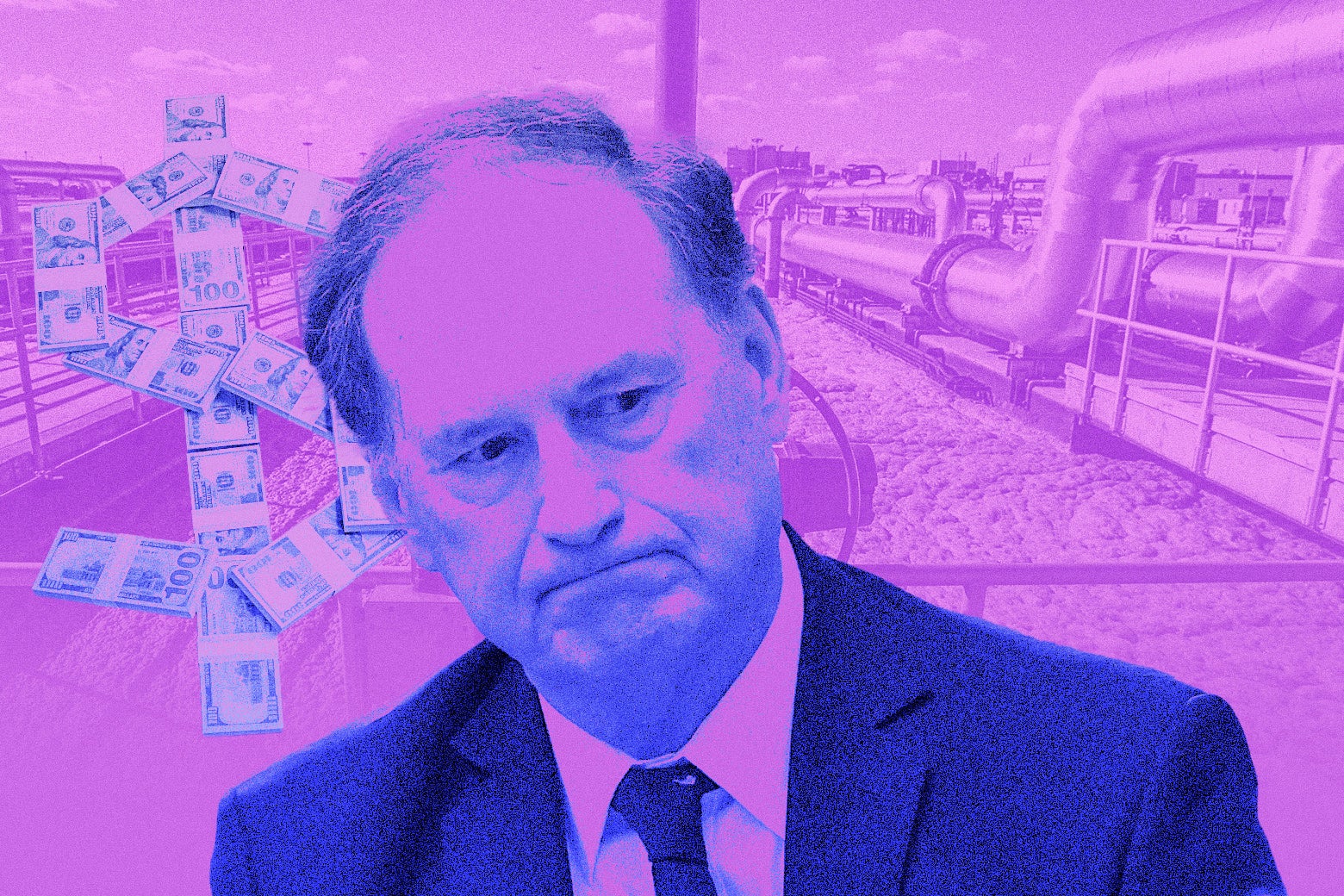
Jurisprudence By Enter your email to receive alerts for this author. Sign in or create an account to better manage your email preferences. Unsubscribe from email alerts Are you sure you want to unsubscribe from email alerts for Dahlia Lithwick? Oct 05, 20261:24 PM Photo illustration by Slate. Photos by Dragon Claws/Getty Images Plus, Nicholas Kamm/AFP via Getty Images, and Kevin Dietsch/Getty Images. Sign up for Executive Dysfunction, a weekly newsletter that highlights one under-the-radar story about how Trump is changing the law—or how the law is pushing back—and keeps you posted on the latest from Slate’s Jurisprudence team. The United States Supreme Court opened a new term with a blockbuster climate case on Monday. The Roberts court has systematically gutted environmental protections in recent years, but Suncor v. Boulder presents an opportunity for Republican-appointed justices to foreclose one of the few remaining avenues for legal accountability for fossil fuel polluters. On this week’s Amicus podcast, longtime environmental advocate and Supreme Court critic Sen. Sheldon Whitehouse of Rhode Island joined Dahlia Lithwick to discuss how Suncor is the latest play in Big Oil’s long game at the court. Their conversation has been edited and condensed for clarity. Dahlia Lithwick: The way this case arrives at the Supreme Court is a signal of how little congressional prerogatives matter to the fossil fuel industry, how little states’ rights matter to the fossil fuel industry, how little the plain text of a statute matters. The argument they’re advancing, as I can tell, is constructed out of preemption vapors. Sheldon Whitehouse: Thin air. The tell here is that, once again, the supposed “conservative” principles of the captured court’s obedient justices are disposable. They pull them out when it’s useful and get them to the right result, and they ignore them when they’re not useful and don’t get them to the right result. So, originalism, textualism, federalism, states’ rights—these are all old school “conservative principles,” but let’s say you go back to Citizens United—try to find a textual basis for corporations having rights in American elections, particularly to proceed anonymously behind front groups; it can’t be found. It’s not textual, it’s not originalist. The Founding Fathers’ heads would have exploded if they thought that legal fictions were going to play a dominant role in American politics. So this is yet another exhibition of the doctrines of convenience that these justices trot out when they help and just coldly ignore when they don’t lead them in the direction that their big donors want. This court has been the delivery agent for its fossil fuel clients on a very consistent basis. This is something that is very well-known in administrative law and in economics—this concept of agency capture or regulatory capture. The original sin of agency capture would be mining millionaires getting all of their cronies onto the mine safety commission so they got only the rules that they wanted. Or railroad barons getting all their cronies onto the commission that set railroad rates so they got all the railroad rates that they wanted. That has been a long-running technique that is much discussed in a lot of economic and administrative law literature. Nobody really understood that you could take that technique of regulatory capture and just transfer it to a court, like the Supreme Court, and make sure your people got on it and then tell them what to do through these flotillas of front groups, then sit back and enjoy the rewards of what you have accomplished. That is more or less what’s taken place. Our friend Lisa Graves calculates that we’re north of half a billion dollars spent in that court capture effort. That sounds like big money until you start doing the math of what the fossil fuel services provided by this court mean financially for the fossil fuel industry. If the fossil fuel industry enjoys a $700 billion subsidy every year in the United States from being allowed to pollute for free, which is the calculation of the International Monetary Fund, and if, let’s say, the Clean Power Plan would have just knocked that back by 10 percent, you’re now talking about $70 billion a year in benefit to the fossil fuel industry, just from the Clean Power Plan decision. In the 10-plus years since that’s gone on, you’re closing in on a trillion dollars in financial benefit to the fossil fuel industry. So the half-billion they spent capturing this court and turning it into their political tool is chump change, it’s nothing. Their court capture effort is probably the most economically rewarding and remunerative and lucrative line of business that they have. And maybe useful also to just flag that this is another way of kneecapping Congress. And in the case of Suncor v. Boulder, kneecapping a statute that was pretty clear on its face. Yes, it has been clear on its face for like 50 years now. It’s not like it’s something new we just cooked up. It’s the Clean Air Act. And it’s important because I think it’s very easy to be cynical. You know, poor supine Congress, doesn’t do anything. But this is an instance where the fossil fuel industry, with a huge assist by the court, is trying to write Congress right out of the picture. And it’s important, I think, to fight for congressional prerogatives when we have a statute that is plainly going to permit exactly what Boulder did. But the true North at the end of the day is the well-being and the demands of the fossil fuel industry. And if it helps to get to that true North to defer to Congress, then the court will defer to Congress. And if it helps to get to that true North to flatly ignore Congress and rewrite the laws we actually wrote that have been on the books for decades, then they will do that. And that’s just another example of this intellectual and principle flexibility that is on display in this court, depending on what outcome they want to get to. This is a big deal for the fossil fuel industry. Let me go back a step, in terms of the fossil fuel industry’s relationship with this court. The three ways that a democracy executes its governance are through legislation, regulation, and litigation in courts. If you look at what’s happened with respect to climate change and fossil fuel pollution: First, the Supreme Court killed off climate legislation. They did that with the Citizens United decision, which unleashed billions in fossil fuel money, including dark money, that killed bipartisanship and turned the Republican Party into a climate denial machine. That made legislation essentially impossible. So there goes Avenue One of governance. Then came the—not one, but two—clean power plan decisions of the Supreme Court and its phony baloney “major questions doctrine,” which collectively have put a target on the back of any climate regulation and have made climate regulation virtually impossible by the agencies. You throw in Slaughter in addition, which politicizes the agencies, allows the president to tell the agencies to not be independent, that makes it even worse. So you’ve got regulation and legislation basically foreclosed by Supreme Court decisions, and that leaves litigation. The Suncor case will allow the Supreme Court to choke off governance of fossil fuel pollution even by litigation. Then you’ve essentially disestablished governance over fossil fuel pollution. And that is the key goal of the fossil fuel industry, because it depends so much on being allowed to pollute for free. Justice Samuel Alito, who has profited mightily in his own life over his investments in fossil fuels, announced last week that he was recusing himself from the Suncor case. Is this evidence that maybe the court is finally doing the thing we’ve asked it to do, which is police its own conflicts? Is the court getting the memo? I suspect you’re going to say no. It’s hard to know. Alito did not disclose what the conflict was that was his reason for recusing. What it illustrates yet again is that the Supreme Court allows all of its justices to make their own ethics decisions and to do so without disclosing any actual facts that could let you know whether their decisions are justified. That is appallingly unique throughout the entire realm of American government. Everybody else who gets an ethics complaint or faces an ethics question faces fact-finding about it. It’s just automatic. It’s baseline rule of law stuff. You do independent fact-finding. We shouldn’t even have to think about that. But these nine people won’t subject themselves to fact-finding even when a very legitimate ethics question has been raised. They just hide in the murk of unknown facts. So this murk of unknown facts persists despite Alito’s recusal. It could be that the other justices are a little frightened that this is getting too smelly, and so they prevailed on Alito to say, “Look, come on, you’re getting a little gross here.” And if that’s so, what could be behind that is, “And don’t worry, the five of us have got this, so we’re gonna be cool, and we don’t need you, and it’s easy and free for you to recuse on this one, and our fossil fuel guys will understand it.” That’s pretty bad, but it’s also a pretty realistic scenario. I think that scenario is more realistic than a sudden agreement by the court or a sudden coming to Jesus by the court that they actually need real ethics, responsibility, and accountability. I just don’t think they’re there yet. We had Erwin Chemerinsky on the show a few weeks ago and he made this poignant observation about the difference between a 6–3 court and a 5–4 court, and I think it affords an immense amount of leeway as you’ve just said. Also, a recusal without an explanation for why the recusal is happening really gives us nothing at all. It’s another feelings ball from Justice Alito that doesn’t tell us in the next case whether he should recuse. There are some baseline things that need to happen in a system that’s working, and nothing is more baseline in a rule of law country than fact-finding. And to have justices hide behind statements issued through the court, or press releases, or things like that where they can lie with impunity and not subject themselves to any kind of consequences under the false statement law, or for perjury under the judicial ethics provisions, it’s really a tell that they only disclose self-serving things and they only disclose them through avenues that create no possible accountability for them if the statements prove to be untruthful. Climate Change Jurisprudence Supreme Court Samuel Alito Colorado
Did Sam Alito Recuse in the Big Climate Case Because His Fellow Conservatives Told Him “We Got This”?
Full Article
Original Source
Read the full article at Slate →KhanList aggregates and links to publicly available news content. We do not host full articles from third-party sources. Always verify important information with original sources.