
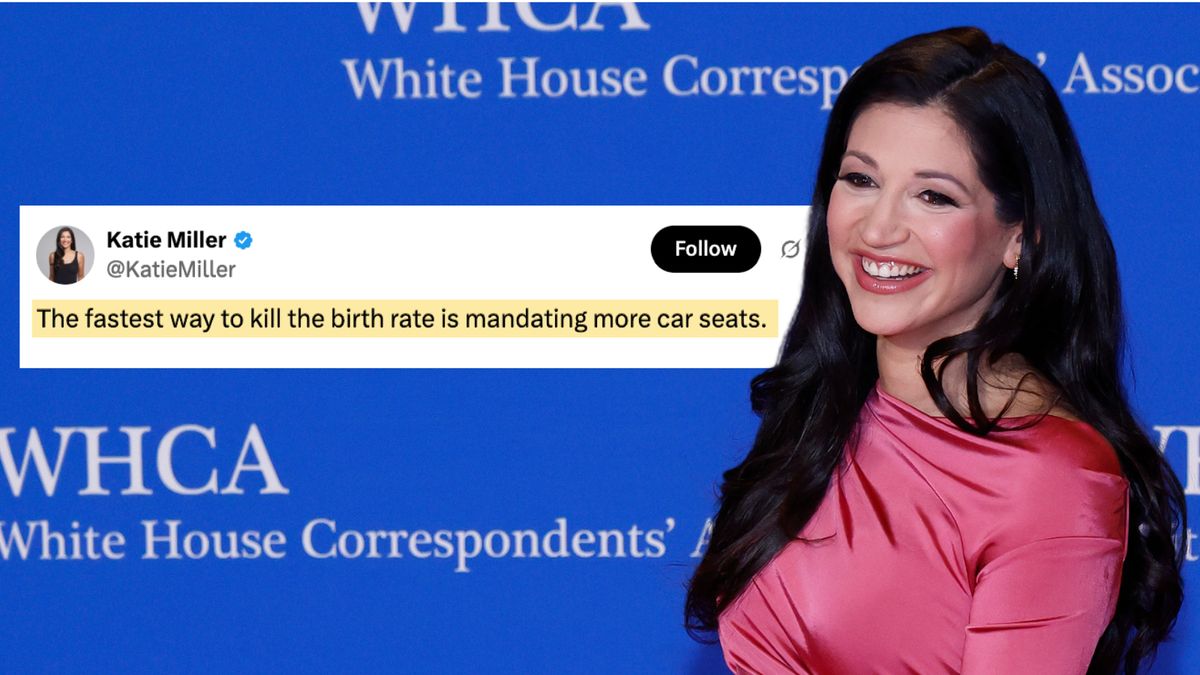
A 2024 study suggested that car seat requirements could discourage some families from having a third child. Published Nov. 27, 2026 Claim: In November, Katie Miller — the wife of Stephen Miller, the White House chief of staff — wrote on X, "The fastest way to kill the birth rate is mandating more car seats." In late November, social media users claimed conservative podcaster Katie Miller — the wife of White House Chief of Staff Stephen Miller — posted on social media that car seat mandates would "kill the birth rate." For instance, one Facebook user claimed in a video (archived), "Katie Miller, the wife of Chief of Staff Stephen Miller, wants you to know that the fastest way to kill birth rates is mandating more car seats." The video featured a purported screenshot of Miller's X post. Similar claims spread on other social media platforms, including Instagram, Facebook and X. Snopes readers also searched our website to find out whether Miller actually made the statement. In short, the post was genuine. Miller published it on her X account on Nov. 25. As such, we rated the claim as correctly attributed. While a 2024 study suggested that car seat mandates could discourage some families from having a third child, it did not establish that they were the "fastest way" to reduce birth rates. We reached out to Miller, the study's authors and several experts on birth rates and fertility for comment and will update this article if we receive responses. What Miller wrote on X On Nov. 25, Miller made a post (archived) on her X account that began, "The fastest way to kill the birth rate is mandating more car seats." In the post, Miller argued that car seats made motherhood more complicated, citing the width of vehicles, car seat anchors and difficulties traveling with the seats. She also said car seats were a factor limiting the number of children she and her husband had. The post read in full: The fastest way to kill the birth rate is mandating more car seats. Car seats make motherhood significantly more complicated and difficult, from vehicle width and anchors to traveling with them. I'm not alone in saying that a limiting factor on the number of children we have is car seats. Miller was responding to an X post about new car seat requirements in California: California Gov. Gavin Newsom signed the legislation, known as Assembly Bill 435, in October 2025. Starting Jan. 1, 2027, children ages 8 through 15 will have to use a child restraint system unless they meet five criteria for wearing a seat belt safely. These include how children sit in the vehicle and how the seat belt fits across their bodies. The law does not require all children under 16 to use booster seats. Do car seat mandates affect birth rates? There is some research suggesting that car seat requirements can influence families' decisions to have more children. A 2024 study titled "Car Seats as Contraception," published in the Journal of Law and Economics, examined the relationship between car seat laws and birth rates in the U.S. (An earlier version of the paper was made available online in 2020.) The researchers, Jordan Nickerson and David Solomon, found that women with two children who were both legally required to use car seats were 0.73 percentage points less likely to have a third child in a given year. The effect was limited to households with access to a car and a male household member present. The researchers suggested that the difficulty of fitting three car seats in the back of many vehicles could explain this finding. They estimated that car seat mandates resulted in approximately 8,000 fewer births in the U.S. in 2017 and prevented 57 children from dying in car crashes that year. The study suggested that car seat mandates could discourage some families from having a third child. However, it did not establish how significant the effect of car seat mandates was compared with other factors affecting birth rates in the U.S. It also did not state that introducing more car seat mandates was the "fastest way to kill the birth rate," as Miller claimed. Moreover, the study was published before California passed the new legislation and did not assess the potential effect the new requirements could have on birth rates in that context. Meanwhile, according to the Centers for Disease Control and Prevention, car seats reduce children's risk of injury in crashes by 71% to 82%, compared with seat belts alone. Booster seats reduce the risk of serious injury by 45% among children ages 4 through 8. For further reading, we previously investigated whether Vice President JD Vance made a similar statement about car seats. Sources Arbogast, K. B., et al. "Effectiveness of Belt Positioning Booster Seats: An Updated Assessment." Pediatrics, vol. 124, no. 5, 19 Oct. 2009, pp. 1281–1286, 10.1542/peds.2009-0908.Arbogast, Kristy B., et al. "An Evaluation of the Effectiveness of Forward Facing Child Restraint Systems." Accident Analysis & Prevention, vol. 36, no. 4, July 2004, pp. 585–589, 10.1016/s0001-4575(03)00065-4.CDC. "Preventing Child Passenger Injury." Child Passenger Safety, 28 May 2024, www.cdc.gov/child-passenger-safety/prevention/. Accessed 27 Nov. 2026.Duke, Brendan. "Didn't Realize California Passed This Until My Brother in Law Told Me Just Now. Pic.Twitter.Com/KmcQC8afrK." X, 25 Nov. 2026, x.com/Brendan_Duke/status/2125737232271306759. Accessed 27 Nov. 2026.Howard, Lisa. "Microplastics: 10 Easy Ways to Reduce Your Exposure | Cultivating Health." Cultivating-Health, UC Davis Health, 13 May 2026, health.ucdavis.edu/cultivating-health. Accessed 27 Nov. 2026.Nickerson, Jordan, and David Solomon. "Car Seats as Contraception." The Journal of Law and Economics, vol. 67, no. 3, 1 Aug. 2024, pp. 517–553, 10.1086/731812.---. "Car Seats as Contraception." The Journal of Law and Economics, vol. 67, no. 3, 1 Aug. 2024, pp. 517–553, 10.1086/731812."Publications | University of Chicago Law School." Www.Law.Uchicago.Edu, 18 June 2012, www.law.uchicago.edu/coase-sandor/publications. Accessed 27 Nov. 2026.Zaloshnja, Eduard, et al. "Effectiveness of Child Safety Seats Vs Safety Belts for Children Aged 2 to 3 Years." Archives of Pediatrics & Adolescent Medicine, vol. 161, no. 1, 1 Jan. 2007, p. 65, 10.1001/archpedi.161.1.65. By Aleksandra Śliż-Wrona Aleksandra Śliż-Wrona is a reporting fellow for Snopes, based in the Warsaw, Poland, area. Article Tags
Did Katie Miller say car seat mandates would 'kill the birth rate'?
Full Article
Original Source
Read the full article at Snopes →KhanList aggregates and links to publicly available news content. We do not host full articles from third-party sources. Always verify important information with original sources.