
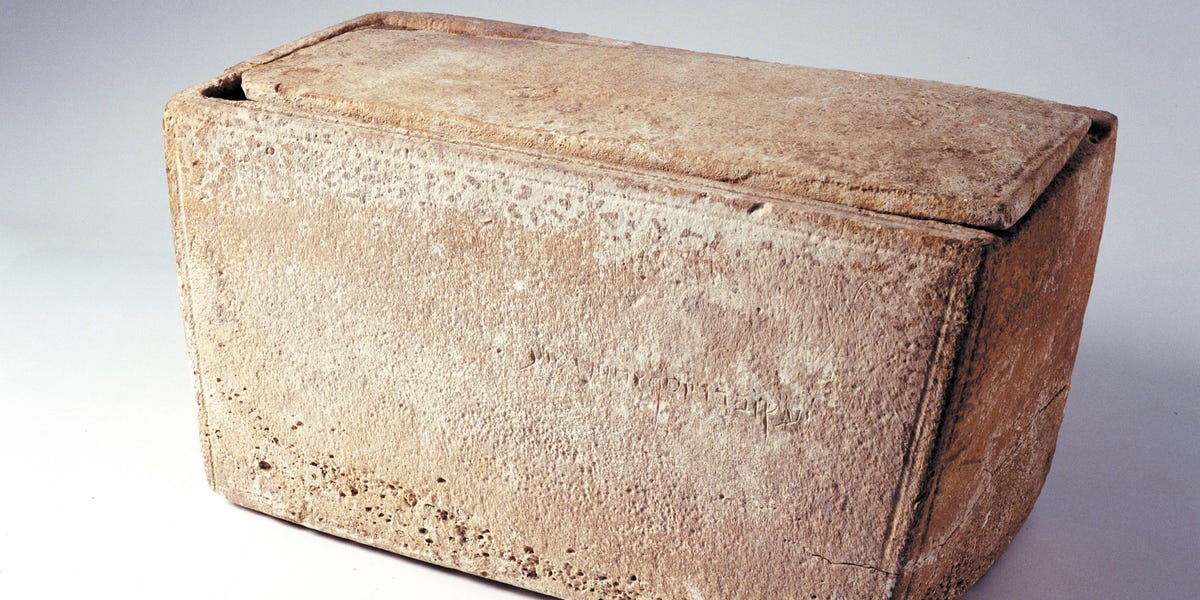
4 min readA first-century limestone box inscribed with “James, son of Joseph, brother of Jesus” emerged in 2002, reigniting a centuries-old theological debate about whether Jesus had biological siblings.Antique dealer Oded Golan faced forgery charges for the James Ossuary’s controversial inscription, but was acquitted in 2012 when prosecutors couldn’t prove he forged it.A biblical scholar plans DNA analysis on bone fragments from the ossuary, potentially providing the first physical evidence connecting to Jesus’s family and resolving a millennia-old religious question.In the Gospel of Mark, estimated to be the earliest of the four canonical Gospels by most Biblical scholars, there’s a moment commonly referred to as the “Prophet Without Honor” episode. In Mark 6, Jesus returns to his hometown with his disciples in tow, only to be greeted by a rather unimpressed crowd.“From whence hath this man these things? And what wisdom is this which is given unto him, that even such mighty works are wrought by his hands?” the people remark, “Is not this the carpenter, the son of Mary, the brother of James, and Joses, and of Juda, and Simon? And are not his sisters here with us?”Mark writes that Jesus answered, “A prophet is not without honour, but in his own country, and among his own kin, and in his own house”—and that, faced with his hometown’s doubt, he was unable to conduct any of his “mighty works” there.While Jesus’ remark about a prophet without honor has endured as an idiom, the proceeding comments from the crowd have themselves inspired an equally enduring question across the centuries: did Jesus really have siblings?The subject has been debated by everyone from the 4th-century bishop Bonosus to the 20th-century filmmaker Kevin Smith, but resolving the question remains more a matter of faith and official doctrine rather than a family record set in stone.At least, for the most part—because a slab of stone with a controversial inscription has once again reemerged as the subject of theological genealogical debate, according to a new report from the Daily Mail.The stone box at the center of the renewed discussion of the siblings of Christ is called the James Ossuary. The limestone box allegedly dates to the first century C.E., but it surfaced publicly only in 2002—first at a press conference, then at Toronto’s Royal Ontario Museum.David Silverman//Getty ImagesThe controversial inscription on the James OssuaryThe box itself is unremarkable, apart from the fact that it’s smaller than typical ossuaries from the first century C.E. Instead, what stands out is an Aramaic inscription on one side that reads “יעקוב בר יוסף אחוי דישוע”—“James, son of Joseph, brother of Jesus.” The box’s owner, antique dealer Oded Golan, argued that the inscription proved the bones it once held belonged to James the Just, first leader of the Church of Jerusalem. And if the word “brother” in the Gospel of Mark (“αδελφός” or “adelphos” in the original Greek) were taken literally, that would make James the actual sibling of Jesus. The inscription, Golan argued, proved it.Just over two years later, however, Golan would find himself on trial for forgery.H.O//Getty ImagesAntique dealer Oded Golan poses with the James OssuaryWhile the announcement of the James Ossuary attracted public attention, and scholarly interest both positive and negative, it also attracted the ire of the Israel Antiquities Authority, who doubted its authenticity and questioned the motives behind the sudden announcement.In December of 2004, the Israeli Justice Ministry brought charges of forgery against Oded Golan and several other co-conspirators, accusing them of counterfeiting a number of artifacts, including the inscription on the James Ossuary. The trial, which stretched on until 2012, called in a myriad of paleographers and other archeological scholars, including the venerated ancient scripts expert André Lemaire, who’d previously attested that “it seems very probable that this [box] is the ossuary of the James in the New Testament.” Part of the defense even hinged on a single photograph from 1976 of a room in Golan’s house where the ossuary had been displayed, to show that the inscription was not a recent addition.In the end, Golan was acquitted of the forgery charges. However, the court stressed that while the prosecution failed to prove that Golan had forged the inscription on the box, that didn’t inherently mean that the inscription itself was authentic. “This is not to say that the inscription on the ossuary is true and authentic and was written 2,000 years ago,” noted the judge, “there is nothing in these findings which necessarily proves that the items were authentic.”GALI TIBBON//Getty ImagesOded Golan leaves the court on March 14, 2012, after his acquittal on charges of forgery pertaining to artifacts including the James Ossuary.Nevertheless, fourteen years after the trial ended, Biblical scholar Dr. Jeremiah Johnston told the Daily Mail that the acquittal, and the expert testimony behind it, amount to evidence of the ossuary’s authenticity. And Johnston is going further than any expert who testified at trial by conducting his own analysis of the box. Bone fragments were reportedly found within the ossuary, and he intends to conduct DNA analysis on them in the coming year.The James Ossuary, and the questions about the siblings of Jesus that it evokes, may once again be at the center of theological and archeological debate. Could this new effort authenticate the first physical artifact to be directly connected to the family of Jesus of Nazareth? Or will the truth of this potential religious relic forever be a matter of faith?For the second time in a single century, one small limestone box has the potential to rock millennia of religious tradition.Michale Natale is a News Editor for the Hearst Enthusiast Group. As a writer and researcher, he has produced written and audio-visual content for more than fifteen years, spanning historical periods from the dawn of early man to the Golden Age of Hollywood. His stories for the Enthusiast Group have involved coordinating with organizations like the National Parks Service and the Secret Service, and travelling to notable historical sites and archaeological digs, from excavations of America’ earliest colonies to the former homes of Edgar Allan Poe.
Did Jesus Have a Brother? The Answer May Be Hiding Inside a 2,000-Year-Old Box.
Full Article
Original Source
Read the full article at Popularmechanics →KhanList aggregates and links to publicly available news content. We do not host full articles from third-party sources. Always verify important information with original sources.