
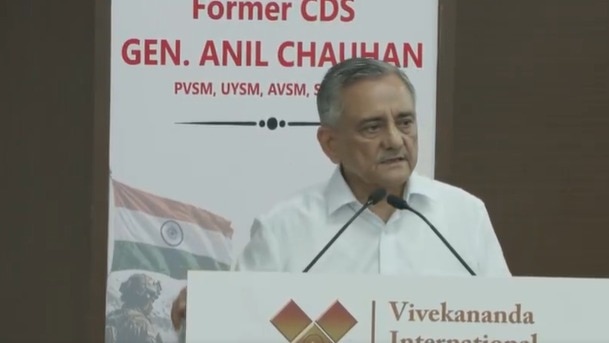
Former Chief of Defence Staff General Anil Chauhan has addressed speculation over whether India struck Kirana Hills near Pakistan's Sargodha during Operation Sindoor, saying a loitering munition searching for radars may have come down and hit one of the hills after failing to find a target.Kirana Hills, located around 10 kilometres north of Sargodha, has long been associated with Pakistan's nuclear infrastructure. Questions over whether India had targeted the area emerged after Pakistani media showed images of smoke rising from the hills during the military confrontation.Chauhan said India had sent loitering munitions towards Sargodha to search for Pakistani radars before the strikes."Before those strikes, we had sent in a lot of loitering missions at Sargodha and Kirana Hills is about 10 kilometres north of Sargodha. So the loitering mission is looking for radars which are in and around Sargodha," Chauhan said at an event organised by the Vivekananda International Foundation. He explained that such a munition could remain airborne for around two hours while searching for a target. If it failed to find one, it would eventually come down."It must have come and hit one of those hills. So that could be one of the reasons as to what people asked, because Pakistani media also showed some kind of images in which there was smoke coming out from Kirana Hills," he said. Chauhan's remarks indicate that any impact at Kirana Hills was not part of a deliberate strike on the area or its nuclear facilities.LOWER AIRSPACE WAS PART OF INDIA'S STRATEGYThe use of loitering munitions around Sargodha was part of India's broader decision to exploit the lower airspace during Operation Sindoor.Chauhan described this as a "third option", distinct from the land-based response after the Uri terror attack and the large air package used following Pulwama."During Operation Sindoor, we decided to use a third option, that is, to exploit the lower airspace. That means it would have kept the threshold of conflict low. It would have assured success and then there would have been an element of surprise," he said.The lower air envelope can be used by drones, loitering munitions, attack helicopters and other low-level platforms.SARGODHA STRIKE CLEARED EVEN AFTER PAK SOUGHT TALKSChauhan also revealed that India cleared further strikes on Pakistani military targets even after Islamabad reached out for talks, with Sargodha among them.He said Pakistan contacted India seeking talks when the Air Chief asked him whether the Indian Air Force should strike Sargodha."Once the Pakistanis had picked up the phone and said they wanted to talk at about 10 AM, the Air Chief asked me whether he should strike Sargodha. I said, 'Go ahead'," Chauhan said.He then asked the Air Chief to identify two more targets."I said, could you please identify two more targets, so one of the targets he identified was Skardu. We gave a yes, but after some time, the weather was bad over it and they had to change over to Bholari," he said.Chauhan said one of the principles in India's escalation matrix was that Pakistan would not be allowed to deliver the final strike."One of the couple of principles which we thought in the escalation matrix which we laid for ourselves was that the last strike or the winning note will always be delivered by us and not by the Pakistanis," he said.The remarks shed light on India's escalation strategy during Operation Sindoor, including its decision to retain the option of further strikes even after Pakistan sought talks.PAKISTAN 'BLIND' ABOUT RESULTS OF ITS STRIKESChauhan also said Pakistan did not know whether its strikes had hit their intended targets and tried to obtain commercial satellite imagery until around May 12 to find evidence of damage."They were actually after 10th also till about 12th they were trying their best to obtain images so that they have some evidence," he said.Chauhan said commercial satellite imagery was available from both US and Chinese companies. Pakistan, he said, also tried other Chinese satellite sources but failed to find evidence that its strikes had hit targets."But since they are not able to hit any target, they got no evidence," he said.WHY INDIA HAD THE EDGEChauhan attributed India's success during Operation Sindoor to better situational awareness, battlefield transparency and networking between the Army, Navy and Air Force."If I had to list out a couple of reasons for India's victory, I would say that we had better situational awareness, better battlefield transparency because we are better networked," he said.He said all three services had access to a common operational picture, allowing them to make better decisions."Army, Navy and Air Force, this situation was available to us in one manner for all of us. So, we were able to make better decisions," Chauhan said.He also credited clear political direction for giving the armed forces freedom to plan the operation."The second thing I could attribute to victory was, I think, clear political direction, which gave us a free hand to plan operations," he said.THREE SERVICES WORKED AS ONEChauhan said the Army, Navy and Air Force did not take their individual capability deficiencies before the political leadership during the operation."We have seen in the past, sometimes in front of political leadership, people bring out the kind of deficiencies that they have. This particular operation stands out in some particular manner in which all three services and I, right from day one, did not bring any of these kinds of deficiencies," he said.Instead, he indicated, the three services worked on a unified plan and dealt with operational gaps within the military structure.REVISITING OPERATION SINDOORIndia launched Operation Sindoor on May 7, 2025, following the April 22 Pahalgam terror attack that killed 26 people.In the initial phase, the armed forces struck nine sites linked to terrorist groups in Pakistan and Pakistan-occupied Jammu and Kashmir.The strikes used precision and standoff weapons, allowing Indian aircraft to engage targets without flying deep into Pakistani airspace.The operation later expanded after Pakistan launched military actions against India, prompting the Indian Air Force to strike Pakistani military infrastructure, including airbases and radar facilities.- EndsPublished By: Aprameya RaoPublished On: Aug 25, 2026 20:51 IST
Did India strike Kirana Hills? Ex-CDS explains what happened during Op Sindoor
Full Article
Original Source
Read the full article at Indiatoday →KhanList aggregates and links to publicly available news content. We do not host full articles from third-party sources. Always verify important information with original sources.