
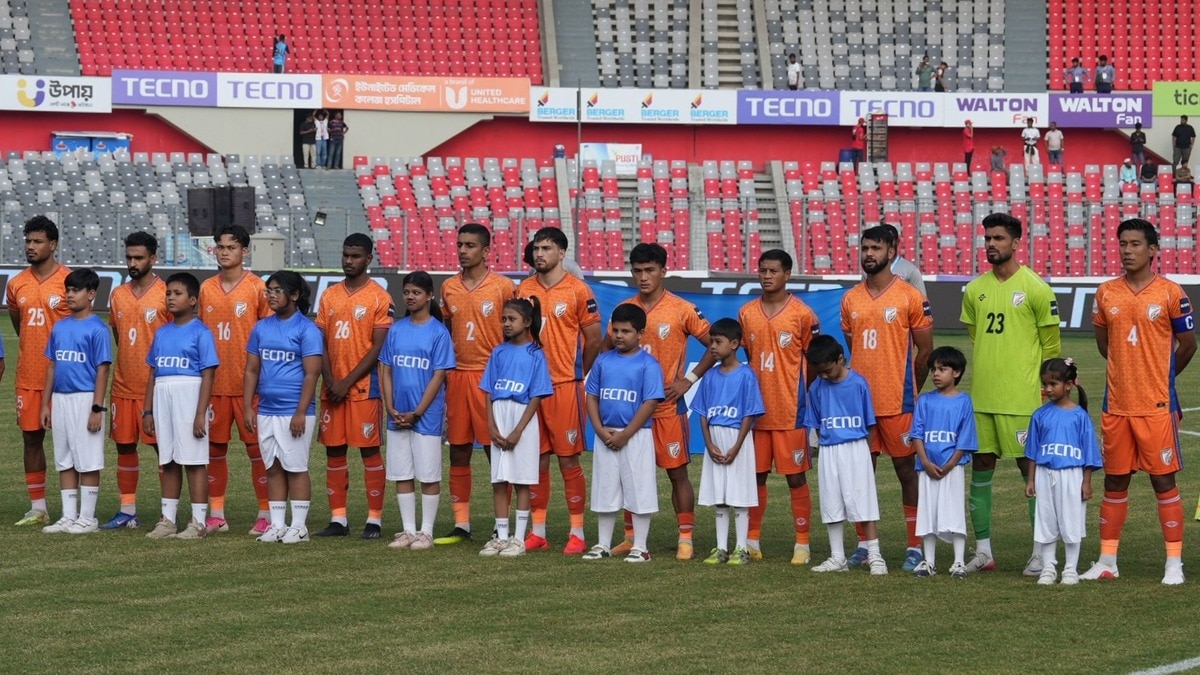
"Why do we fall? So that we can learn to pick ourselves up."Thomas Wayne's words in Batman Begins might be worth remembering for Indian football.The Blue Tigers have fallen repeatedly over their last five international outings, taking on Brazil, Uruguay, Panama and New Zealand. Nobody expected them to walk away with victories against these opponents. But there was an expectation that they would pick up a few lessons along the way. Instead, the same questions continue to follow Khalid Jamil's side.Five friendlies, four defeats, one draw and 19 goals conceded. India got the opportunity to rub shoulders with some of the best in international football, but what did they actually take away from those encounters? If you keep facing stronger opponents without showing that you can adapt, improve or even change the script, what exactly is the point? The bigger question, however, is whether India should have sacrificed competitive tournament football in the first place to make room for these glamorous fixtures. The AIFF chose Brazil over the FIFA ASEAN Cup, then struggled to manage the senior team's New Zealand commitments alongside the SAFF Championship.And after all that juggling, the promised lessons from playing the big boys are still difficult to spot.THE BRAZIL NIGHT CAME AT A COST Let's rewind a little.When Brazil's visit to Kolkata was announced, Indian football had every reason to celebrate. Watching Vinicius Junior and company take on the Blue Tigers at Salt Lake Stadium was a once-in-a-generation occasion for many fans. The AIFF, too, was understandably keen to make it happen.But as all good things come with a price, so did this.India had already been invited to participate in the inaugural FIFA ASEAN Cup, where they were set to face Indonesia, Malaysia and Singapore. The competition offered three guaranteed competitive fixtures against teams India could realistically expect to encounter in future Asian competitions and qualification campaigns.The Brazil friendly, scheduled for October 3, clashed with the ASEAN Cup final on October 4. The AIFF initially explored the possibility of sending separate squads, but eventually withdrew from the tournament after FIFA's participation requirements made that option unfeasible.AIFF general secretary M Satyanarayan was rather candid when he argued that India regularly faced ASEAN opposition and could play those teams again, whereas the opportunity to host Brazil might not come around again.Brazil were Brazil, after all. But former India captain Bhaichung Bhutia had a different view. He argued that three or four competitive matches would have been more beneficial for the team's development than a one-off glamour friendly.But can we ignore the obvious?The ASEAN Cup was not Brazil. It did not have the same star power or commercial appeal. But it offered something India desperately needed, competitive minutes against teams closer to their level, where they could build combinations, experiment and, importantly, compete for results.The AIFF chose the spectacle and promised to make up for the lost tournament exposure through more high-profile friendlies.The question now is whether that trade-off was worth it.SAME SCRIPT, DIFFERENT OPPONENTSIndia's September-October international window began with a 1-1 draw against Panama in Bengaluru. There were encouraging passages of play, and the Blue Tigers showed that they could threaten a higher-ranked opponent.Then came Brazil.For the opening 25 minutes at Salt Lake Stadium, India actually made the visitors work. The defensive line pushed high, the players looked willing to take responsibility on the ball and Brazil were repeatedly caught by India's offside trap. Sahal Abdul Samad looked comfortable receiving the ball under pressure, while Ryan Williams provided an outlet on the flank.It was not domination, nor was it ever likely to be. But India were making Brazil uncomfortable, and there was enough evidence to believe that this could become a proper contest.Then Brazil changed the angle of the game.Estevao became increasingly influential, Brazil found ways around India's defensive structure, and the opening goal arrived in the 28th minute. Once the initial resistance was broken, the gap between the two sides became increasingly apparent.India eventually lost 4-0. Individual errors, including a difficult evening for Gurpreet Singh Sandhu, made matters worse. Jamil admitted after the game that lapses in concentration and individual mistakes had cost his side dearly. He also stressed that India needed to play more matches of this quality to gain experience.Fair enough. But the Uruguay game three days later suggested that the lessons had not travelled very far.India lost 6-1, with Anirudh Thapa scoring a historic but inconsequential goal. Uruguay regained control and India struggled to keep up.There was a pattern emerging. India could compete for short bursts, but sustaining that intensity against stronger opponents was proving a different challenge altogether.Against both Brazil and Uruguay, the Blue Tigers looked increasingly out of gas beyond the opening 30 minutes. The players struggled to maintain their shape, the distances between them grew and the opposition found it easier to dictate proceedings.Interestingly, there were brief signs of life after Jamil made several substitutions deep into the second half of both matches. Fresh legs brought back some of the energy and urgency that India had shown at the start. But those bursts were short-lived, and by then, the damage had largely been done.Was it a fitness issue? Was India struggling to maintain the intensity of its approach? These were questions that needed answering before the next international assignment.Instead, the New Zealand tour brought more of the same.FIVE GAMES, SAME OLD QUESTIONSThe two matches against New Zealand were supposed to be an opportunity to apply whatever India had learnt from the September-October window. Instead, the Blue Tigers were beaten 5-0 in Auckland and 3-0 in Christchurch.The first defeat was particularly disappointing. India struggled to keep possession, were repeatedly exposed by New Zealand's movement and conceded five goals. The hosts did not need to do anything extraordinary to find openings.After the 5-0 defeat, one would have expected a more convincing response. Jamil did make five changes for the second match in Christchurch and altered the team's shape, but India still conceded three times before half-time.The hosts were in control for much of the game, and India struggled to create anything meaningful at the other end. The second half was better in terms of the scoreline, but it was hardly the sort of response that suggested the team had turned a corner.This is not about expecting Jamil to find a magic formula in a matter of weeks. Nor is it about questioning every selection or substitution after a defeat. But when the same weaknesses keep appearing across five matches, the coaching staff must offer more than another reminder that the opposition was stronger.India needed to show some learning. Instead, the team kept looking like it was encountering the same problems for the first time.AND WHAT ABOUT THE SAFF CHAMPIONSHIP?This is a boiling question that we all come down to.The SAFF Championship was initially scheduled for September 21 to October 6, but was pushed back to November 4-17 after India's interest in participating in the inaugural FIFA ASEAN Cup prompted a change in the regional tournament's calendar.India eventually withdrew from the ASEAN Cup to prioritise the Brazil friendly. Then, with the New Zealand tour scheduled for November 12 and 15, the senior team's commitments once again clashed with the knockout stages of the SAFF Championship.For a while, there was genuine uncertainty over whether India would participate in the regional tournament at all. Reports suggested that the defending champions could withdraw because of difficulties in assembling a squad. SAFF eventually dismissed the speculation, clarifying that it had received no official communication from the AIFF regarding India's withdrawal.India eventually sent a predominantly Under-23 side under Naushad Moosa, while Jamil's senior team travelled to New Zealand.The tournament began outside the FIFA international window, meaning clubs were not obliged to release their players for the opening fixtures. The squad was subsequently reshuffled, with Bijoy Varghese, Muhammad Suhail and Liston Colaco called up to the senior side for the New Zealand tour.Farukh Choudhary, Noufal PN and Hmingthanmawia Ralte were also released to return to Mumbai City FC, while injuries further reduced Moosa's options.The Under-23 side, meanwhile, kept going. India beat Pakistan 3-2 in the group stage and defeated Bhutan 2-1 in the semi-final to reach the final.According to a report by Khel Now, Moosa will have only 17 outfield players available for the final against Pakistan, with no further reinforcements planned.Pakistan, on the other hand, strengthened their squad with the arrival of diaspora players ahead of the semi-final, where they defeated hosts Bangladesh 1-0.The depleted squad is not the main story here, but it is a telling example of what happens when competing commitments are not managed properly. Moosa's young side has had to navigate a tournament with a changing group of players, while the senior team has returned from New Zealand without a win.And for what?WHAT WAS THE POINT OF FIVE FRIENDLIES?There is absolutely nothing wrong with seeking stronger opposition. Indian football needs more such opportunities. Playing against teams with greater technical ability, physical strength and international experience can expose weaknesses that are not always visible against regional opponents.But exposure alone does not guarantee development.The ASEAN Cup offered India competitive matches against teams closer to their level. The SAFF Championship offered an opportunity to defend a title and give younger players meaningful tournament experience. Both competitions had their own value, and neither should have been treated as expendable simply because a more glamorous fixture came along.The argument is not that India should stop playing Brazil, Uruguay or New Zealand. Quite the opposite. The Blue Tigers should be playing more teams of that quality. But those matches need to fit into a larger development plan, not become a replacement for competitive football.And the coaching staff must be able to show what they have learnt from them.There have been some changes in approach, but not enough evidence that the team is becoming better equipped to handle the challenges these fixtures were meant to expose.The AIFF also needs to think beyond the attraction of a big-name opponent. A Brazil friendly can fill a stadium and generate enormous excitement, but three competitive matches against Indonesia, Malaysia and Singapore could have offered something that one glamour fixture simply cannot replicate.There is no guarantee that India would have won the ASEAN Cup or defended the SAFF title with a senior squad. But at least those competitions would have given the team a chance to build rhythm, test combinations and compete for something tangible.India got the fixtures they wanted. They got the exposure they were promised. What remains unclear is whether they got any better.Because there is little point in sitting at the big boys' table if you keep leaving without learning how to play the game.- Ends
Did India learn anything from five high-profile friendlies?
Full Article
Original Source
Read the full article at Indiatoday →KhanList aggregates and links to publicly available news content. We do not host full articles from third-party sources. Always verify important information with original sources.