
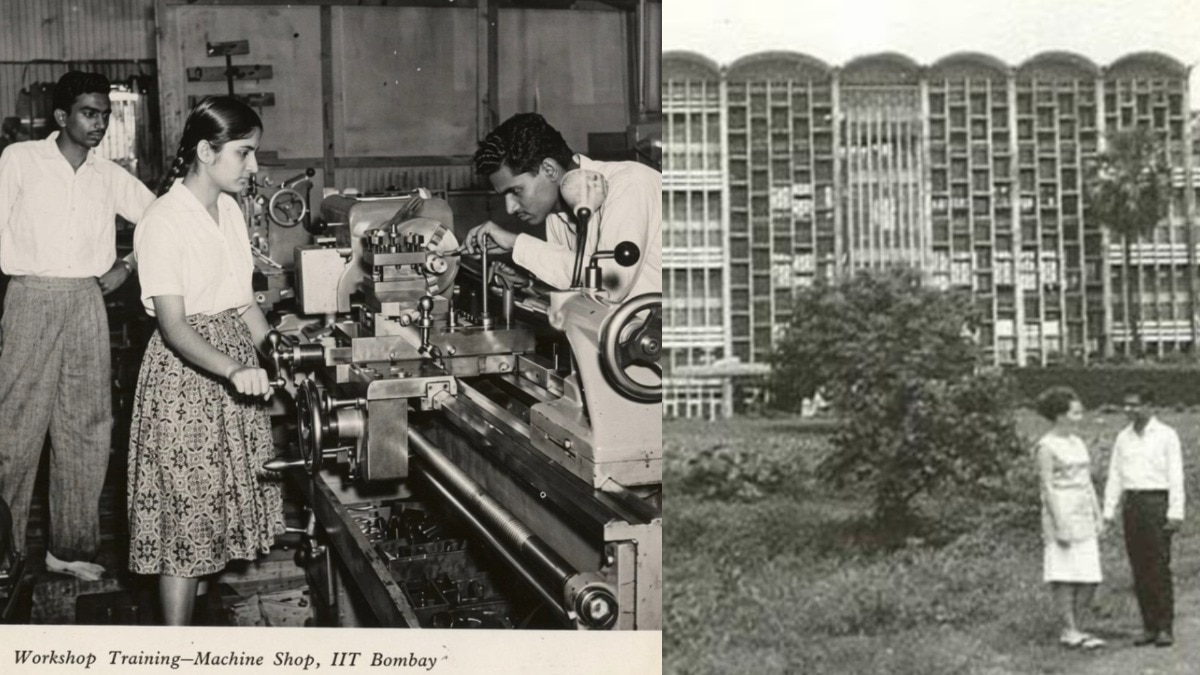
An X post claimed IIT Bombay students in the 1960s had to learn the Russian language. Soviet influence on the institute at the time was significant, from equipment and faculty training to its early development. But was Russian really compulsory? And did students have to pass it?Image Courtsey: IIT BombayIt was the 1960s. India had begun building the institutions that would define its scientific and technological ambitions. IIT Kharagpur had already been inaugurated in the old Hijli Detention Camp in West Bengal, IIT Bombay followed as the second IIT (starting at the Worli campus) with substantial Soviet assistance, and IIT Madras came next with West German support. India was extending its feet on the ground of science and technology, looking beyond its colonial past and building relationships with competing powers of the Cold War.At a time when India's literacy rate was still around 20 per cent, young Indians were entering the IITs. But at IIT Bombay, something unusual appears to have happened. Alongside engineering and the machinery that was beginning to fill its laboratories, Russian may have found a place in the curriculum.A recent post on X resurfaced explaining this rarity. An IITian, Akash Sampurnanand Pandey wrote that, "In the 1960s, getting an engineering degree from IIT Bombay required passing one mandatory subject: Russian." The claim immediately stood out.Studying a foreign language at an engineering institute was unusual enough to invite a closer look. India Today Digital tried to independently verify the claim. The evidence available so far, however, does not conclusively establish that Russian was a compulsory subject for every IIT Bombay student, or that passing Russian was formally a requirement for an engineering degree. However, what the available documents and accounts do establish is something almost as surprising – Soviet technology was deeply woven into the early life of IIT Bombay.The institute was built with Soviet assistance. Teams visited India, equipment came from the USSR and its laboratories were expected to operate machinery whose manuals, technical specifications and working culture were new to the young institute. In that space, learning Russian would not have been entirely disconnected from the technological project taking shape on the campus. Russian machinery in IIT Bombay lab. (Image: IIT Bombay) BUT WHY RUSSIAN?A history of IITs published by the Institute for International Education records how foreign assistance shaped the early institutions. At IIT Bombay, Soviet support came not merely in the form of money but through equipment and machinery. More than Rs 2 crore worth of external expenditure had accumulated under the UNESCO project, while the USSR also provided additional assistance. The scale of the intervention was considerable for a young institution.Yet the Soviet machines presented a problem of their own.An account published in 'Raintree', IIT Bombay's magazine, decades later, gives us a glimpse into what had transpired back then. Former director PK De, in the same magazine, recalls how the institute was "stocked with an extensive arsenal of Soviet equipment." Much of it, he writes, was sophisticated in its own way but difficult to maintain. Spare parts were hard to obtain, equipment arrived without adequate support and some machines were simply unsuitable for the kind of teaching and research IIT Bombay was trying to develop."The Institute’s faculty suffered a lot on this account compared with their counterparts in the other IITs," De's frustration is evident from the way he reminisces the 'Russian' influence on the campus back then.The problem went beyond machinery. Soviet equipment came with its own technical ecosystem. Faculty and students had to understand machines designed elsewhere, often according to standards and practices different from those familiar in India or the West.This is where the Russian-language claim becomes intriguing, but also difficult to prove.EVERYONE HAD TO LEARN RUSSIANThere is no concrete evidence available that establishes Russian as a mandatory subject at IIT Bombay in the 1960s. No conversation with IIT Bombay officials, faculty or alumni has so far been conducted to settle this claim. The available material instead provides the larger context in which such a curriculum decision, if it existed, would have made sense."We recall also that roubles were inconvertible in the 1950s and 60s, obliging IIT-Bombay’s laboratories to be populated with Soviet equipment alone," writes Rohit Manchandana in Monastery, Sanctuary, Laboratory - 50 years of IIT Bombay.The Soviets were attempting to deepen their influence in newly independent India, just as the United States and Western Europe were building their own scientific relationships with the country. IIT Bombay became one of the places where that competition played out — not only through diplomacy, but through laboratories, machines, professors and students.The story of Russian at IIT Bombay, therefore, may be less about a language class and more about a young institute learning to operate in a world where technology itself had a geopolitical language. The evidence does not yet prove that every IIT Bombay engineer had to pass Russian. But it does show that, in the institute's formative years, Soviet technology was impossible to ignore.- EndsPublished By: Rishab ChauhanPublished On: Sep 2, 2026 12:55 IST
Did IIT Bombay students have to pass Russian in the 1960s?
Full Article
Original Source
Read the full article at Indiatoday →KhanList aggregates and links to publicly available news content. We do not host full articles from third-party sources. Always verify important information with original sources.