
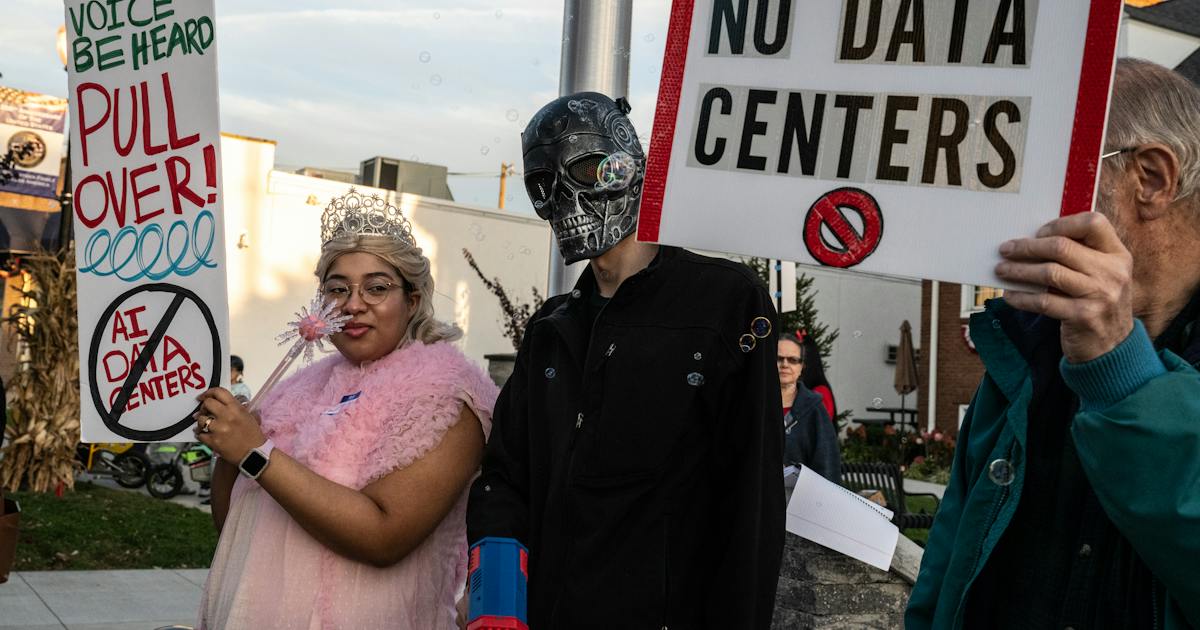
Democrats expected these midterms would be good for them. What they got was nothing short of a blowout. So far, the party has secured 54 Senate seats and 259 in the House, sailing to its biggest congressional landslide in half a century. If Democrats’ lead holds in states that are still counting ballots, 75 percent of the country will live in a state with a Democratic governor. More than half will live in states where Democrats control both the governor’s mansion and the legislature. The flashiest contest this cycle certainly wasn’t the race for New Jersey’s 2nd congressional district, spanning most of the southern part of the state. And yet it has a few features that showcase the strength of a blue tsunami that stretched well beyond national headlines. For years, the district was represented nationally by a relatively moderate Republican. Then, in 2018, it flipped to Democrat Jeff Van Drew. The next year, Van Drew became a Republican and pledged his “undying support” to President Trump. The change seemed to track with the district’s rightward-shifting politics. Van Drew was reelected by a 17-point margin in 2024, when New Jersey’s 2nd congressional district swung for Trump by 15 points. With that history, he seemed poised to sail to a comfy reelection this year. Last month, nevertheless, the House Democrats’ campaign arm, the DCCC, added the race to its “districts in play” list and poured in $1.5 million. Van Drew was still expected to easily best his Democratic challenger, Cape May Mayor Zack Mullock. Instead, he lost by three points.How did the upset happen, and did it have anything to do with the much-maligned data center being built in the heart of the district? Behind thick walls, the concrete firm Northeast Precast and DataOne Vineland—the local subsidiary of a European company—is erecting an AI data center for Nebius, a so-called “neocloud” provider responsible for designing the facility, sourcing the chips, and stewarding its racks and servers. Per the terms of a deal worth up to $19 billion, the end buyer of DataOne Vineland’s computing power will be Microsoft. As I wrote this summer, the project has attracted intense opposition from Cumberland County residents, who have turned up by the hundreds to newly rowdy City Council and planning meetings.“I think everyone was kind of shocked,” said Matt Williams, a co-founder of SustainSJ, which has spearheaded local organizing against DataOne Vineland. In addition to Mullock’s surprise win against Van Drew, Democrats swept the sheriff’s and county commissioners’ race in Cumberland County, where the data center is located. “People just drew a hard line,” he said, and wanted change “regardless of political affiliation.” In the lead-up to Election Day, Williams said, he saw “Republicans for Mullock” signs dotting yards.He’s hopeful that the blue wave will create a friendlier environment for the group’s ongoing fight against the data center. In August, an investigation by Floodlight News and The Guardian found that DataOne Vineland had been operating dozens of gas generators without permits from the state’s environmental regulator. New Jersey’s Department of Environmental Protection then issued a $1.1 million fine and demanded the facility apply for the necessary permits or cease operations by November 6. The project’s developers are contesting the fine, arguing that they don’t need permits. They’ve reportedly continued operating generators as they install gas fuel cells. In recent days, residents have reported that noise emanating from the site is louder than ever.It’s not hard to connect Van Drew’s loss to residents’ unhappiness with the data center. One of the data center’s developers had called Van Drew’s support for the project “critical” to its being able to get off the ground. Its investors donated to his campaign. And while Van Drew eventually walked back his public support for the project, Mullock dinged him on the campaign trail over it. “My opponent has sold out South Jersey to data centers, to the war in Iran, to doubling our health insurance prices, all for a pathetic undying support to Donald Trump,” Mullock said in the opening statement of his debate with Van Drew last month.Nationwide, data centers and broader debates around AI were a hot issue this cycle. All but one of the at least 41 local ballot questions to ban data centers and take away their tax breaks passed by healthy margins this election. In case the scale of voters’ repudiation didn’t land the first time: No fewer than 40 of 41 data center restrictions passed. Insurer Allianz now predicts that 47 gigawatts’ worth of planned data center projects are at risk from Democratic governors who’ve backed full or conditional moratoria. In Downe Township, which is also in Cumberland County, 87 percent of voters responded “no” to a nonbinding ballot question asking if they “support data centers” being built there. More than 100 New Jersey municipalities have already banned them.Democrats looked to tap into that ire at the ballot box. The DCCC pushed for ads targeting Republicans’ records on data centers and AI in nearly half of the races it targeted. NJ-2 was not among them. Mullock certainly hasn’t been shy about where he stands on DataOne Vineland. “I feel really strongly that Vineland got duped and these people got left behind, and you have a company that’s clearly polluting the area and has been fined,” he told me. Yet while Mullock reasons that stance certainly helped win support in Cumberland County—where his vote share was strongest—he isn’t sure how much of a factor it was in his victory overall.Mullock said the top question he got over the course of the campaign was, “Will you be a decent human being?” Affordability concerns, he believed, were a distant second. Many voters also complained about the Iran war. To the extent that data center fights contributed to his win, Mullock suspects it was thanks to the many issues wrapped up in them, including voters’ concerns about money in politics, corruption, how to regulate artificial intelligence, and the money and power concentrated in Big Tech. “It even gets to the president—his statements on not regulating AI, and the people he chooses to have sitting behind him at his inauguration,” Mullock told me, referencing the coterie of Silicon Valley billionaires who attended the event in 2024. “That says something. Clearly there was a rebuke.”If these elections were a rebuke of Trump, they were also a referendum on the company he keeps. Just a few years ago, Silicon Valley executives cast themselves as do-gooder liberals who opposed Trump and cared about things like climate change. Just two years into those billionaires’ love affair with MAGA, polling has found that most voters think of tech CEOs as Republicans and of tech companies as the biggest corporate spenders on GOP campaigns. The party didn’t seem to benefit much politically from its associations with Silicon Valley this cycle. Exit polling shows voters trust Democrats more to handle the economy, foreign policy, health care, government corruption, and policies about transgender people. Data centers and AI weren’t top issues for voters on Tuesday, but 57 percent said those technologies will do more to hurt society than help. Seventy-six percent said they opposed building data centers in their communities. Despite the nearly $500 million Elon Musk poured into the midterms on behalf of Republicans, the party suffered some of its biggest losses in living memory.Hyperscalers now have to reckon with the reputational consequences of having jumped into bed with Trump. Facing prospective material consequences, companies like OpenAI are scrambling to align their messaging with the new political reality. A post-midterms missive from OpenAI chief global affairs officer Chris Lehane name-drops Franklin Delano Roosevelt and urges aspiring Democratic presidential candidates to embrace “an affirmative, big idea that puts people back in control—not by shielding them from AI but by helping them use it to reclaim agency over their lives.” Democrats may not be so easily convinced that OpenAI—whose president poured millions into MAGA Inc. and GOP candidates this cycle—has their best interest at heart.As this week’s results show, Democrats may not need tech oligarchs on their side to win big. Centrists, by contrast, have been arguing that their party spent the Biden era being too tough on Big Tech—that overzealous antitrust enforcement, “faculty lounge populism,” and personal snubs had mistakenly alienated Democrats from corporate allies that had helped them win since the 1980s. A group funded by OpenAI—along with Amazon, a16z, and Flock Safety—has made the case that Democrats need to get back in Silicon Valley’s good graces. The Chamber of Progress’s Blue Horizon Project argued earlier this year that if the Democratic Party hopes to “rebuild our coalition and reclaim our legacy as the party of innovation,” it will have to “reset” its relationship with the technology sector.After an election where Democrats secured historic margins while tearing into Big Tech, the Chamber of Progress has somewhat frantically contended that the election actually had very little to do with that. Like climate change, the group’s executive director, Adam Kovacevich, points out, data centers and AI in this election were what pollsters call a “low salience” issue, i.e., far down on their list of priorities. Data centers, though—which are broadly unpopular—do seem to be an uncomfortably loud and hyperlocal manifestation of lots of things voters care quite a lot about, including income and wealth distribution. The fact that tech industry spending has become so singularly focused on a uniquely resource-intensive model of machine learning development, moreover, has also given its executive a very different set of material interests than they had even during the Obama administration. In their endless hunt for land and electrons, hyperscalers like OpenAI have become fossil fuel–guzzling real estate developers demanding tax breaks and preferential regulatory treatment. It makes sense that their billionaire executives have embraced Republicans too. Mullock, whose race received backing from the centrist Blue Dog PAC, strongly supports his new colleagues’ calls to subpoena Big Tech CEOs and data center developers. “When you have a president who’s saying that there are no guardrails—that they should come up with the guardrails themselves—that should be disturbing,” he said. And when it comes to AI, Mullock added, “we don’t have a full understanding of what could or could not happen. To me it’s common sense that our elected officials need to have a very clear understanding of where we stand.”The question after this year’s midterms isn’t whether Democrats need to say nice things about Silicon Valley CEOs in order to win big majorities; clearly they don’t. The party will, however, have to figure out how to deliver for voters who see those executives’ data centers as big, ugly symbols of an economy that makes billionaires richer and their lives more expensive. Here’s hoping it can.
Did Data Centers Make the Difference for Democrats?
Full Article
Original Source
Read the full article at Newrepublic →KhanList aggregates and links to publicly available news content. We do not host full articles from third-party sources. Always verify important information with original sources.