
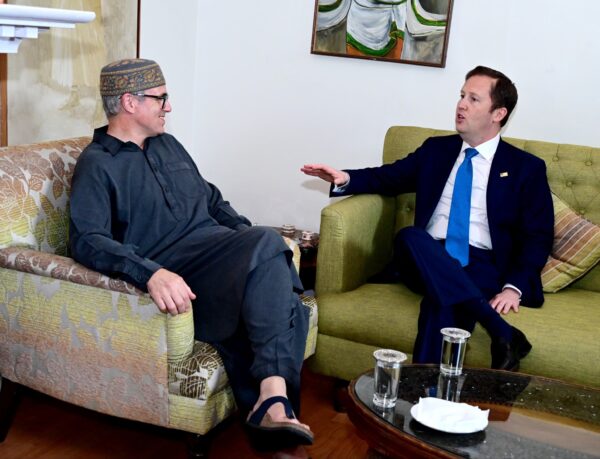
U.S. Ambassador to India Sergio Gor’s description of Jammu and Kashmir as an “important part of India” has triggered discussion in New Delhi over whether this is an endorsement of the Indian position on the India-Pakistan dispute over the former princely state of Jammu and Kashmir (J&K). “This is the first time that a U.S. ambassador has made a statement like this, which accepts the reality” on the ground, Amitabh Mattoo, professor at the Jawaharlal Nehru University in New Delhi, told The Diplomat. “No American Ambassador goes to Kashmir without a brief. I think this statement indicates a shift in the U.S. position,” he added. The Indian government, however, is being cautious. Its reaction to Gor’s statements was rather guarded. India’s Ministry of External Affairs spokesman Randhir Jaiswal neither welcomed nor dismissed Gor’s comments but reiterated India’s oft-stated position that “Jammu and Kashmir and Ladakh, which are Union Territories, have been, are, and will continue to be integral and inalienable parts of India.” Gor’s visit to Kashmir on August 19 was the first standalone visit by a U.S. ambassador since India revoked J&K’s special status in August 2019 and designated Jammu and Kashmir and Ladakh as regions administered directly by New Delhi, Gor met J&K Chief Minister Omar Abdullah and other local leaders. “It’s a pleasure to be here. As everybody knows, I am the U.S. ambassador to India and this is an important part of India,” Gor told reporters later. He said his meeting with Abdullah had been a good one and that he looked forward to “building this relationship forward.” “New Delhi, the chief minister here and the government here, we believe, have made some incredible steps to keep this area safer and make it more secure,” he said, adding that the U.S. was examining the possibility of downgrading a travel advisory warning against travel to Jammu and Kashmir, given improvements in the security environment in the Kashmir valley. The comment triggered strong protest from Pakistan, which claims the region as part of its territory. Islamabad, which has significantly reworked ties with the U.S. in the past year, summoned U.S. Charge d’Affaires Natalie Baker to lodge a protest against Gor’s remarks. The U.S. does not currently have an ambassador to Pakistan. Describing Gor’s remarks as “irresponsible,” Pakistan’s foreign office “strongly condemned and categorically rejected the characterisation of Indian-administered Kashmir as a ‘part of India,’” it said in a statement posted on X, adding that it “negated the long-standing and well-documented position of the United States on the Jammu & Kashmir dispute, and also ran contrary to the United States’ commitment to supremacy of international law and the UN Charter,” Recalling U.S. President Donald Trump’s offer to mediate between India and Pakistan, Pakistan urged the U.S. to ensure its public statements take into account the “disputed status” of the region. Vivek Katju, a former diplomat in charge of the Pakistan desk in the Indian foreign ministry in the 1990s, noted in an opinion piece that Pakistan reacted strongly to Gor’s comment because of its hypersensitivity over recent protests in Pakistan-administered Kashmir. The protests, which began last year over rising wheat and electricity prices, escalated in recent months to include demands for electoral and constitutional reforms. Pakistan’s use of force to put down the protests sparked outrage abroad. Gor’s comment on the U.S. revisiting its Kashmir travel advisory also angered Pakistan as it punctures its argument that Indian-administered Kashmir is a restive region with its people clamoring for independence from India. So why has India’s MEA chosen to respond cautiously to Gor’s statement? Its guarded response probably stems from the fact that it is still unclear whether Gor’s statement reflects the U.S. State Department’s position. Besides, Trump could follow up by making a contrary statement, perhaps one offering to mediate between India and Pakistan, something he did during his first term. Since the May 2025 India-Pakistan military clashes, Trump has repeatedly claimed that it was his intervention that stopped war. That has ruffled Delhi’s feathers as India is opposed to third party intervention in the Kashmir issue. With U.S.-Pakistan relations having warmed considerably over the past year, Delhi is unsure of how Trump will follow up on Gor’s statement. India and Pakistan have fought several wars over J&K. Both countries administer Kashmir in parts. India accuses Pakistan of fomenting terrorism in the part of Kashmir it administers in a bid to wrest control of the region. It’s a charge Pakistan denies. During the Cold War, the U.S. position on Kashmir favored Pakistan as the latter was a military ally. India, in contrast, pursued a policy of non-alignment, which irked the U.S. India-U.S. relations worsened with New Delhi growing closer to Moscow in the 1970s. A statement by Robin Raphel, then U.S. Assistant Secretary of State for South and Central Asian Affairs, in 1993 questioning Kashmir’s accession to India, angered Delhi. A perceptible change in U.S. policy on Kashmir came during the 1999 Kargil conflict, when the U.S. described the Kashmir dispute as a bilateral issue and declined to intervene. This was an endorsement of the long-held Indian position on Kashmir. It marked a significant shift in India-U.S. relations. India-U.S. relations have frayed significantly over Trump’s punitive tariffs and other matters. Whether Gor’s statement on Kashmir marks a turning point in India-U.S. relations is unclear. New Delhi will be closely watching any comments from the White House and the State Department that will indicate a major change in U.S. stance on Kashmir.
Did Ambassador Gor Signal a Change in U.S. Stance on Kashmir?
Full Article
Original Source
Read the full article at Thediplomat →KhanList aggregates and links to publicly available news content. We do not host full articles from third-party sources. Always verify important information with original sources.