
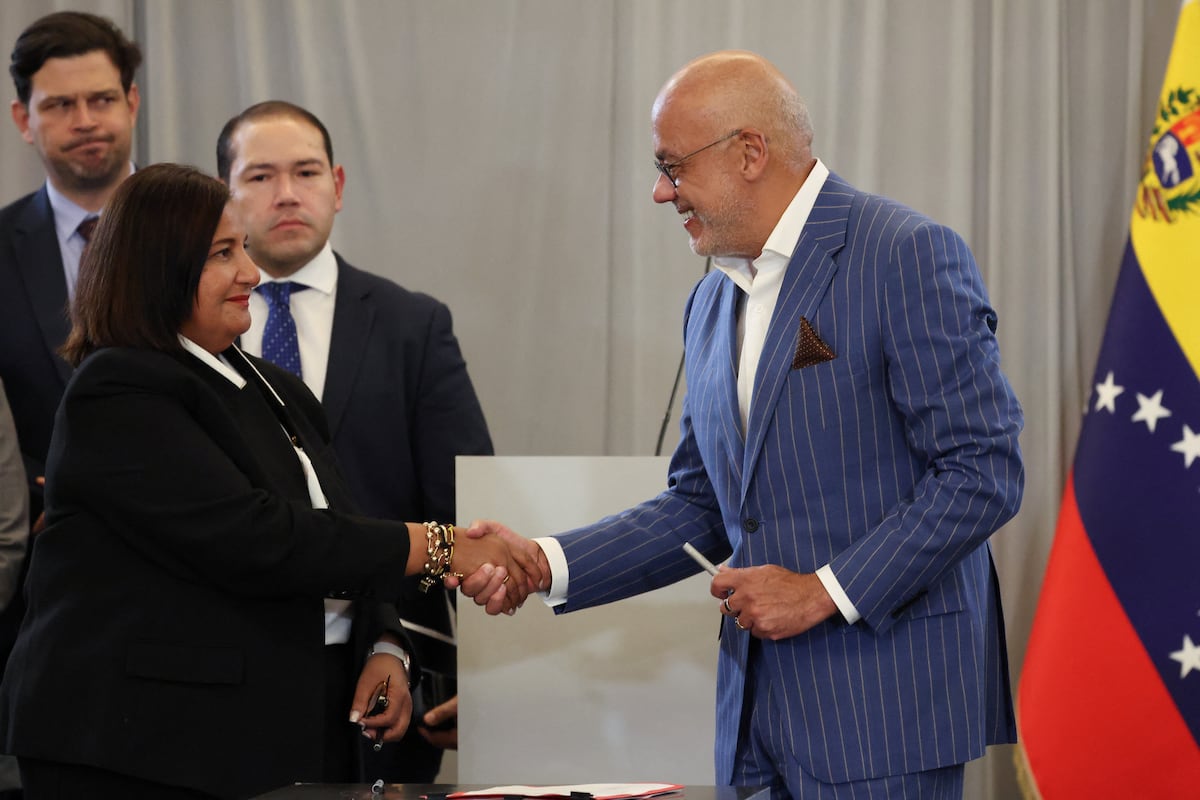
The Chavista and opposition delegations participating in the U.S.-sponsored political dialogue in Caracas concluded their fourth monthly session without significant results. On Monday, they at least agreed to follow up on previous agreements regarding issues such as freedom of expression and the status of political parties. The two sides also reiterated their commitment to reforming the most restrictive laws used to persecute opposition members.Before announcing the agreements, Dinorah Figuera, the opposition’s representative in the talks, told the media that they were working toward incorporating “the electoral path” into future discussions. However, the renewal of the National Electoral Council was not mentioned among the agreed-upon points. It has been specified, however, that a review of the Law on Political Parties, Meetings, and Demonstrations will begin to analyze the status of the parties, update their organizational structures, and review their membership rosters.Most opposition parties were placed under judicial administration and taken over by leaders from other political factions, including the oldest one, the Communist Party of Venezuela. María Corina Machado’s organization, Vente Venezuela, for example, is not officially registered as a party. According to the agreement, an Office of the Ombudsman for Political Guarantees will be created.The issue of elections came up in the discussion — and raised expectations — after U.S. Secretary of State Marco Rubio laid out an electoral roadmap following Machado’s return to Venezuela on October 25. Rubio spoke of 2027, when, according to the U.S. plan, a new interim president is expected to be appointed and the presidency declared vacant in order to call for elections. This clarification has made the talks more difficult. Delays may force a revision of the work schedule agreed upon in August and push back the announcements planned for 2027, as acknowledged by those directly involved in the process.The atmosphere during this fourth round of talks was tense. “The Chavista delegation feels it has been forced to concede on almost everything, and that has put them on the defensive,” says a source very close to the negotiating table. “We have to be very patient and tread very carefully. The negotiations have become more complicated; they’ve gotten difficult — there’s no doubt about that — but I believe we’re still making progress.”Media and lawsThe most concrete agreements reached during this latest session pertain to the media. The state-run channels of the National Assembly and Venezolana de Televisión will undergo an “update and regularization” of their operating licenses, according to the agreement signed between Figuera and Jorge Rodríguez, head of the National Assembly and brother of interim president Delcy Rodríguez. Also included in the review are Fe y Alegría, a media outlet affiliated with the Catholic Church, and the private networks Globovisión, Venevisión, and Televen — Venezuela’s main free-to-air channels. In the past, the Chavista government has ordered that international channels such as Deutsche Welle, NTN24, CNN, and others be removed from cable operators’ lineups. Despite the political opening that began earlier this year, these channels are still not available.In the fourth round of talks, new topics have been added to the discussions, such as the long-standing dispute between Venezuela and Guyana over the Essequibo territory. Guyana brought the matter before the International Court of Justice in 2018 and obtained a favorable ruling. The dialogue table reaffirmed “its firm defense” of Venezuela’s rights over this strip of land in the eastern part of the country, as well as its position based on the 1966 Geneva Agreement, which obligates the states to seek a mediated solution.The political negotiations taking place in Caracas — yet another consequence of Nicolás Maduro’s capture by the U.S. military on January 3 — began on August 12 and are held monthly. Jorge Rodríguez has confirmed that the parties will meet again in December.They got off to a strong start in a relatively cordial atmosphere, reaching important agreements regarding the country’s institutional renewal and the reform of certain laws, as well as decisions favorable to the exercise of freedom of expression, such as unblocking 200 news websites that had remained censored since Maduro’s time in office.One of the most important points agreed upon in this forum has been the process of replacing all the members of the Supreme Court of Justice, which is currently under review by a special commission of seven legal experts. More than 1,300 applications were received, and this Monday, challenges began to be raised against certain nominees, such as judges involved in cases against political prisoners. The new justices of the Supreme Court will be announced in December.Sign up for our weekly newsletter to get more English-language news coverage from EL PAÍS USA Edition
Dialogue table in Venezuela commits to reviewing the status of political parties
Full Article
Original Source
Read the full article at English →KhanList aggregates and links to publicly available news content. We do not host full articles from third-party sources. Always verify important information with original sources.