
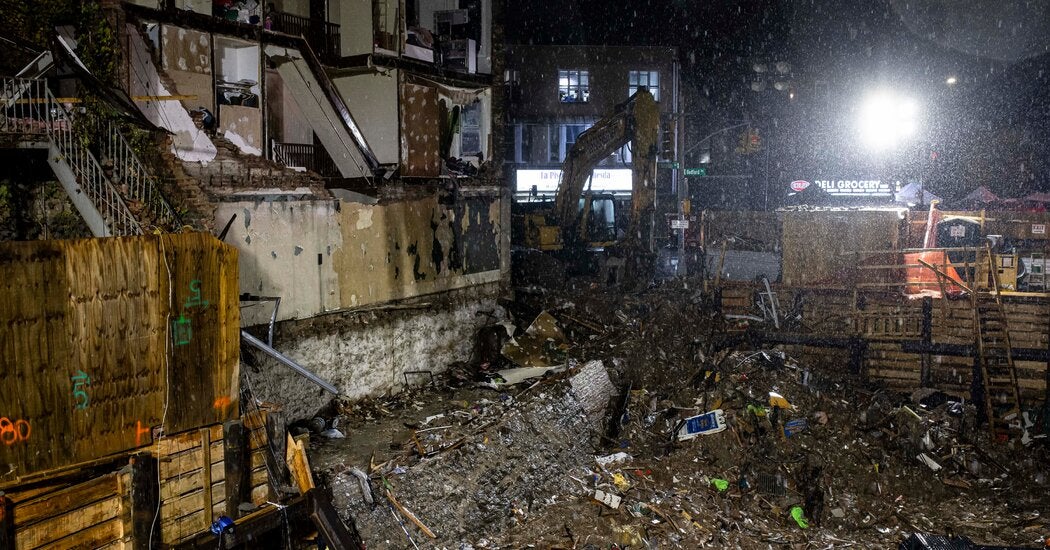
By winning approval for a three-story building, then seeking to add more stories, the Brooklyn developer was not subject to the more rigorous oversight required for larger projects.A site on Bedford Avenue in Brooklyn was under construction when a neighboring building collapsed.Credit...Dave Sanders for The New York TimesDeveloper Avoided Stricter Oversight Before Fatal Building CollapseBy winning approval for a three-story building, then seeking to add more stories, the Brooklyn developer was not subject to the more rigorous oversight required for larger projects.A site on Bedford Avenue in Brooklyn was under construction when a neighboring building collapsed.Credit...Dave Sanders for The New York TimesNew York City officials on Friday were examining whether a developer’s desire to construct a taller building in Brooklyn than had initially been approved factored in the fatal collapse of a neighboring structure earlier this week.Records show that the city signed off on plans for a three-story, eight-unit construction project at 2625 Bedford Avenue in the Flatbush neighborhood in March 2026. But other filings reveal that, from as far back as November 2025, the developer had intended to build something much larger: It ultimately sought approval for a nine-story building with 64 apartments, a 9,000-square-foot community space and a grocery store.The city had not approved the more ambitious plans by Wednesday, when the more than 96-year-old building next door collapsed into the construction site, killing eight people, injuring 18 more and leaving dozens displaced.“We have approved plans for a three-story building,” Ahmed Tigani, the commissioner of the Buildings Department, said at a news conference on Friday. But, he added, “The nine-story plan is something they seek, not what they have approval for.”The difference between the two projects could be a key to understanding what went wrong, building experts said. The developer, a limited-liability company tied to the real estate investor Robert Fischman, was excavating the Bedford Avenue site when the building fell.Neither Mr. Fischman nor other representatives of the development company could be reached for comment on Friday, despite visits to their homes and phone calls.It is not uncommon for developers to win approval for a more modest project and then seek to expand its size and scope, in part because obtaining permission to build taller structures can take several months.ImageThe building collapse killed eight people and touched off frantic rescue efforts.Credit...Bing Guan for The New York TimesBut the Bedford Avenue site’s status as a three-story project created an important distinction: It meant that city rules requiring stricter safety oversight were not triggered, according to the building experts, who reviewed the site’s plans at the request of The New York Times.The rules mandate projects over seven stories to have a site safety coordinator to ensure tasks like demolition and construction are carried out safely. Records the developer filed with the Buildings Department listed no such coordinator for the Bedford Avenue site.Pablo Vives, the founder of a construction consulting firm called DVA Advisors, said the coordinators were supposed to provide “an extra set of eyes” on excavation and other sensitive work. The development team typically pays for the coordinator.Jay Valgora, the founder of an architecture firm called Studio V, said past clients had specifically requested that their projects be smaller to avoid the added cost and scrutiny of hiring a site safety coordinator.“The question is, did that play a factor in what happened” at the Flatbush building? he said.Records show the developer of the Bedford Avenue site already had a spotty record of complying with city rules before the collapse.In March, the Buildings Department put the project under a stop-work order after inspectors found that a building on the site was being demolished without proper overhead protection, like netting and sheds.ImageThe developer of the construction site next door had initially won approval for a three-story building, but had planned a nine-story structure, records show.Credit...Dave Sanders for The New York TimesA follow-up inspection in April found that the building had been completely demolished in violation of the stop-work order, although no digging or excavation had begun. The Buildings Department fined the developer $10,000 before lifting the stop-work order in May.Asked why the city gave the developer the go-ahead to begin excavation despite the developer’s stated plans to build a nine-story structure that had not received city approval, Andrew Rudansky, a spokesman for the Buildings Department, said the officials appropriately granted approval to the work that was authorized, not the larger job the developer had wished to see approved.If and when the developer wanted to expand the scope of the project, it could have applied for an amendment to the permit, he said.Excavating a construction site in New York City, where century-old buildings abut much larger projects, can be a delicate and painstaking process, because digging can destabilize neighboring structures.Adding to the challenge is the nature of the soil in New York City. It can vary drastically, from being rocky in some places to sandy in others, sometimes even just 20 feet apart, engineering experts said. Groundwater or water from leaking pipes can also complicate things. Before excavation begins, workers must collect soil samples from across the site, boring into the ground and extracting cylinders of earth to be tested in a lab, said Anil Agrawal, the chairman of the civil engineering department at the City College of New York.Another important step involves inspecting adjacent buildings to make sure they are sound, and shoring them up if they are not, the engineering experts said.Older buildings like the one next to the Bedford Avenue site tend to have more shallow foundations than newer buildings and may have brittle exterior walls. Bricks used decades ago might not be as strong as modern bricks, and mortar can be more likely to give way when rattled horizontally by vibrations, which can happen during nearby construction.ImageThe cause of the building collapse, at 1321 Flatbush Avenue, remains under investigation.Credit...Dave Sanders for The New York TimesAt 1321 Flatbush Avenue, the building that collapsed, there were signs that the developer “didn’t do due diligence,” Mr. Agrawal said.An inspection report from March — commissioned by the development team before construction began — identified signs of distress at the neighboring three-story apartment building, which was built sometime before 1930. The inspection report noted visible cracks in at least three of the building’s facades. The northern face of the building — the wall closest to the construction site — was in “poor condition,” the inspectors noted, meaning they had visually identified “a wide range of major deficiencies.”It was not clear whether the developer or its contractors attempted to stabilize the structure while carrying out the excavation.LMW Engineering Group, an engineering firm involved with the plans, did not respond to requests for comment on Friday. Jieming Wang, the engineer who drafted the excavation plans, answered the phone but hung up after a reporter inquired about the project.The Brooklyn District Attorney’s Office has opened a criminal inquiry into the collapse as investigators work to determine what caused the Flatbush Avenue building to topple over.One lead they were pursuing was a complaint filed with the city hours after the collapse, in which an anonymous tipster suggested that a “subcontractor may have excavated too much of the area along the neighboring foundation.” The tipster did not name the subcontractor in the complaint.Whatever the cause, it was most likely a result of missed warnings, said Mr. Valgora, the architect.“You have to do something — unfortunately, tragically — very wrong to have a catastrophic failure,” he said. “The real tragedy is that buildings tell you before they fall down.”Jeffery C. Mays contributed reporting. Kitty Bennett contributed research.Stefanos Chen is a Times reporter covering New York City’s transit system.Mihir Zaveri covers housing in the New York City region for The Times.Amy Julia Harris has been an investigative reporter for more than a decade and joined The Times in 2019. Her coverage focuses on New York.Bianca Pallaro is a Times reporter who combines traditional reporting with data analysis skills to investigate wrongdoing and explain complex issues by turning numbers into insightful information.Dionne Searcey is a Times reporter who writes about wealth and power in New York and beyond.William K. Rashbaum is a Times reporter covering municipal and political corruption, the courts and broader law enforcement topics in New York.Related ContentAdvertisementSKIP ADVERTISEMENT
Developer Avoided Stricter Oversight Before Fatal Building Collapse
Full Article
Original Source
Read the full article at Nytimes →KhanList aggregates and links to publicly available news content. We do not host full articles from third-party sources. Always verify important information with original sources.