
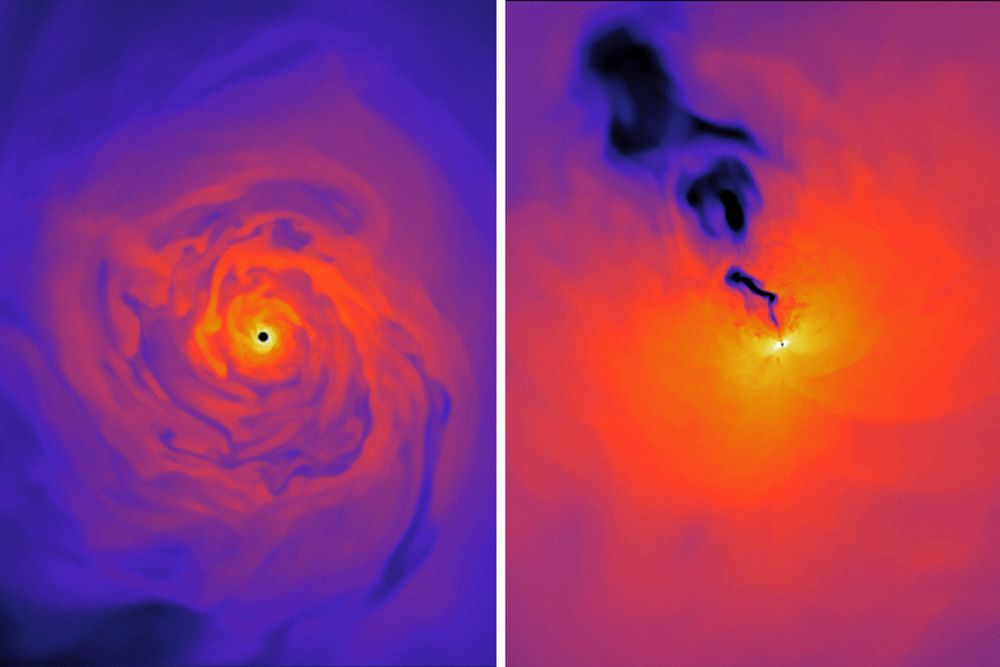
Dark matter is hypothetical matter that makes up the large majority of the matter in the Universe, but we can't see it because it doesn't interact with light. Scientists put their minds into hyperdrive trying to understand it and figure out what it is. One of the proposals is that primordial black holes (PBH) account for some or all of dark matter. Primordial black holes are hypothesized to have formed in the first fractions of a second after the Big Bang, from the direct collapse of pockets of dense matter. Really small PBHs wouldn't have survived this long because of Hawking Radiation, but more massive ones could have. New research focuses on asteroid-mass PBHs and how they could be detected, if they exist. The research is "The Life and Death of Stars that Capture Primordial Black Holes," and it's published in The Astrophysical Journal. The lead author is Ore Gottlieb, an assistant professor of physics at MIT. The authors focus on what are called Hawking stars, stars that have engulfed a microscopic PBH. They're named after renowned physicist Stephen Hawking, who first proposed them in the 1970s. "Primordial black holes (PBHs) in the asteroid mass window (1017–1023 g) remain viable dark matter candidates and can be captured by stars," the authors write. Though it's all theoretical at this point, the researchers developed a framework for what would happen to stars that capture these PBH. They used stellar evolution models, simulations, and other tools to try to understand what would happen. Primordial Black Holes are only theoretical, so far. But if they exist, they could find their way inside main sequence stars. Image Credit: NASA and G. Bacon/STSCI First of all, a single star on its own is unlikely to capture a PBH. But a star with a stellar or planetary companion would have enough gravitational interactions to trap a PBH in one of the stars. It could take thousands or even millions of year for a PBH to work its way into a star's center. “Then, this is where the action begins,” said lead author Gottlieb. Once the PBH reaches the center, the star can't survive. According to this work, there are two outcomes for stars that suffer this misfortune, and both spell doom. "We find that the fate of these systems bifurcates: PBHs that form an accretion disk before consuming the host drive explosive disruption, whereas PBHs captured too late or growing too slowly consume the star quietly," the authors write. Once a PBH finds its way into the center of a star, it takes only a few million years before it consumes about 1% of the star's mass. Then, the rotation rate comes into play. If it's fast enough, the star's gas can't fall directly into the PBH. Instead, an accretion disk forms around the PBH, inside the star. This is where the two outcomes diverge. “Inside the star, you have a black hole with a disk,” Gottlieb said. This is an almost unimaginable scenario, but the research shows it's possible. “The black hole is also spinning, and it’s twisting space and time.” The PBH then warps the star's magnetic fields, and just like in a SMBH, powerful jets are launched. “This twisted magnetic field will power very strong electromagnetic jets from the poles of the black hole,” Gottlieb explains. What star could survive powerful jets being emitted from inside? “Once the disk forms, this is essentially a death sentence for the star,” said lead author Gottlieb. The authors write that this produces "an explosive Hawking-star transient powered by a rapidly spinning PBH." The PBH emits jets that tear through the star, quickly destroying it. “And these jets will just explode the star, within a few dozen seconds," Gottlieb said. "It’s very fast. Once you have a disk, you are done.” This schematic illustration shows the evolutionary sequence of a Hawking star. First the PBH is captured, and eventually it migrates into the stellar core. Once the PBH is embedded in the core, the PBH grows by accreting stellar mass. What happens next depends on whether the PBH forms a disk before it consumes its host. If a disk forms, that warps the magnetic fields, and the PBH launches jets from inside the star, destroying it in seconds. If no disk forms, the star dies a quiet, gradual death, and a stellar-mass black hole is left behind. Image Credit: Ore Gottlieb et al 2026 ApJ 1012 157 In the second case, the star's destruction is less cinematic. "The system dies quietly," the authors write, "leaving a PBH with mass of the order of the consumed stellar mass and little or no bright disk-powered emission." It's basically a stellar-mass black hole indistinguishable from others of its kind. These two paths to destruction create different prospects for observing PBHs engulfed by stars. "Our results carry important observational implications across both electromagnetic and GW channels," the authors explain. "If a PBH has grown sufficiently to form an accretion disk, the associated disk winds and relativistic jets can inject enough energy and momentum into the stellar envelope to unbind the star and power an explosive transient." The rapid destruction creates a bright transient that emits EM radation across multiple wavelengths. This could be detectable at long distances with modern telescopes, similar to supernovae. “We would initially detect some X-rays and gamma rays, then over time optical and infrared emissions, and later on radio emissions,” Gottlieb says. “This is something we could potentially detect, if it’s not happening too far from us. It could be many galaxies away, not just in our backyard.” This simulation depicts the moments after a primordial black hole is captured by a star. As soon as the black hole falls into the star’s center, it creates a swirling disk of material (orange). Within a matter of seconds, interactions between the black hole and the spinning disk should launch powerful jets of matter that ultimately pierce through the star, making it explode. GWs from these events are likely more rare. Scientists have long wondered if PBH could be GW sources, and it's possible that the Hawking-star remnant that's left behind could be detected as one if it ever formed a compact binary with another compact object. The authors say that if this happens, it's exceedingly rare. But if it does happen, observing them would be very informative. "Thus, GW detections would be highly diagnostic if found, but should be regarded as a binary-evolution-limited and likely subdominant discovery channel for Hawking stars. Here's where dark matter comes in. These Hawking-stars, if they exist and can be detected individually, could be used to calculate their population. If these stars work the way the researchers think they work, they can be detected and used to "provide independent observational constraints on the PBH population," the authors write. But on the other hand, "the absence of such transients or of convincing subsolar merger candidates could constrain the fraction of DM in PBHs." So it seems there's a potential viable pathway to detect dark matter, if indeed PBHs are real and astronomers can find them destroying a star in a telltale blinding flash. “There is hope for us to probe primordial black holes through interactions with stars,” Gottlieb said. “We expect this to be visible, and it’s something we should look into.”
Detecting Primordial Black Holes By The Stars They Destroy
Full Article
Original Source
Read the full article at Universetoday →KhanList aggregates and links to publicly available news content. We do not host full articles from third-party sources. Always verify important information with original sources.