
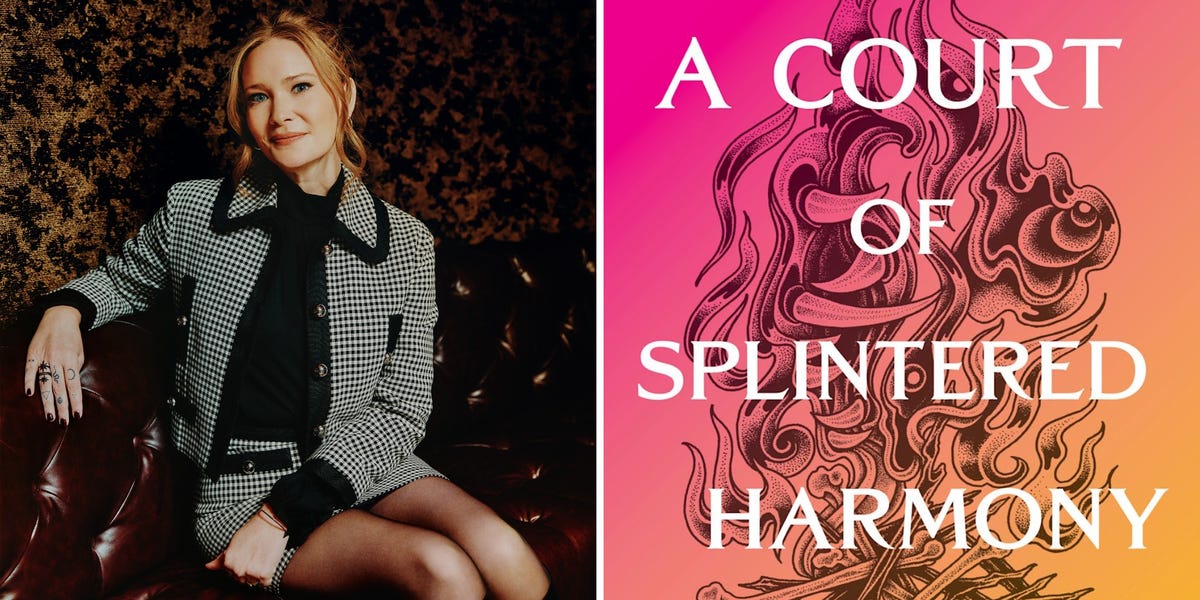
The sixth "A Court of Thorns and Roses" novel is out. Alexandra Genova / SAINT LUCY Represents It's "ACOTAR" time, people.On Tuesday, Sarah J. Maas released "A Court of Splintered Harmony," the sixth book in the "A Court of Thorns and Roses" series. The book is the first volume in a larger story arc within the world of "ACOTAR," which Maas has titled "The Valkyrie Cycle."Maas took readers back to Prythian in the novel, picking up after the events of "A Court of Silver Flames" and "House of Flame and Shadow," the third book in her "Crescent City" series. High Lord Rhysand, High Lady Feyre, and their Inner Circle are working to protect humans and keep Koschei, a death god, from escaping the enchanted lake where he's trapped. There's plenty of turmoil for the Inner Circle at home, too, though, from power struggles to love triangles.Luckily, parts two and three of "The Valkyrie Cycle" come out in January 2027 in one volume called "A Court of Forgotten Melody," so fans won't have to wait too long to see what happens next in "ACOTAR."In the meantime, "ACOSH" was packed with plot twists and shocking reveals, so read on for a look at the most important details you may have missed.Spoilers for Maas' works ahead. "A Court of Splintered Harmony." Bloomsbury Koschei the DeathlessKoschei was positioned as the looming villain in Maas' latest novel, though the character has yet to physically appear on page. (He made a brief appearance in a shadowy form in "A Court of Silver Flames.")In "ACOSH," Vassa, a human queen trapped by Koschei, tells Feyre and Rhysand that he projects his voice to others rather than allowing anyone to get close to him, with the notable exception of Feyre's father, according to Lucien.Vassa also shared that all the women Koschei keeps as prisoners are distant descendants of the fae warrior who initially trapped him at the lake. It's not the first time Maas has alluded to the mysterious female fae who trapped Koschei and his sister Stryga. The Bone Carver, their brother, spoke of her to Feyre and Cassian, Rhysand's general, in "A Court of Wings and Ruin," saying, "Clever, that fae warrior. Her bloodline is long gone now — though a trace still runs through some human line." He also said she could have been his "salvation," though he doesn't explain how.The Bone Carver said her name had been forgotten to history, but perhaps Koschei will reveal her identity in future Maas works.The Bone Carver also said he and his siblings came from another world, much like the Asteri (known as the Daglan in Prythian). It's possible they originate from the world on which Maas' "Throne of Glass" series takes place, considering Maas has been tying her three fantasy worlds together in her recent works.Azriel's shadows"ACOSH" offers readers a more in-depth look at Azriel's shadows. Through his narration, Maas reveals that the shadows are sentient, exploring the world for Azriel and telling him everything from the weather to how people are feeling. Sarah J. Maas. Weiss Eubanks/NBCUniversal via Getty Images They also display feelings toward different characters throughout the novel, investigating intruders in the Night Court or avoiding others, such as the shadow creature Erebos.They seem either unable or unwilling to come anywhere near Elain Archeron. They won't enter any room she is in, whether that be a dining room or a temple.Azriel thinks his shadows' disappearance is "a gift," but their absence puts him in danger twice in "ACOSH."First, he does not sense the creature Bryaxis approaching during baby Nyx's naming ceremony, thinking to himself that his shadows weren't there because "Elain had chased them away." Bryaxis was able to attack the Inner Circle in part because Azriel didn't feel her coming.Hours later, Azriel's shadows do not warn him that Lucien, Elain's mate, is outside her bedroom, as they had "fled the moment he'd sought out Elain," again leading to trouble for the Shadowsinger. He and Lucien physically fight during the interaction, and Rhysand kicks Azriel out of the house. Morrigan, Rhysand's third and the object of Azriel's longing for years, also scolds him, and the interaction marks the last time he sees Elain in the novel, who ends up fleeing Prythian in the aftermath.In contrast, his shadows are thrilled to see someone else a few pages later: Gwyn. Azriel ventures to the House of Wind to retrieve some of his belongings after the incident, and when he hears singing, his shadows "surged past his feet, a black tide racing ahead," sprinting to Gwyn. The shadows then gather at Gwyn's feet, watching her until Azriel summons them back.Perhaps Maas will explore what Azriel's shadows know about each female in future works.Nesta and the prisonAs she is in "A Court of Silver Flames," Nesta Archeron is central to the plot of "ACOSH," quarreling with the Inner Circle and ultimately saving them when Bryaxis comes back to town. "A Court of Silver Flames" by Sarah J. Maas. Bloomsbury She is also drawn to the prison throughout the novel, which she explored extensively with Bryce Quinlan in "House of Flame and Shadow." During their journey there, they discovered that the prison had once been an eighth court that could have served as the Dusk Court.Maas leans into dusk imagery each time Nesta visits. During one trip to the prison, she looks "to the purpling eastern sky. To the first star of evening. To the darkness, the night growing beyond it."She also sees that the prison is along "that northern horizon, stained with a dazzling blend of encroaching night and lingering day."It also appears that Nesta and Rhysand may share a connection to the prison. When Nesta tries to winnow to the island, she almost drowns and sees something "glimmering" on the floor below, believing it is calling, "Find me," to her. Rhysand saves her, telling Nesta he heard her mentally scream, "Find me," to him.It's possible Nesta was confused and shouting out mentally for aid, but it's also possible Nesta and Rhysand were being beckoned by the same Made object. Rhysand controls the prison through his bloodline, so it's plausible that a Made object associated with it is calling to them both.In addition to the dusk imagery she associates with her, Maas also ties Nesta to the word "splintered," which appears in the novel's title. Nesta asks her house for guidance on her relationship with Cassian, and the house offers her a pile of splinters from a punching block she broke during her training. For Nesta, the demonstration is meaningful."The House couldn't have chosen a better symbol of where she and Cassian stood," she thinks to herself. "The training, the determination, the love that had grown between them — all shattering not due to some outside force, but because of her."The splinters lead her to open up to Cassian about her feelings, but they also may indicate that "Splintered Harmony" in the title has a lot to do with Nesta and Cassian.Other imageryNesta isn't the only character Maas associates with specific imagery throughout the book.Maas repeatedly associates Elain with spring. Azriel describes Elain as "a whisper of spring" and "as lovely as a spring dawn." Lucien says she has a "floral scent," and she is seen tending flowers and decorating Nyx's naming ceremony with them in the book.Maas also introduces the concept of Feyre and her son, Nyx, as a flash of silver in the night court.Clotho made "a braided, silvery piece of fabric" for Feyre and Rhysand to use during Nyx's naming ceremony, telling Nesta it was one of a kind as she gave it to her to pass on to the High Lord and Lady. Later, when Lucien is dining at their home, he notices a tapestry Feyre has hung on the wall, saying his magical eye can see the silver thread moving in it.During his chapter, Lucien also says his magic eye has shown him a silver aura around Feyre since the moment he met her, describing it as a "silvery brightness" that intensified as Feyre found love and joy at the Night Court.Gwyn's powerDuring both passages in which Gwyn appears in the novel, she is singing, which seems significant given the musically themed titles of books six and seven in the "ACOTAR" series. "A Court of Forgotten Melody" by Sarah J. Maas. Bloomsbury Maas gives indications that Gwyn's music may have magical properties.Nesta notices that Gwyn's singing voice is more powerful than the voices of her fellow choir singers, saying, "Gwyn could have carried the entirety of the song herself, that mezzo-soprano voice so rich and resonant that it seemed to effortlessly burst from her."Likewise, Azriel describes Gwyn's voice as "otherworldly" and "strange and yet familiar," adding that "starlight spilled down the steps, almost in answer to the song" as she sang.Maas also seems to liken Gwyn to light, particularly when she's singing.When Nesta watches Gwyn sing, she notes that she "shone" and seemed to "radiate light," thinking to herself that "the candlelight seemed to bend toward" her friend. Similarly, when Azriel sees Gwyn at the House of Wind, he describes her hair as "shining in the starlight," remarks on her "bright gaze," and notes that her eyes were lit by the stars above.Similarities between Azriel and GwynThroughout "ACOSH," Azriel describes himself as a monster because of his shadow-wielding abilities and talent at extracting information from enemies. He says he was often called a monster or a demon in his youth, and he came to think of himself that way."He was a monster — merely a creature," Azriel thinks of himself in the text. "Best left skulking in shadows. Most suited to collecting information through subterfuge or pain."Other characters in "ACOTAR" have said people think of them as monsters, like Rhysand, but the only other character in "ACOSH" who seems to genuinely think of herself as monstrous is Gwyn.In a chapter told from her perspective, Gwyn reveals that she has been avoiding training with the Valkyrie and the world outside the temple because she relished killing enemies during the Blood Rite. Her chapter ends with her thinking she hears Bryaxis laughing at her, "like it knew it wasn't the only monster down here."Maas also highlights parallels between Azriel's and Gwyn's powers in "ACOSH."Azriel talks about his Siphons, which help control his magic, repeatedly in the book. He notes that they are all "a cobalt bordering on turquoise," for a reason he has never known.Later, Gwyn throws her Invoking Stone at Azriel when he startles her, which he says "glittered with turquoise fire." Gwyn's eyes are a similar shade, described as teal throughout Maas' works.In addition to the similar coloring of the Siphons and the Invoking Stone, Azriel notes that the Stone has a similar magical feel, thinking he "never realized how much presence it seemed to have, like his Siphons, but wholly different," he said.Azriel quickly returns the Stone to Gwyn after their brief interaction, but Maas may explore the similarities between the two down the line.Parallels with MorAt the end of "ACOSH," Elain begs Mor to take her with her to Vallahan, and Mor agrees, seeing that Elain needs space from Azriel, Lucien, and the Inner Circle to figure out what she wants.It's not the first time Mor has helped an Archeron sister get some distance from a male causing her problems.In "A Court of Mist and Fury," Mor whisks Feyre away from males twice. First, she rescues Feyre from the Spring Court after Tamlin traps her in his house. Later, Mor winnows Feyre to the cabin after she discovers that Rhysand had been keeping the fact that they were mates a secret. "A Court of Mist and Fury" by Sarah J. Maas. Bloomsbury She does the same for Nesta in "A Court of Silver Flames," winnowing Nesta to Emerie's home when she needs a break from Cassian. She brings Gwyn to the house, too, so Nesta has the support she needs during her turmoil.For Feyre and Nesta, that time away allowed them to figure out how they felt about the males in their lives, positive or negative. Hopefully, Elain gets the same clarity from her space. Read next Business Insider tells the innovative stories you want to know Business Insider tells the innovative stories you want to know Business Insider tells the innovative stories you want to know Business Insider tells the innovative stories you want to know Samantha Grindell Pettyjohn is a Senior Lifestyle Reporter at Business Insider with more than eight years of experience in the lifestyle space.At Business Insider, Samantha's coverage focuses on unique living situations, interior design, celebrity style, and books. Her work includes features on multigenerational living and one-of-a-kind houses, timely articles on celebrity fashion, live coverage of award shows and pageants, and fun pieces about popular book series. Samantha also loves reporting on celebrities on her beats, from HGTV stars Christina Haack and Tarek El Moussa to authors such as Sarah J. Maas and Rebecca Yarros.Samantha appeared on Scripps News and CBS in 2022 to discuss the royal family, and in 2023, she won an Anthem Award for her work on Business Insider's package "Better Me."Samantha received her B.A. in English from Birmingham-Southern College in 2017, graduating Summa Cum Laude. She later earned her M.S. in Publishing from New York University in 2019. Samantha was previously a staff writer at Romper, and her writing has appeared in Cosmopolitan, Mic, and Oprah.com. Today, Samantha lives in Atlanta with her husband and dog.Email her at sgrindell@businessinsider.com and follow her on X. Lifestyle Entertainment Books More
Details you might've missed in Sarah J. Maas' 'A Court of Splintered Harmony'
Full Article
Original Source
Read the full article at Businessinsider →KhanList aggregates and links to publicly available news content. We do not host full articles from third-party sources. Always verify important information with original sources.