
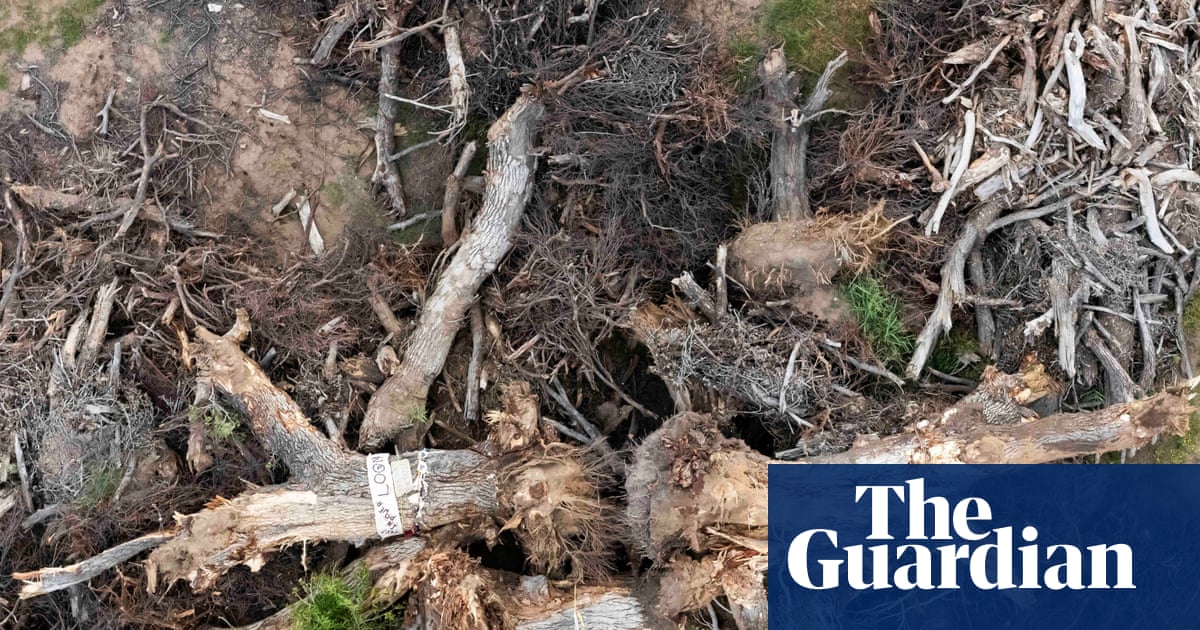
A 200-year-old cottonwood tree near the US-Mexico border, known as the “grandmother”, has been destroyed to make way for the construction of Donald Trump’s border wall, despite a months-long effort by protesters trying to save it.In late July, land defenders began a tree-sit in the ghost town of Lochiel, Arizona, taking turns occupying a platform high in the tree’s canopy. The group remained there for more than 70 days.Then, on Monday at dawn, more than 80 federal agents swarmed the protesters’ camp, which is located on private land, making arrests and preventing people from reaching the cottonwood. Some agents in a steel basket on an extendable crane lift forcibly removed the person in the tree platform, according to videos and photos shared on social media and descriptions of people there at the time. Others were shoved and tackled as they tried to rush toward the tree to prevent its destruction, according to witnesses.Contractors with Fisher Sand & Gravel, a company building this section of wall, then used an excavator to push over the tree, which cracked and crashed to the earth. Land defenders shrieked, cried and yelled at the federal agents.“Seeing that – it crushes your heart,” said Erick Meza, the Sierra Club’s Borderlands coordinator who has been working to save the trees for months, beginning with a series of letters to US Customs and Border Protection (CBP).“That tree brought a lot of people together,” he said. Now, he added, “there’s a community response of outrage. People are pissed off.”The cottonwood’s toppling was filmed by a team from Turning Point USA, the far-right political group, who appeared to be embedded with border patrol and allowed free access to roam throughout the closed off public road.A tree-sitter on 29 July 2026 in the ancient cottonwood tree at the US-Mexico border in Lochiel, Arizona. Photograph: Rebecca Noble/ReutersOne of the land defenders had scaled another ancient cottonwood tree situated right on the border with Mexico. On Thursday, CBP and Mexican police, who have been present for several days and visibly working with American authorities, removed the tree-sitter’s platform, food and water supplies, according to Alex Chabbott, a land defender who has been present at the camp on and off for over a month.Late on Friday, the tree-sitter came down on their own volition after not being resupplied for several days.The agents involved include border patrol officers, part of CBP, and a special forces tactical unit called Bortac, whose self-described purpose is to “respond to terrorist threats”.The tree-sit began shortly after contractors knocked over and killed three other ancient cottonwood trees nearby on 27 July.Two 30ft-tall walls are being built throughout this area, known as the San Rafael valley, a remote and once idyllic high elevation prairie where the movie Oklahoma was filmed. The valley, and the Patagonia and Huachuca mountains on either side of it, form one of the most important regional wildlife corridors between the US and Mexico, providing passage to animals including jaguars, ocelots, bears and even beavers and porcupines in recent years.Already, government contractors have finished 88 miles (140km) of secondary wall, which is a second 30ft fence set at some distance from a primary wall of the same height. Another 444 miles of secondary wall are under construction, according to DHS, much of that in Arizona, using billions of dollars allocated by Trump’s One Big Beautiful Bill Act.Members of the Nogales fire department use a cherrypicker to remove a platform from another tree on the border with Mexico, leaving a protester stranded. Photograph: Rebecca Noble/ReutersProtesters say that construction in the area is progressing rapidly, 24 hours a day. In recent days, Fisher Sand & Gravel has completed the secondary wall, which includes placing 30ft steel panels within a trench filled with rebar and cement, along a part of the private property where the camp is located, including up to the point where the tree stood.These trees, which depend on a regular supply of water underground, are a hallmark of riparian forests, an endangered ecotype throughout Arizona and the south-west, said Russ McSpadden, an advocate with the Center for Biological Diversity. The ecological importance of these trees is one of the animating factors behind the land defenders.Water use for wall construction has depleted wells throughout the south-west, threatening natural features such as Quitobaquito Springs. CBP does not say how much current construction uses, but in 2008 it estimated a smaller wall nearby could use up to 710,00 gallons per mile for construction; the current project likely uses more, as it is larger.skip past newsletter promotionafter newsletter promotion‘We are starting a movement’Since Monday, dozens of land defenders have been arrested, many for entering the road between the private property and the border, which was ordered closed by federal authorities in late September due to wall construction. Protesters have been doing prayers in the road near the tree every morning.Some of those arrested were physically hit and came back with bruises and black eyes, Chabbott claimed.Several more people attempted to use nonviolent tactics to halt or delay construction, including one woman who locked herself to a cement truck on 7 August, according to videos shared on social media.Protesters face off with US border patrol as Fisher Sand & Gravel construction crews work on 8 October 2026. Photograph: Rebecca Noble/ReutersThe protester was sprayed in the face with mace and wrestled by several agents, and her limbs forced into painful positions, according to witnesses and social media videos.The truck was later driven away while the land defender was still attached, and cut from the vehicle later that evening, according to witnesses. She is now in custody, according to what authorities have told the land defenders’ lawyers.Julia Butterfly Hill, who spent two years living in a redwood in California’s Humboldt county in the late 1990s, said she was horrified to see how roughly border patrol treated this woman on a livestreamed video, she said.This land defender’s courage and commitment to nonviolent resistance in the face of brutality “brought tears to my eyes”, Butterfly Hill said. “She’s a hero of the highest order.”CBP did not respond to a request for comment about this and other clashes, but has previously said that walls in areas like this will help combat unauthorized immigration. The sheriff of Santa Cruz county, David Hathaway, who did not respond to a request for comment for this story, has previously said a wall in this area is senseless since this remote valley has no history of significant illegal activity. Fisher Sand & Gravel did not respond to a request for comment.A drone view shows the remains of two other ancient cottonwood trees in Lochiel, Arizona, on 27 July. Photograph: Rebecca Noble/ReutersIn a press conference on 8 October, Adelita Grijalva, a congresswoman who represents the area, said she was “heartbroken” about the loss of the “grandmother” trees, and said she plans to try to introduce a bill that will revoke the DHS’s ability to waive any and all laws in building border infrastructure.The tree-sit began shortly after contractors knocked over and killed two other ancient cottonwood trees nearby on 27 July.In felling the tree, the contractors and federal agents “try to break us, but we are not broken”, said Kate Scott, one of the leaders of the tree-sit. “We are starting a movement, and we’re not going anywhere. We are rooted, like the grandmothers.”
Despair after 200-year-old ‘grandmother’ tree toppled for Trump’s border wall: ‘It crushes your heart’
Full Article
Original Source
Read the full article at Theguardian →KhanList aggregates and links to publicly available news content. We do not host full articles from third-party sources. Always verify important information with original sources.