
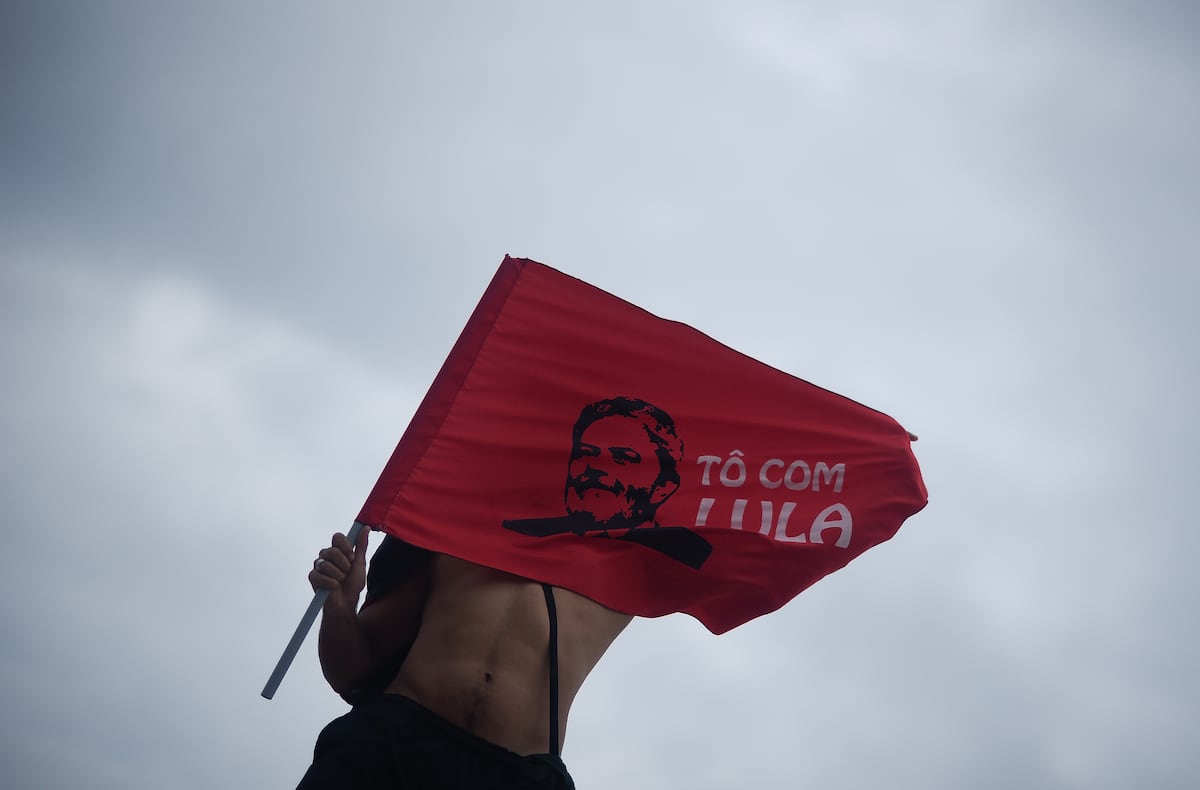
In October 2026 a statuesque young man, shirtless and wearing gray sweatpants and a mask, waved a pro‑Lula flag and a Palestinian flag atop a structure at Trianon‑Masp metro station on Avenida Paulista in São Paulo, during a pro‑democracy march. The moment was caught on camera and the image spread like wildfire. The photograph of the young man at the rally became a symbol of the Brazilian election campaign, offering what looked like a perfect formula whose ingredients were physical beauty, a certain fetish, political conviction and an instant mystery — and internet users, skilled at spotting whoever is struck by the viral wand, were quick to identify him. He was Israel Augusto, christened “o gostoso da Paulista” (the hottie of Paulista), who has nearly 400,000 followers on Instagram.Thus was born the hashtag #GostososcomLula, where other men with bodies sculpted by genetics, the gym and creatine posted their sexiest images to become the most surprising — and effective — show of support for Lula’s campaign. “To be young and not be a revolutionary is a genetic contradiction,” Augusto writes alongside a shirtless photo.The political muscleAlthough architect Oscar Niemeyer’s phrase A crise da esquerda nunca será estética (The left’s crisis will never be aesthetic) predates this movement, it fits perfectly with the wave of young, indisputably fit supporters who have rallied behind Lula. The Brazilian term biscoitagem refers to posting pictures on social media to collect compliments — typically a body photo accompanied by a mock‑modest line such as “I need to go to the gym more.” Following this trend, many men are turning to politics while indulging in exhibitionism: for example, they flex their biceps to form the L that stands for Lula. The study Thirst Traps and Quick Cuts: The Effects of TikTok “Edits” on Evaluations of Politicians examines how desire can function as another channel of political communication, and Lula himself has taken note, opting for athletic shorts and sleeveless shirts to show his silhouette while training (he may not compete with Instagram’s gostosos, but at age 80 his workouts and physique are exemplary). Ties and suits are no longer the garments that best attract younger voters.The Gostosos com Lula profile posts images of muscular men who use their bodies as the perfect ally to win political support. Its motto? “Aesthetics as a political manifesto.” Marcos Dosantos, a political scientist and writer, points out that although Lula did not win because of the gostosos, the “progressive torsos” have, literally, given him extra muscle. “Those handsome men waving the red flag add electoral libido to the candidate who lifted millions of Brazilians out of poverty and is the only leader capable of stopping the Bolsonaro dynasty. Lula was the most‑voted president in Brazil’s history, and that means a mobilization that was also activated on the screens where my friends in Brasília or Porto Alegre have been seeing for weeks that the gymbros can be left‑wing and that pop fandoms can repurpose AI so Lula sings like Lady Gaga or dances like Britney Spears. What’s behind all that? The emotional battle,” he explains.“We already know the algorithm favors hate, rage and falsehoods — fertile ground for the far right — but Brazil has shown that the digital left can win back the attention of wavering voters with other hooks such as beauty, tenderness or enthusiasm. Just as love can curb hate, desire can hook people more than a hoax. A picture is worth a thousand words and a good reel can activate more voters than a thousand speeches,” he adds.The power of social mediaThe president of Brazil, re‑elected for a fourth time with 51.7% of the vote, made sure to strengthen his digital communication by incorporating social media into his campaign to amplify his messages. Ana Elisa Santos Silva, a deputy from Minas Gerais for the Workers’ Party (PT), warned the left on October 5: “Do you know what the 10 most‑voted lawmakers in Brazil have in common? Social media. Those people are not analog (…) I could have done much more if I hadn’t wasted time explaining to my own camp that social media chooses lawmakers,” she said.Paula Pissaco, a communications and strategic marketing consultant, told La Audiencia that many young leftists took to the streets amid suspicions that the algorithm favored right‑wing voters, a matter that even reached the Federal Prosecutor’s Office. “While the right leverages its platform presence, the Brazilian progressive field seeks to contest the election from the streets. Many social organizations and activists wager on mobilizing people beyond Instagram. And then our muscular comrade shows up: he goes out to protest and ends up mobilizing others,” she says. That raises an interesting question: are people admiring someone or reducing them to their abs? “Objectification is not exclusive to women, although we have faced it historically and structurally. Desire is not the problem. Erasing the person behind the body is,” she concludes. A few days ago an attractive young woman went viral for appearing next to Flávio Bolsonaro — the surprise came when it was revealed she was an AI creation.Lu Quispe, a political scientist, writes in Deconstrucción Mediática (Media deconstruction) that what just happened in Brazil is not a miracle but the result of changes in Lula’s digital communication. “He just went down in history as the man who beat the platforms, who beat the technomagnates who did everything they could so Bolsonaro would win today. They restricted his account, shut down Facebook, concealed him in searches. Against all that, he still managed to recover 10 million votes. How did he do it? He decentralized communication. The campaign slogan was: ‘Every person is an influencer.’ He added millions of people to his communities on WhatsApp and Telegram,” she explains. “He listened to men and women under 25, who advised him in the campaign’s second phase. All that, of course, combined with street canvassing and concrete public policies. But he had already done that in the previous phase with no result. What he adjusted the most this time was the digital part,” she adds. “We beat outside interference from digital platforms,” Lula said in his victory speech, referring to Instagram and WhatsApp’s alleged favoritism toward Bolsonaro.A strategy not so new, but always revolutionaryIn Golpes de vista, an essay on how politics does not just play out in institutions but also in images, the sociologist Olivia Muñoz‑Rojas includes two pictures that recall those of these young men. One, from the Arab Spring, was taken in Cairo’s Tahrir Square and shows a shirtless man with Versace underwear peeking shyly above his pants as he hoists the Egyptian tricolor flag. Another photo, from protests against deportations in Los Angeles, captures a chiseled man with his face covered and his six‑pack serving as a flag while standing on a car bearing the Mexican flag. “That’s why what we’ve just seen with the gostosos isn’t as new as it might seem. The first thing that attracts is the image, and then the political message. Here physical attractiveness and humor intertwine, which is how social media now work. These images have infiltrated nonpolitical circuits and people share them for pleasure, not militancy,” she says. She does not believe these muscular, youthful bodies have a specific ideology. “I think youth, strength and physical fitness cut across political sensibilities. What changes is the meaning. To distinguish it you need flags and accessories, which alter the context. It’s about turning the body itself into a slogan.”Sign up for our weekly newsletter to get more English-language news coverage from EL PAÍS USA Edition
‘Desire hooks more than falsehoods’: how shirtless youths helped secure Lula’s victory in Brazil
Full Article
Original Source
Read the full article at English →KhanList aggregates and links to publicly available news content. We do not host full articles from third-party sources. Always verify important information with original sources.