
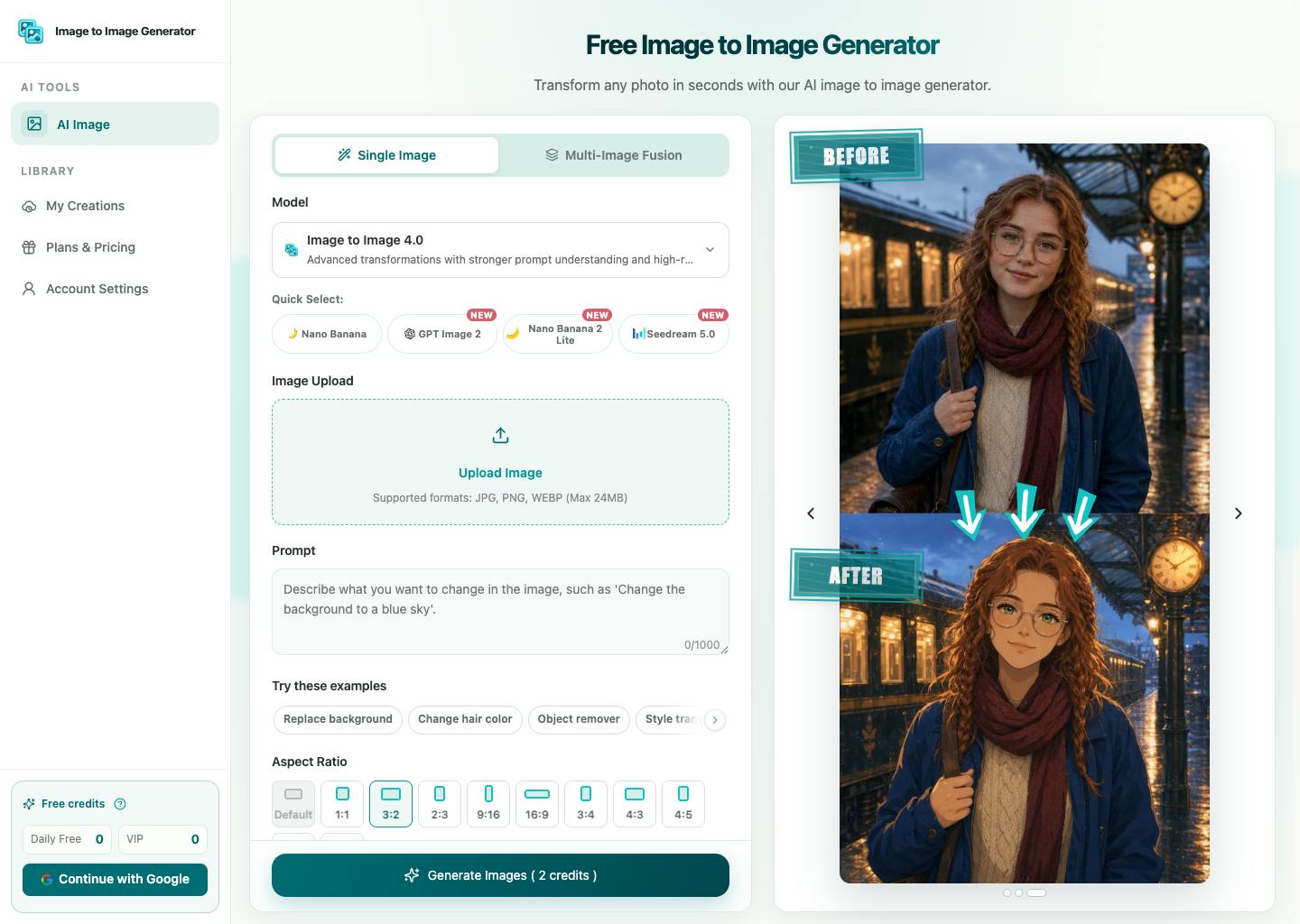
Disclosure: I work on Image to Image Generator, the product example used near the end of this article.The hardest part of a multi-model image-to-image interface is not adding another model to a dropdown. It is keeping the interface truthful while source-count rules, file constraints, resolutions, account gates, credit costs, and provider availability vary underneath it.The implementation mistake is to scatter those rules across components. The safer design is to treat the active capability definition as a contract, turn each submission into an immutable request snapshot, and make review a real state rather than decorating a download screen.Start with a capability contractA front end should not infer that every visible option works with every model. A single-image mode may require exactly one source. A fusion mode may accept several. One model may expose a higher resolution while another does not. Authentication or credit cost can also depend on the selected branch.A simplified contract can look like this:type ImageMode = { id: "single_image" | "multi_image_fusion"; minSources: number; maxSources: number; acceptedMimeTypes: string[]; maxBytesPerSource: number; promptMaxChars: number; aspectRatios: string[]; resolutions: string[]; requiresAuth: boolean; creditCost: number; }; type CapabilityDocument = { version: string; models: Array; }; The UI derives its controls from one active model-and-mode branch. When the model changes, dependent selections survive only if they remain valid. Otherwise, the form chooses a safe replacement and tells the user what changed.This avoids a common trust failure: a control appears selectable, but the server later rejects the combination. The server is still authoritative, but a contract-driven client prevents most invalid requests before upload or billing.Validate the bytes, not the filenameAn upload named reference.png is not necessarily a valid PNG. Client-side checks improve feedback, but server-side validation must inspect the actual payload.A robust upload path checks:declared MIME type;detected file signature;compressed byte size;successful image decode;pixel dimensions and decoded-memory risk;orientation and metadata handling;source count against the active capability branch.The distinction between compressed size and decoded size matters. A modest compressed image can expand into a large bitmap in memory. Dimensions should therefore be bounded independently of transfer bytes.The reviewed product accepts JPEG, PNG, and WebP in its current public interface, with a stated limit of 24 MB per file. MDN's overview of image file types is a useful reminder that extension, encoding, transparency, animation, and browser support are separate concerns.Uploaded sources should become normalized assets before generation. That makes retries cheaper and safer:{ "assetId": "src_7f31", "detectedMime": "image/webp", "width": 1536, "height": 1024, "bytes": 842119, "status": "ready" } The generation request then references asset IDs instead of retransferring the same files.Give every reference an explicit roleMultiple-image generation adds a semantic validation problem. A server can count files, but it cannot know whether the user expects image one to define the subject and image two to define the setting unless the request represents those roles.Even if the upstream model accepts a flat array, the product can preserve intent in its own request:{ "sources": [ {"assetId": "src_subject", "role": "subject", "priority": 1}, {"assetId": "src_material", "role": "material", "priority": 2}, {"assetId": "src_scene", "role": "environment", "priority": 3} ], "change": "Place the subject in the evening scene using the supplied fabric", "preserve": ["face", "pose", "silhouette"] } This structure may be compiled into a provider-specific prompt, but retaining it internally has two benefits. It makes the result reviewable against explicit intent, and it allows the application to migrate providers without losing the user's original brief.The product should not imply that more references always mean more control. Conflicting perspective, light direction, scale, or identity can create ambiguity. The UI can surface that tradeoff before submission instead of presenting source count as a simple “more is better” feature.Freeze an immutable request snapshotCapabilities can change while a tab remains open. Costs and availability can also change between form load and submission. The browser should therefore send its capability version, but the server must revalidate against the current contract.A generation snapshot might include:{ "idempotencyKey": "gen_01J...", "capabilityVersion": "2026-08-26.4", "model": "model_a", "mode": "multi_image_fusion", "sourceAssetIds": ["src_subject", "src_scene"], "prompt": "Change the setting to evening; preserve face, pose, and framing", "aspectRatio": "original", "resolution": "standard", "quotedCreditCost": 2 } The server performs four operations in order:resolve the current capability branch;revalidate sources, options, authentication, and policy;calculate the authoritative cost;persist the accepted snapshot before invoking the provider.Never trust the price or supported combination sent by the browser. If the capability version is stale, return a structured conflict that preserves the user's sources and prompt while identifying which choice became invalid.An idempotency key matters because a network timeout does not prove that submission failed. Retrying blindly can create two provider jobs and charge twice.Model generation as a state machine“Loading” is too vague for an asynchronous image job. A useful state machine separates client validation, upload readiness, provider processing, review, and terminal failure:idle -> validating_sources -> uploading -> ready -> submitting -> queued -> processing -> reviewing -> completed Any active state -> failed | cancelled ready means the form is locally valid. queued means the server accepted and persisted the request. processing means a provider job exists. reviewing means an output exists but has not been accepted by the user. Only completed represents a deliberate handoff to download or downstream use.This vocabulary prevents another trust failure: equating provider completion with output quality.Polling should use backoff and durable job IDs. The API should distinguish provider rejection, timeout, insufficient credits, authentication loss, policy rejection, invalid input, and cancellation. Each error needs a different recovery path.For example, an expired result URL should refresh authorization for the existing output, not regenerate the image. A provider timeout can remain unknown until reconciled. An invalid option should return the user to a preserved draft rather than erase the prompt and uploads.Review is part of the system boundaryGenerated output can be technically successful and still unusable. A review screen should show the output beside the frozen request: sources, prompt, model, mode, ratio, and resolution.The review itself happens at two scales. Full-frame checks cover composition, lighting, subject placement, and transformation strength. Detail checks cover faces, hands, text, product edges, reflections, repeating patterns, and perspective.A change-and-preserve request makes this review concrete. The user can mark whether the requested transformation happened and whether protected details survived. That is better than a single “looks good” reaction.It is also important not to promise what the system cannot verify. Generation does not guarantee exact identity preservation, artifact-free output, uniqueness, commercial clearance, fixed processing time, or perfect prompt compliance. Rights review remains outside the model pipeline.What this changed in the productThe practical product lesson is that capability data, validation, job state, and review copy are not separate concerns. Together they form the user-visible truth of the workflow.I applied this approach while building Image to Image Generator. Its reviewed interface separates a one-source path from a two-to-five-source fusion path and exposes only currently supported settings. The implementation still treats those controls as changeable capability data, not permanent guarantees.The product is currently English-only and image-only. Guest access, sign-in requirements, daily credits, subscriptions, credit packs, supported models, source counts, resolutions, and availability can vary. Higher-resolution output applies only to eligible combinations.These boundaries are not marketing disclaimers pasted onto the end. They are inputs to the state machine and validation layer.For related engineering discussions, HackerNoon's software development and generative AI sections are useful starting points.ConclusionA flexible image-generation interface earns trust when it says what is valid now, preserves exactly what the user submitted, distinguishes processing from acceptance, and makes failures recoverable.Adding models is the visible feature. Keeping the contract, request snapshot, and review state honest is the engineering work that makes those models usable.Disclosure: I work on Image to Image Generator and used it as the implementation example in this article.
Designing an Honest Multi-Model Image-to-Image Generation Workflow
Full Article
Original Source
Read the full article at Hackernoon →KhanList aggregates and links to publicly available news content. We do not host full articles from third-party sources. Always verify important information with original sources.