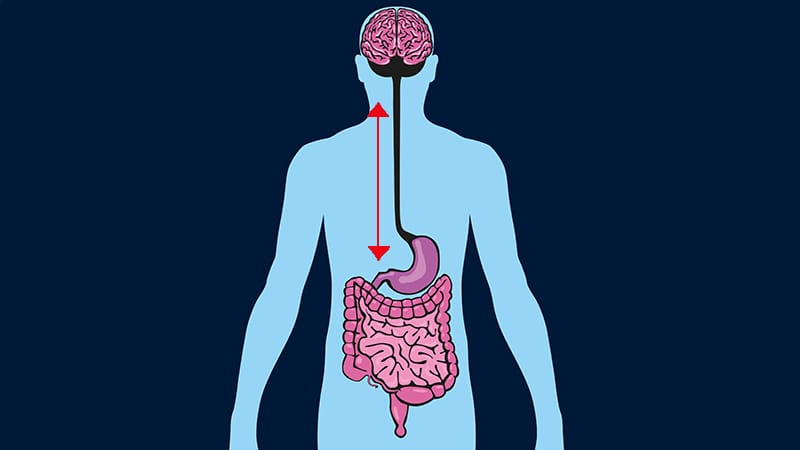
Disorders of gut-brain interaction (DGBI) may increase the risk for eating disorders (EDs), and the relationship appears to go both ways, according to a retrospective UK cohort study of more than 1.25 million people published in Clinical and Translational Gastroenterology. The investigators also found that depression is an independent risk factor for developing an ED among people with DGBI.“It is unclear whether DGBI directly predisposes individuals to one or more EDs or is a consequence of these disorders, nor is it clear whether anxiety and depression cause both EDs and DGBI, or whether, in these conditions, anxiety and depression are present simultaneously but have no causal link — that is, they represent only a comorbidity,” wrote the researchers, led by Stella-Maris C. Egboh, University of Newcastle, Callaghan, Australia.“This study is very interesting because it links gastrointestinal [GI] disorders and eating disorders while taking into account several relevant variables, such as age of onset, diagnosis, and the role of anxiety and depressive symptoms,” Angela Favaro, a full professor of psychiatry in the Department of Neuroscience at the University of Padua School of Medicine in Padua, Italy, and chief of both the Psychiatric Clinic and the Eating Disorders Unit at the Hospital of Padua, told Univadis Italy, part of Medscape’s Professional network.The expert confirmed the presence of an association — well known to clinicians — between DGBI and EDs, but she disagrees with the study’s authors when they discuss predisposition. “A study of this type, based on case registries, does not provide evidence regarding predisposition, but only regarding the association between disorders. To speak of predisposition, one would need to demonstrate a cause-and-effect relationship, which is not demonstrated here,” she said.Sequence of OnsetThe main objective of Egboh and colleagues was to determine the associations and the temporal sequence of onset of DGBI, EDs, and psychological comorbidities such as anxiety and depression.The analysis included 1018 participants diagnosed with both irritable bowel syndrome (IBS) and EDs, 777 of whom also had information regarding anxiety and/or depression. The results showed a prevalence of 0.7% for EDs, while prevalences of 13.4% for IBS, 20.7% for functional dyspepsia, and 1.2% for chronic constipation were recorded. The strongest associations were observed between chronic constipation and anorexia nervosa (odds ratio [OR], 2.12; 95% CI, 1.84-2.45) and any ED (OR, 2.06; 95% CI, 1.79-2.36).IBS and functional dyspepsia also showed associations with specific EDs. Contrary to the authors’ initial hypothesis, in most cases the ED preceded the diagnosis of DGBI (59.5%) compared with the opposite direction (40.5%). Among the independent predictors of a GI disorder diagnosis preceding that of an ED, the authors identified a younger age at the time of the first GI disorder diagnosis, a history of depression, and a history of proton pump inhibitor use.Favaro noted that EDs can lead to a range of GI complaints, including constipation, bloating, and dyspepsia. These symptoms are often linked to reduced or irregular caloric intake, but they may also result from compensatory weight-control behaviors such as self-induced vomiting, laxative misuse, or dehydration from diuretic use. She added that bowel regularity can become a fixation in some patients.In clinical practice, she said, the relationship can also run in the opposite direction, with EDs developing after dietary restriction — sometimes recommended by clinicians — aimed at treating a functional GI disorder. In avoidant/restrictive food intake disorder, for example, patients may limit intake or avoid certain foods because they fear bloating, abdominal pain, or vomiting.…and Psychological ComorbiditiesIn the subpopulation with DGBI and ED, anxiety and depression were present in 42% and 70% of patients, respectively — percentages significantly higher than those in the general population of the cohort. Considering the 777 patients with DGBI, an ED, and a psychological disorder, the analyses also showed that in 42.9% of cases, the first diagnosis was a psychological disorder — primarily depression — in 35.6% it was an ED, and in only 21.5% it was DGBI.According to the authors, these data suggest that depression may represent a cross-cutting factor capable of promoting both the onset of IBS and that of EDs, reinforcing the need for early screening of psychiatric comorbidities.As Favaro explained to Univadis Italy, based on this type of case-register study, it is very difficult to draw conclusions about the role of psychological distress in determining the gut-brain axis. “Eating disorders are metabolic-psychiatric disorders; that is, they have both psychological and metabolic implications and are therefore strongly linked to both anxiety and depressive symptoms and to metabolic alterations — and, most likely, also to changes in the gut microbiota, which we know is very important for our overall well-being and that of our brain,” she commented, emphasizing that the brain-gut relationship is highly complex, shaped by both genetic and environmental factors, and works in both directions.Complex Disorders, Multidisciplinary ManagementEgboh and colleagues highlight the importance of a multidisciplinary approach that integrates gastroenterology, psychiatry, clinical psychology, and nutrition in the management of these patients. Similarly, in an interview with Univadis Italy, Favaro noted that multidisciplinary care is essential in the treatment of EDs, and gastroenterologic symptoms must be taken seriously because they cause distress and can act as a perpetuating factor. “This does not mean that all patients should be referred to a gastroenterologist but rather that the internist or nutritionist and also the psychiatrist who are part of the multidisciplinary team should know how to manage these symptoms and alleviate patients’ distress,” she clarified.The primary care physician plays a fundamental role in the early recognition of cases and in helping patients overcome the “stigma” that sometimes delays their request for help. The expert noted, in fact, that patients are more willing to discuss GI symptoms and, at times, use them to hide a broader sense of unease that they themselves struggle to recognize. It is up to the general practitioner to build a relationship that allows the patient to recognize the problem, she said. “I believe the most accurate message to convey through this study is that DGBI should be considered a warning sign for the presence of a current or latent ED; therefore, it is important for gastroenterologists to take this aspect into account and to investigate further or monitor these cases, especially when other risk factors such as age, female gender, or psychiatric symptoms are present.”Favaro disclosed no relevant financial relationships.This story was translated from Univadis Italy, part of the Medscape Professional Network.
Depression Ties Gut-Brain and Eating Disorders Together
Full Article
Original Source
Read the full article at Medscape →KhanList aggregates and links to publicly available news content. We do not host full articles from third-party sources. Always verify important information with original sources.