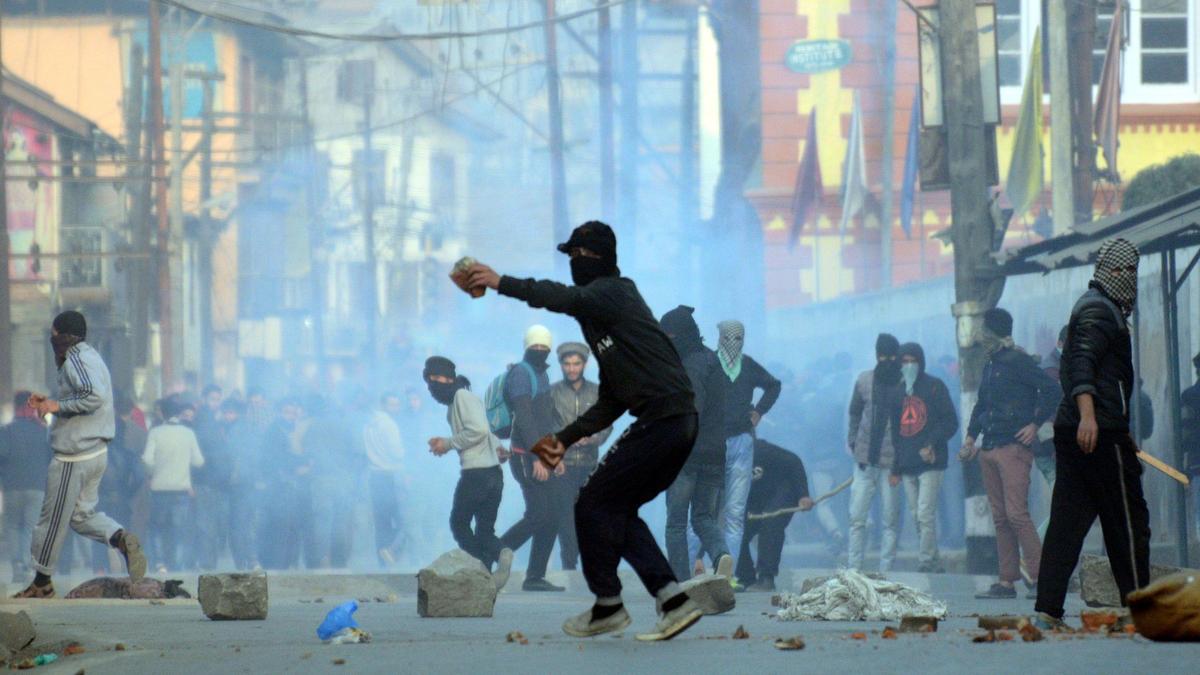
Kashmiri youth clash with police during the 2016 protests in Srinagar. | Photo Credit: The Hindu At the peak of the 2016 protests in Jammu & Kashmir, Javeed Khan (name changed) was protesting on the streets of Srinagar’s old city when a shot from a pellet gun hit him. Everything went blank, a feeling Mr. Khan described as having “hot iron” inside his eyes, and he lost vision in one eye.Ten years later, Mr. Khan vividly remembers that day. “I still get flashes of the day when I lost vision in my one eye. It felt like hot iron inside my eye, setting a fire-like sensation. I am still under the supervision of psychiatrists in Srinagar,” he said.Mr. Khan is one of those thousands of pellet gun victims who carry the scars and visit psychiatrists and ophthalmologists in Kashmir for treatment.With the use of pellets against protesters during the NEET protests in Delhi grabbing the headlines, a 2018 study on pellet victims in Kashmir is back in focus. The study throws light on the psychological impact of the weapon, which impacted around 6,000 locals in 2016.According to the study done by the Government Medical College, Srinagar, 30.38% pellet victims who suffered eye injury reported depression, 16.92% adjustment disorder, 13.08% panic disorder and 10.77% post-traumatic stress disorder (PTSD).Out of 380 cases, 219 (57.63%) had suffered simple pellet gun injuries while 161 (42.37%) had grievous injuries. Grievous injuries were defined as those involving loss of eyes, ears, joints, fractures, disfigurement and emasculation as per Section 320 of the now-replaced Indian Penal Code. All other minor injuries defined by Section 319, 321 and 323 were defined as simple, it said.“It was found that out of 161 cases with grievous pellet gun injury, the majority (65) had depression followed by PTSD, adjustment disorder, panic disorder,” the study said.It said that the majority (260) suffered eye injuries and 100 others reported injuries on their limbs.“In patients with limb injuries 29% cases had no psychiatric illness and the rest of the cases were diagnosed with mixed anxiety with depression, specific phobias, hypomania, PTSD, substance abuse, GAD, panic disorder, adjustment disorder and depression comprising of around 2% to 16% each,” it said.The research paper, published in 2018, studied 380 pellet victims, which included 333 males and 47 females. Most of the cases were in the age group of 10-20 years, comprising 155 (40.79%), followed by 21-30 years, comprising 154 (40.53%) cases. “Most of the cases with psychiatric morbidity (56.97%) belonged to rural areas while 43.03% belonged to urban areas,” it said.In cases with psychiatric morbidity, the study documented that most of the patients belonged to the nuclear family (75.23%) followed by the joint family (18.89%) and the least number of cases belonged to the extended family (5.88%).Pellet shotgun cartridges, which contain up to 500 pellets, were introduced in J&K in August 2010, following street protests that left around 100 civilians dead. According to a study published by the India Journal of Ophthalmology in 2022, 30% of the pellet victims in 2010 reported eye injuries and 50% open globe injuries. “Due to its high speed and small size, pellets most commonly result in penetrating or perforating globe injury or retained intraocular or intraorbital foreign body,” it said.It suggested that CT scan of the orbits was performed in 662 patients (85.2%). “Intraorbital foreign body was reported in 415 patients (62.7%), while intraocular foreign body (IOFB) was detected in 180 patients (27.2%). Two hundred four patients (33.8%) had VH (Vitreous hemorrhage) on CT scan,” it added. Published - July 30, 2026 04:57 pm IST
Depression, PTSD, substance abuse: Kashmir study reveals the psychological impact of a pellet gun wound
Full Article
Original Source
Read the full article at Thehindu →KhanList aggregates and links to publicly available news content. We do not host full articles from third-party sources. Always verify important information with original sources.