
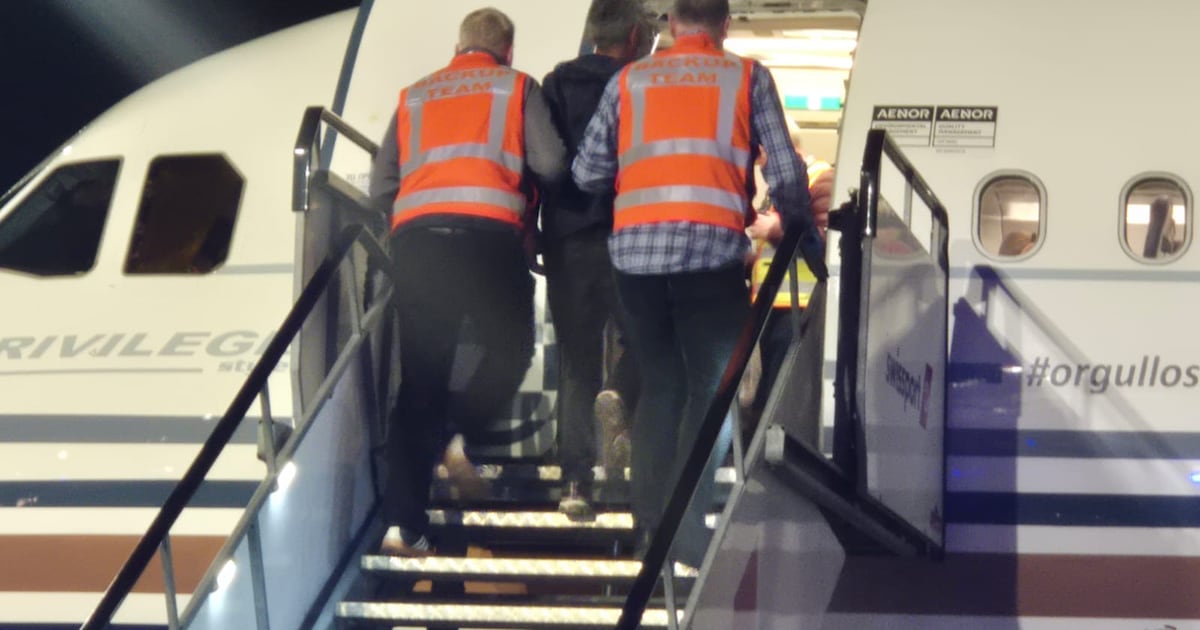
Forty-three Georgian nationals were deported from Ireland on Sunday amid the intensification of removal operations in recent years. . Jim O’Callaghan became Minister for Justice, Home Affairs and Migration in 2024, and he has made illegal immigration one of the Department of Justice’s key priorities. When did the latest flight take place? Sunday’s flight saw 43 Georgian nationals deported, of whom 33 were men and seven were women.Three minors were also deported as part of a family group. READ MOREMany Georgians seek asylum in Ireland, but Georgia is designated as a “safe country of origin” by the Government. The majority of applications by Georgians are refused. Applications from safe countries are fast-tracked, which means a first decision is targeted within 90 days. Many of the people who are sent back to Georgia are ruled to be in Ireland for better financial opportunities due to poverty or economic hardship at home. Some individual claims are based on discrimination due to sexuality or risk to personal safety. Why the focus on deportations? O’Callaghan has said that enforcing deportations ensures that people use proper, legal methods to enter and live in Ireland. He believes a strict and visible removal policy shows the public that the immigration and asylum system is robust and controlled.Some Opposition TDs and migrant advocacy groups have accused the Minister of pandering to far-right and anti-immigrant groups in Ireland. They have criticised frequent social media updates about deportations by the department. However, O’Callaghan insists that deporting people without the right to remain in Ireland is of benefit to the State’s immigration system. How much do deportation flights cost? Figures released by the Department of Justice, Home Affairs and Migration earlier this month, following parliamentary questions from Independent Ireland TD Ken O’Flynn, revealed the Government had spent €570,702 on deportation flights so far in 2026. This included two flights to Poland and Lithuania (at costs of €191,286 and €256,330) and one flight to Nigeria at a cost of €123,085. The flight to Georgia on Sunday came in at €225,575, bringing the total cost of deportation flights so far this year to €796,2777. A total of 349 deportations had taken place in 2026 at the time the figures were released. This includes 282 enforced deportations, mostly via charter flights, and 67 other deportations. Sunday’s flight brings the number of deportations in 2026 up to 392. There were 434 deportations in 2025. This represents a significant increase from 2024 (162 deportations) and 2023 (79 deportations). Who carries out deportation flights? Deportation flights and operations in Ireland are carried out by the Garda National Immigration Bureau (GNIB), which is a specialised unit of An Garda Síochána. The GNIB works in co-operation with the Department of Justice and the Irish Prison Service.When individuals do not leave voluntarily, GNIB officers physically enforce the deportation orders by conducting operations, detaining individuals and escorting them to the aircraft.Flights are normally chartered via private aviation contracts secured by the State. GNIB garda escorts, medical teams, interpreters and independent human rights observers are normally present on deportation flights. What is the position on children?In June 2025, a number of children were removed from school for a deportation flight to Nigeria. The Government faced huge criticism over the manner in which the children were taken from schools in Dublin. In response, O’Callaghan said it would be “untenable” to ban child deportations. Are the destinations safe? At a recent Dáil Public Accounts Committee meeting, the Department of Justice indicated charter flights were also used as it could be unsafe for accompanying gardaí to have to wait in certain parts of the world. Fine Gael TD James Geoghegan, a member of the Public Accounts Committee, said he was struck by the department’s statement that the safety of gardaí in a destination country could be a factor in deciding to fly them straight home on the charter aircraft.“There may well be legitimate operational reasons for that, but it raises an obvious question: if there are circumstances where it is considered unsafe for gardaí to remain in a country, how is that assessment reconciled with the decision to return people there? That deserves a clear explanation,” he said.The Department of Justice said charters had a number of benefits, “including that they allow for groups of people to be removed on one direct flight, whereas most airlines place restrictions on the numbers who can be removed on one flight”.“Furthermore, in many cases commercial flights will require a transit through a hub airport, which brings additional complexity. The security and safety of deportees, Garda and other support personnel and fellow passengers is also an important consideration in determining the mode of travel.”
Deportation flights: How much do they cost, how do they work and why have they ramped up?
Full Article
Original Source
Read the full article at Irishtimes →KhanList aggregates and links to publicly available news content. We do not host full articles from third-party sources. Always verify important information with original sources.