
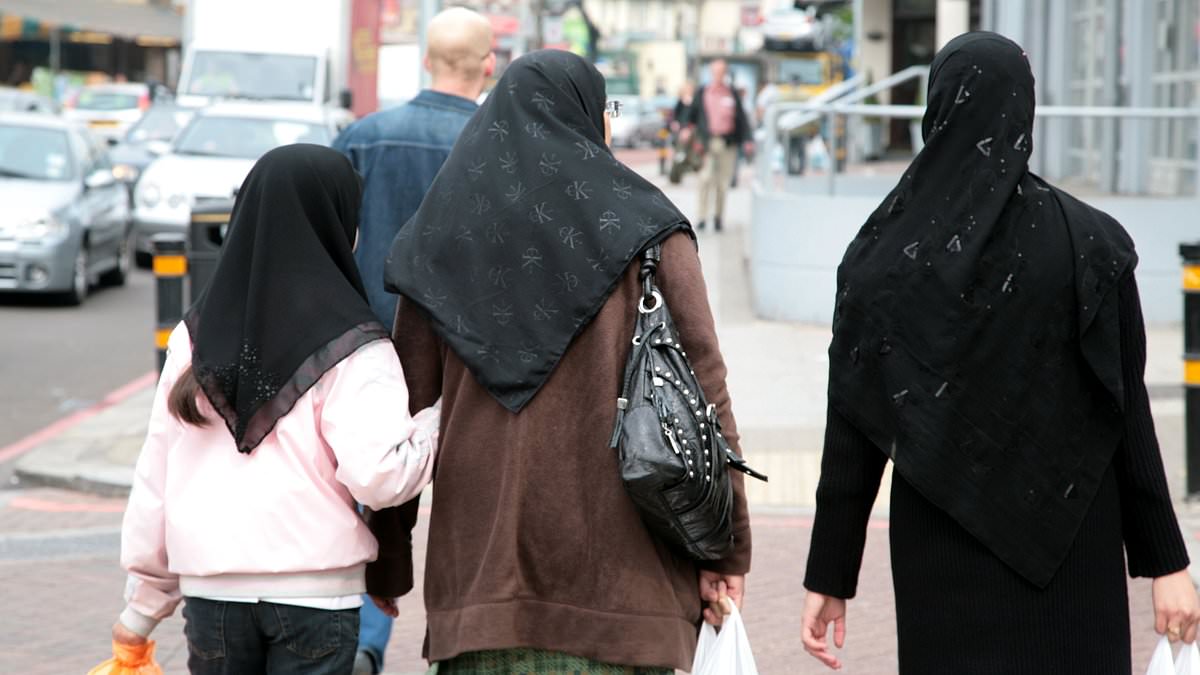
Published: 07:03 EST, 25 November 2026 | Updated: 07:23 EST, 25 November 2026 The Danish government has banned prosecutors from wearing religious headscarves in court. The announcement came as the government debates whether to ban headscarves in schools and universities, and follows a 2018 ban on full-face Islamic veils such as the burqa and niqab in public places.'We are now introducing rules that require prosecutors, just as is the case for professional judges, to appear religiously and politically neutral when they take part in court hearings,' Justice Minister Nicolai Wammen said in a statement.'This includes religious headscarves, which prosecutors will no longer be allowed to wear in court,' he added.The minister did not state what consequences there would be for prosecutors who did not wish to remove their headscarves.It comes as Social Democrat Prime Minister Mette Frederiksen expressed support for a ban on headscarves in primary and lower secondary schools - a proposal put forward by right-wing and far-right parties.At the same time, Frederiksen voiced doubts about whether it could be implemented in a country where freedom of religion and freedom of expression are cardinal virtues.Frederiksen recently stated that in her eyes, 'the veil is an expression of oppression'. The Danish government has banned prosecutors from wearing religious headscarves in court (file image) Social Democrat Prime Minister Mette Frederiksen recently stated that in her eyes, 'the veil is an expression of oppression'However, activists have long noted that headscarf bans amount to removing those freedoms from women by telling them what they can and cannot wear. Denmark has some of the toughest migration laws in Europe, which were introduced after its Left-leaning government, which came into power in 2019, promised to curb migration to 'protect Danishness'. In addition to introducing the famous 'burka ban', new rules came in compelling all newcomers and their children to learn Danish or lose asylum-seeker benefits.Immigrants were also moved around the country to stop a 'parallel' foreign society growing up under a so-called 'ghetto law'.Denmark's border force also has powers to confiscate items such as jewellery and watches from incoming migrants to help fund the cost of their stay.Migrants who tire of Denmark and return home voluntarily are given a £4,500 sweetener to leave.And if a migrant's country of origin is deemed 'safe', such as Syria after last year's fall of President Bashar al-Assad, even a successful asylum seeker can lose Danish residency and face being returned home.Earlier this year, the government also announced plans to ban the call to prayer in Denmark, as ministers complained that parts of the country felt like 'a suburb of Islamabad'.This month, Frederiksen made comments about defending European values and culture. Speaking on November 17 on a Danish political podcast, Frederiksen, of the Social Democrats Party, said she was 'not (a) supporter of a great replacement of the population'.'We are a Danish society and our origin, our descent is ethnically Danish,' she said, a day after unveiling her plan for a European migrant centre in Rwanda, which she has advocated for more than six years.'I am Danish and I am European, I believe in Danish and European values, and I do not want to compromise on them,' the prime minister said.'The majority culture I want to see in Europe in the future is this one.'Her remarks were hailed by the Danish branch of the anti-immigration movement Generation Identity.
Denmark bans prosecutors from wearing religious headscarves in court after female PM called veils 'an expression of oppression'
Full Article
Original Source
Read the full article at Dailymail →KhanList aggregates and links to publicly available news content. We do not host full articles from third-party sources. Always verify important information with original sources.