
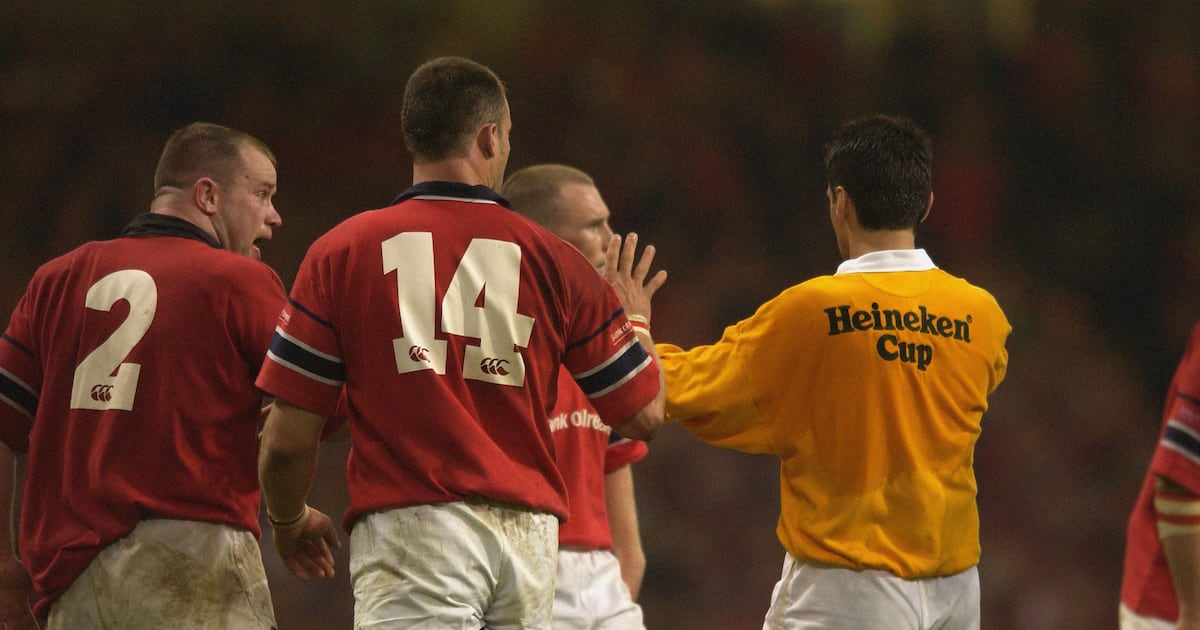
In the build-up to Munster’s Champions Cup game on Saturday, Denis Leamy and Tadhg Beirne both mentioned the “dark arts” and their creeping demise under the rule of law. Leamy is a defence coach now, but he was a flanker in his playing days, so the destruction of nice things has been central to his mission in rugby.“I think the dark arts have gone out of the game around the breakdown,” said Leamy. “Certainly, the team without possession is getting refereed.”Beirne spoke about the increasing hopelessness of trying to defend a lineout maul, at least if he must behave himself. “There were a few ways of getting around the laws a little,” he said. “I tended to do it where you have one shoulder attached to the maul and you can reach around, but that’s all gone now … The dark arts are slowly going out of the game, that’s for sure.”Just like in all team sports, there is a certain, half-suppressed admiration for the “dark arts”. It is an instinctive reaction to dire straits. As a player, or coach, or supporter, if somebody is threatening your tryline or your goal, the means of prevention is suddenly not a matter of conscience. Hymns to fair play are for another time.READ MOREThe phrase “dark arts” comes from a family of words such as skulduggery and blackguarding, all of which include the concept of cheating, even though that word is deliberately silent. It’s like those food labels that carry the soothing phrase “no added sugar”, which is not to suggest that such products are sugar-free.Our attitude to cheating in sport, though, is full of contradictions and double standards. We are appalled by the behaviour of Manchester City, for example, or any doping scandal in athletics or cycling, and we cannot countenance the thought of someone cheating in golf, but we have a certain tolerance for the “dark arts”.Forgiveness for this kind of behaviour is always along party lines. Neil Back has still not been forgiven by Munster supporters for slapping the ball out of Peter Stringer’s hands when Leicester were defending their own line, and a narrow lead, in the closing minutes of the 2002 Heineken Cup final. But Back’s justification for his actions at the time captures the essence of the dark arts: motive, opportunity, a breakdown in surveillance, and a jackpot for petty crime. “This game is all about little edges – particularly in finals – and doing what you can to win,” he said. “That was a very crucial scrum, and I did what I had to do to ensure a win for Leicester. I am not a cheat, and I would be very upset if anyone accused me of being one. What I did was part of the professional game. I am sure that other backrow players have done it in the past.”Neil Back (right) of Leicester tussles with Alan Quinlan of Munster during the Heineken Cup Final at the Millennium Stadium, Cardiff, Wales, May 25th, 2002. Photograph: David Rogers/Getty In common with all practitioners of the “dark arts”, Back rejects its association with cheating, even though the difference is only a matter of labelling: no added cheating, in other words.Hip-drop tackles (which involve a defender dropping their weight onto the legs of an opponent while bringing them to ground) will be banned from November 1stThe “dark arts” is a sidebar issue in rugby’s ongoing reckoning with safety and self-image and how the contact zone is managed. As Leamy pointed out, the breakdown is not nearly as lawless as it once was. The punitive practice of raking the back of a player who had landed on the wrong side of a ruck, for example, was phased out in the build-up to the 1999 World Cup after decades of acceptance. The game, though, was not nearly as conscious of its appearance then as it is now.The way the lineout maul is being refereed this season is not a law change but a “law application guideline” that emerged from a Shape of the Game conference hosted by World Rugby in February.[ Owen Doyle: Conflating cheating with ‘character’ will make refereeing rugby impossibleOpens in new window ]It became a lightning rod for competing visions of how the game should be played. It had been suggested going into that conference that rugby was about to be “depowered” in order to produce “rugby league lite”. It has been reported since by Charlie Morgan in the Times that South Africa and France were instrumental in protecting the status of the maul, leading to the current clampdown in illegal interference. According to one source, South Africa “came out swinging”.Naturally, given their power, the virility of the lineout maul is in the Springboks’ interests. Rassie Erasmus and his assistants reportedly arrived at the conference armed with copious video examples of lineout mauls being disrupted by what Beirne might describe as “dark arts”.Munster's Tadhg Beirne after the victory against Racing 92 in the Investec Champions Cup Round 1, SuperValu Páirc Uí Chaoimh, Cork, on Saturday. Photograph: Dan Clohessy/Inpho Of course, this is not a joust between rugby’s white knights and dark knights, and it is not a matter of right and wrong; South Africa are only interested in leveraging the direction of the game to their benefit. They are world leaders in the “dark arts”.Rugby is more concerned with how it is perceived than it ever was, and, partly to that end, rugby’s laws are in a perpetual state of review. Between now and the World Cup in Australia next autumn, 10 law changes are on the agenda. For example, hip-drop tackles (which involve a defender dropping their weight onto the legs of an opponent while bringing them to ground) will be banned from November 1st.[ Irish rugby bickering is a collision between blowhards and blow-insOpens in new window ]As of October 5th, referees were instructed to punish players who drop to one or both knees before making a tackle. Greater protection for scrumhalfs at rucks has also been introduced. All these measures are designed for enhanced player welfare.Other law changes include less time for kickers to take a conversion, and allowing just 30 seconds to get a lineout set up. There is also more protection for a player trying to move the ball away from a maul. Those interventions are meant to deliver more ball-in-play time and to further enhance the spectacle.“It’s hard to keep scorelines down now,” said Leamy last week, speaking for all bewildered defence coaches as basketball scores have infiltrated the top echelons of the game. “Attacks and the way the game is refereed allows for a little bit more of a free-flowing product.” With the sanitising of rugby, the “dark arts” were always going to meet a legislative termination. Take it or leave it.
Denis Walsh: The ‘dark arts’ are slowly being legislated out of the game
Full Article
Original Source
Read the full article at Irishtimes →KhanList aggregates and links to publicly available news content. We do not host full articles from third-party sources. Always verify important information with original sources.