
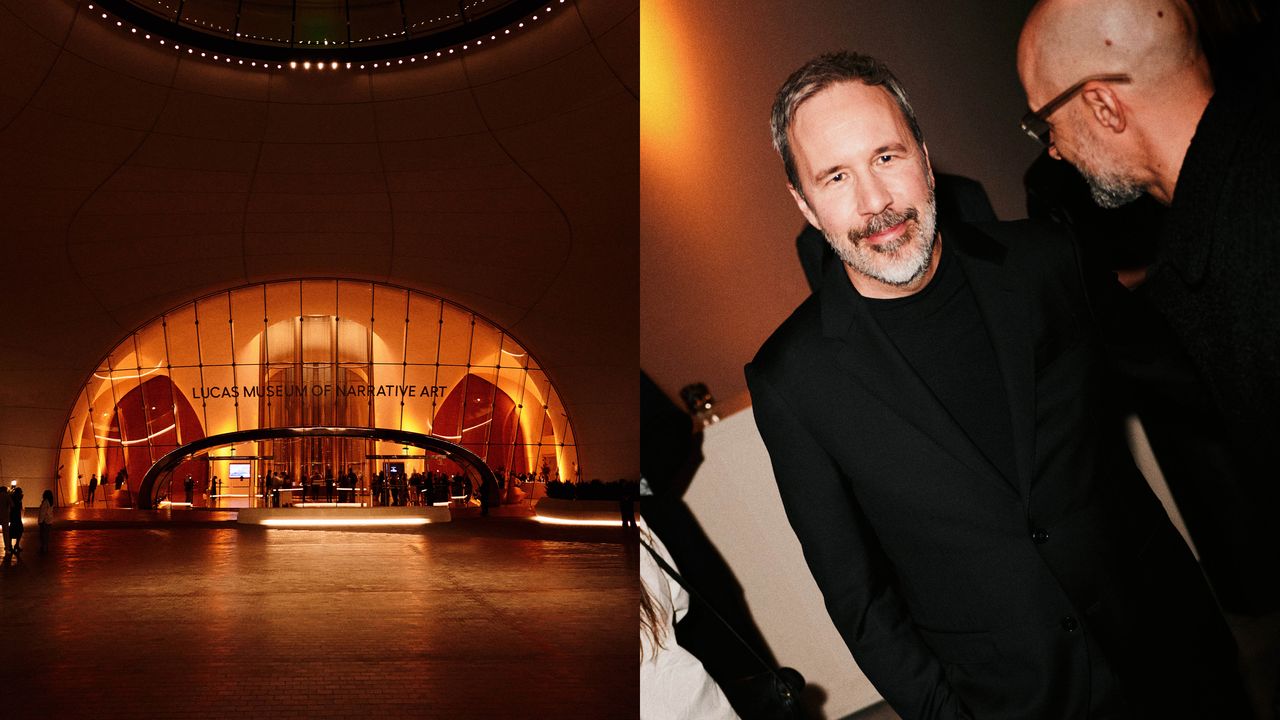
“I’m out of a job,” Denis Villeneuve said, jokingly. Hours earlier, Villeneuve had signed off on the IMAX 70-milimeter print of Dune: Part Three, officially wrapping post-production on that film—and in turn, a decade-long chapter of the Quebecois writer-director’s working life.Fresh off this milestone, Villeneuve and GQ had come to the Lucas Museum of Narrative Art in Los Angeles for a conversation and a private screening of Dune: Part Two, presented by OMEGA, in honor of his anointment as GQ’s Director of the Year. Global Editorial Director Adam Baidawi introduced Villeneuve before the director and GQ’s Zach Baron dove into a conversation that covered his original Dune plans, where Dune: Part Three breaks from its predecessors, and Villeneuve’s feelings about taking over the James Bond franchise.GQ’s Adam Baidawi and Zach Baron with Denis Villeneuve “I feel light,” the director of the year told Baron, then added, “Numb.” He was still processing Dune’s end, he said—while also coming to grips with closing the book on “the most rewarding, inspiring, and best ten years of my life as a filmmaker.”Villeneuve’s first two Dune films have raked in more than a billion dollars at the box office. Part Three appears likely to nearly double that when it hits theaters (and locks up most of the world’s IMAX screens) a week before Christmas. But at one point during his conversation with Baron, the director pushed back gently on the notion of these movies as a “franchise.”“There was nothing industrial in the way they were made,” Villeneuve said. They were the work of “a bunch of friends”—a familial crew, out in the desert putting things together.“In French,” the Quebecois director continued, “there is a word—artisanal. They are very personal. Made with a lot of care. They’re little big things—but in a way, they are delicate.”After all, as sprawling and cosmically grand as they are, these movies are also a deeply personal project for the director, born of images that took root in his head when he first read Frank Herbert’s thick-as-a-brick, notoriously adaptation-resistant 1965 novel Dune at age 13. Later, as Villeneuve racked up credits and clout, people would ask him what his dream project was; the answer was always Dune.“I kept saying to myself, Someone else will do it one day,” he told Baron. “Another filmmaker will adapt this book again. And I kept waiting, and I kept waiting, until I felt ready to do it myself.”Abubakr Ali Pitchfork’s Mano Sundaresan Philippe Uter wearing OMEGA Herbert wrote five escalatingly bonkers Dune sequels before his death in 1986, but Villeneuve intended to walk away from the table after adapting the first book across two films.“Trilogies are very dangerous,” he told Baron. “The first movie is a promise, and if you fulfill the promise with the second one, then there’s a feeling of security that comes with that, and you feel that you have a recipe…That’s the trap. Because then you repeat yourself.”But after wrapping Part Two, Villeneuve found himself unable to stop thinking about Dune Messiah—the second Dune novel, which Herbert supposedly wrote in frustration, believing the audience had missed the point by embracing Paul Atreides as a hero.Villeneuve said his take on Messiah is “a different beast” than the first two films, built it around the tension between Timothée Chalamet’s Paul and his Fremen consort Chani (Zendaya), who Villeneuve has re-imagined—in a pivotal departure from Herbert’s version—as a nonbeliever who takes a critical view of Paul’s rise to power.Van Lathan and Khalika Abrams Tom Francis Neel Shah, Timothy Simons, and Michael Lasker Of course, the specter (S.P.E.C.T.R.E.?) of another franchise hung over the proceedings at the Lucas Museum. Villeneuve, after all, is only technically between jobs; he’s a self-described “monomaniac” who insists that he can only hyper-focus on one project at a time and has been locked in on Dune for a decade, but the as-yet-untitled 26th Bond film is in motion, with Villeneuve signed on to direct.GQ’s Adam Baidawi, Denis Villeneuve, and OMEGA’s Lucien Jornod Denis Villeneuve and GQ’s Zach Baron He could say almost nothing in public about the project, or even when he’d begin shooting it—he joked about having “the target of the sniper” on his chest—but spoke of feeling the responsibility not to fail: “We cannot fuck it up. We do not have the choice.”Over the past week, the casting rumors around Villeneuve’s Bond reboot have reached what our UK colleagues accurately termed the “fever-dream” stage. It might be Callum Turner or Slow Horses’ Jack Lowden, but it might be Robert Pattinson, who’s emerged as a surprise front-runner after months of supposition about the part being earmarked for a relative unknown. At some point, toward the end of Tuesday’s conversation, the subject of Bond 26’s lead could no longer be avoided.GQ’s Adam Baidawi “Has the role of James Bond been cast?” Baron asked the director.“It’s—it’s in the process. In the process,” Villeneuve said with a smile. “I am pushing the gas.”“Blink once for Robert Pattinson,” Baron suggested, “and twice for Callum Turner.”Villeneuve, for the record, did not blink. ✦GQ would like to thank Legendary Entertainment, Warner Bros., and Brianna Smith.
Denis Villeneuve Talks ‘Dune: Part Three’ and Rebooting James Bond: ‘We Cannot F*ck It Up.’
Full Article
Original Source
Read the full article at Gq →KhanList aggregates and links to publicly available news content. We do not host full articles from third-party sources. Always verify important information with original sources.