
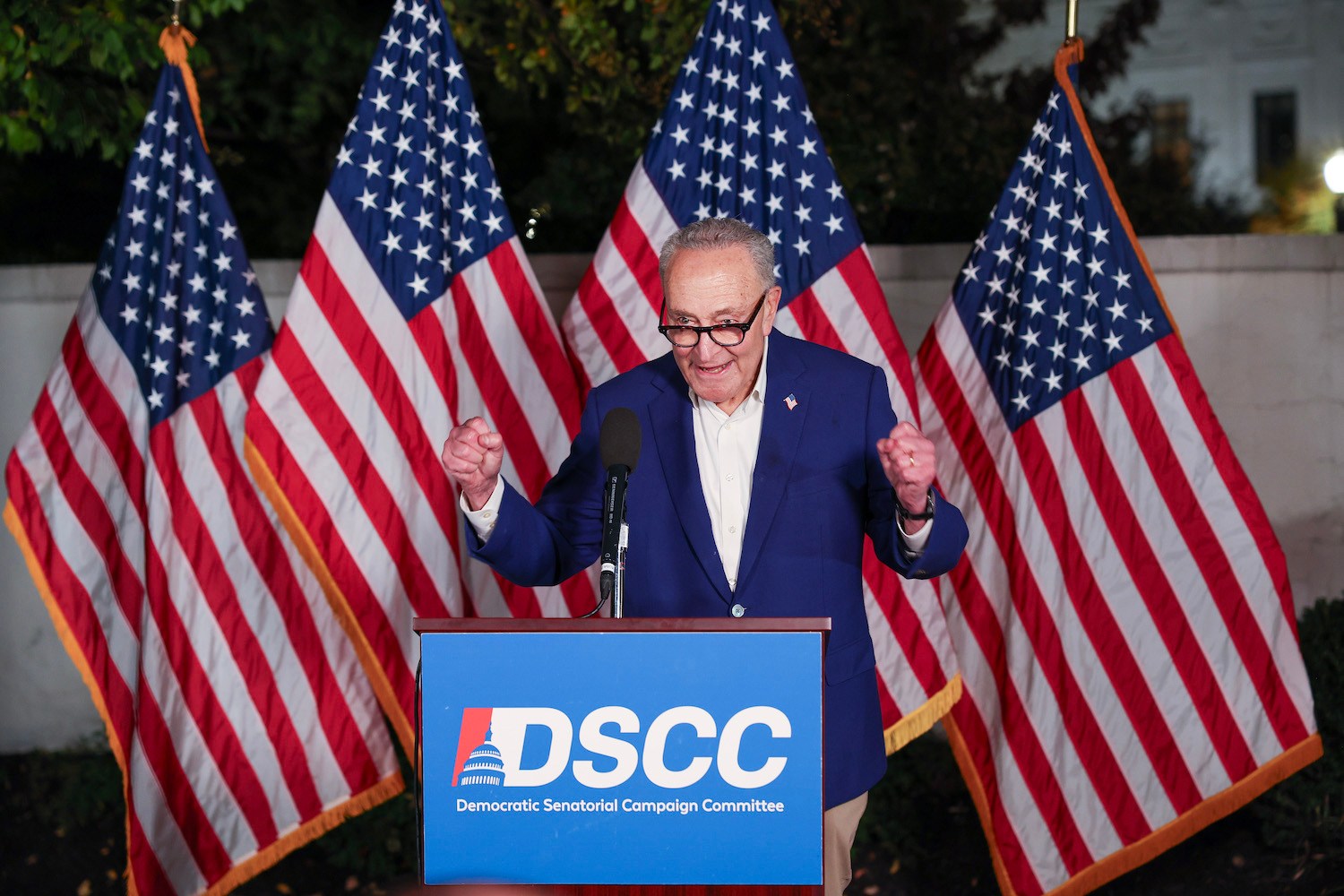
Welcome back to World Brief, where we’re looking at how a Democrat-controlled Congress might impact U.S. foreign policy, the start of coalition-building talks in Israel, and Ukraine’s timeline for European Union accession. The Blue Wave Democrats took back control of the U.S. Congress in Tuesday’s midterm elections in a dramatic rebuke of President Donald Trump and his Republican Party. With Democratic candidates making big gains in historically deep red states, even top White House officials have recognized that Americans appear to be tired of the administration’s playbook and want significant change. “[E]veryone knows why we lost,” Vice President J.D. Vance wrote on X on Wednesday. “And any honest conversation about where we go from here must start there.” According to Vance, many voters’ frustration centered on the Iran war. Since U.S. and Israeli forces first launched strikes on Iran in late February, fuel costs have skyrocketed to record highs, making inflation and pricing concerns the No. 1 issue for more than one-third of Americans, according to an Economist/YouGov poll published in September. The cost of living for the average U.S. household has grown by around $2,000 since the war began, according to economists at Moody’s Analytics. And dozens of U.S. products, from medical supplies to computers to condoms, have suffered strains to their supply chains. On Election Day, Trump appeared to make a last-minute bid to convince voters that his Middle East policies are adaptable, abruptly announcing that Washington will cut off $4 billion in aid to Israel by the end of this year. However, that did not seem to assuage voters. Kansas saw a Democrat win a Senate seat for the first time in nearly 100 years, with other big party flips occurring in Texas, Iowa, and North Carolina. Michigan elected the country’s first Muslim senator, Georgia elected the country’s first Black woman governor, and New Hampshire elected the country’s first openly gay man to serve as a senator. All of them are Democrats. With the left now poised to hold a majority in the Senate and House of Representatives when the new Congress is sworn in on Jan. 3, experts expect that Democrats will crack down on some of Trump’s most controversial policies. That could include challenges to sweeping tariffs, new limits to military spending for the Iran war, and investigations into alleged corruption within Trump’s inner circle. Pursuing the impeachment of Defense Secretary Pete Hegseth could well be at the top of that list. Other foreign-policy priorities for Democrats may include improving the U.S. relationship with NATO; providing greater support for Ukraine; reining in U.S. boat strikes in Latin America; and requiring greater regulation of Big Tech, artificial intelligence, and data centers. Trump has flip-flopped in recent days between agreeing to work with Democrats and vowing to veto everything placed on his desk. House Democrats, meanwhile, have already outlined a 100-day agenda to bring down the cost of groceries, reverse cuts to healthcare programs, and launch investigations into some of Trump’s cabinet members. “Lawyer up,” Rep. Robert Garcia, who will chair the House Oversight Committee in the next Congress, said on Tuesday. Many foreign leaders appeared optimistic that Democrats’ midterm mandate will “introduce a new era in world relations,” as South African President Cyril Ramaphosa said. Norwegian Prime Minister Jonas Gahr Store stressed that U.S. politics may now better align with European priorities, and Spanish Prime Minister Pedro Sánchez compared the results to last month’s left-wing victory in Brazil. Still, analysts anticipate that the road ahead will not be easy for Democrats. “[N]o one should kid themselves that the next two years are going to be anything other than ugly, chaotic, and brutal,” FP’s Michael Hirsh wrote. “Looking ahead to 2028, many of those newly alienated former Trump voters will be up for grabs. The question is whether a badly divided Democratic Party will be in a position to draw them in.” Today’s Most Read Why Kushner and Witkoff Keep Failing by Stephen M. Walt Don’t Read Too Much Into These Midterms by Emma Ashford Reigniting War With Iran Would Be a ‘Huge Gamble’ by John Haltiwanger What We’re Following Coalition talks begin. Israeli President Isaac Herzog on Wednesday formally accepted last week’s parliamentary election results, paving the way for party consultations to begin. His announcement came after Israel’s election commission said that a thorough investigation found “no evidence of irregularities that compromised the integrity of the election or affected its results.” A separate Shin Bet investigation into alleged foreign interference is still ongoing. Herzog’s decision deals a blow to Prime Minister Benjamin Netanyahu’s efforts to sow distrust in the results, which saw his hard-right bloc lose its majority in the Knesset. Netanyahu and his allies have repeatedly touted unsubstantiated claims of Arab-led parties stealing the election, including by allegedly receiving aid from Qatar; Qatar has denied any involvement. Nonaligned Arab-led parties won a record 19 seats in the Knesset in late October. Now, Herzog will begin meeting with party leaders to determine who will be named prime minister-designate. Most individuals are expected to back either Netanyahu or Gadi Eisenkot, the leader of the opposition bloc. However, that will likely depend on who the Arab parties choose to support. Several of Eisenkot’s allies have balked at the idea of allying with Arab groups, yet Arab parties have largely ruled out joining any coalition that includes Netanyahu. Not on target. The European Commission warned Ukraine on Wednesday that it needs to speed up its reform efforts if it wants to meet its European Union accession goal, which is to conclude membership negotiations by the end of 2028. “The Commission is committed to support this ambitious objective but considers that to meet it an acceleration of the pace of reforms is required,” the body wrote in a report seen by Reuters. EU membership remains a core foreign-policy priority for Ukrainian President Volodymyr Zelensky. Kyiv has long argued that joining the bloc would give Ukraine greater long-term security against Russia; the EU granted Ukraine candidate status in June 2022, mere months after Russia launched its full-scale invasion. However, on Wednesday, the bloc outlined only seven policy areas out of 35 in which Kyiv could conceivably finish reforms before its 2028 deadline expires. According to the commission’s report, Ukraine must now focus on improving rule of law standards, delivering an action plan on national minorities, and tackling corruption. Several major scandals have undermined Kyiv’s reform efforts, including controversial cabinet reshuffles as well as evidence of politicians and other elites having received kickbacks from defense contractors. “Act of treason.” Indonesia deployed more than 20,000 troops and personnel to the capital of Jakarta on Wednesday. Although military spokesperson Maj. Gen. Muhammad Nas insisted that the movements were “a normal occurrence,” their timing comes as local authorities are investigating an alleged illegal wiretapping operation targeting President Prabowo Subianto. Earlier this week, Indonesian police detained three senior police generals suspected of intercepting communications, accessing electronic systems, and deleting electronic data between 2025 and 2026. The incident allegedly targeted Prabowo and dozens of other prominent figures, including journalists, activists, and business executives. “Based on the progress of the investigation so far, there are signs and indications pointing toward an act of treason,” Yusril Ihza Mahendra, the Indonesian coordinating minister of law, human rights, immigration, and correctional institutions, said on Wednesday, adding that the operation could have been part of a broader effort to undermine the government. Already, Gen. Listyo Sigit Prabowo, who was appointed as the presidential chief of staff just last month, has been dismissed. Listyo was a known loyalist of former President Joko Widodo, who is Prabowo’s biggest rival and remains highly influential despite no longer serving in public office. Odds and Ends The dachshund has long been a favorite dog breed among the wealthy and famous, from Queen Victoria to Andy Warhol. Now, a German art museum is celebrating the sausage dog’s influence across the ages. On Saturday, the Kunsthalle Bremen unveiled “The Dachshund: An Icon Off the Leash,” an exhibit featuring paintings, photography, stuffed toys, and other works of art by fans of the four-legged hunting dog. The dachshund was “like a muse,” museum director Christoph Grunenberg said, pointing to the impact that it had on artists such as Pablo Picasso, David Hockney, and Thorsten Brinkmann.
Democrats Won Big in the U.S. Midterms. What’s Next?
Full Article
Original Source
Read the full article at Foreignpolicy →KhanList aggregates and links to publicly available news content. We do not host full articles from third-party sources. Always verify important information with original sources.