
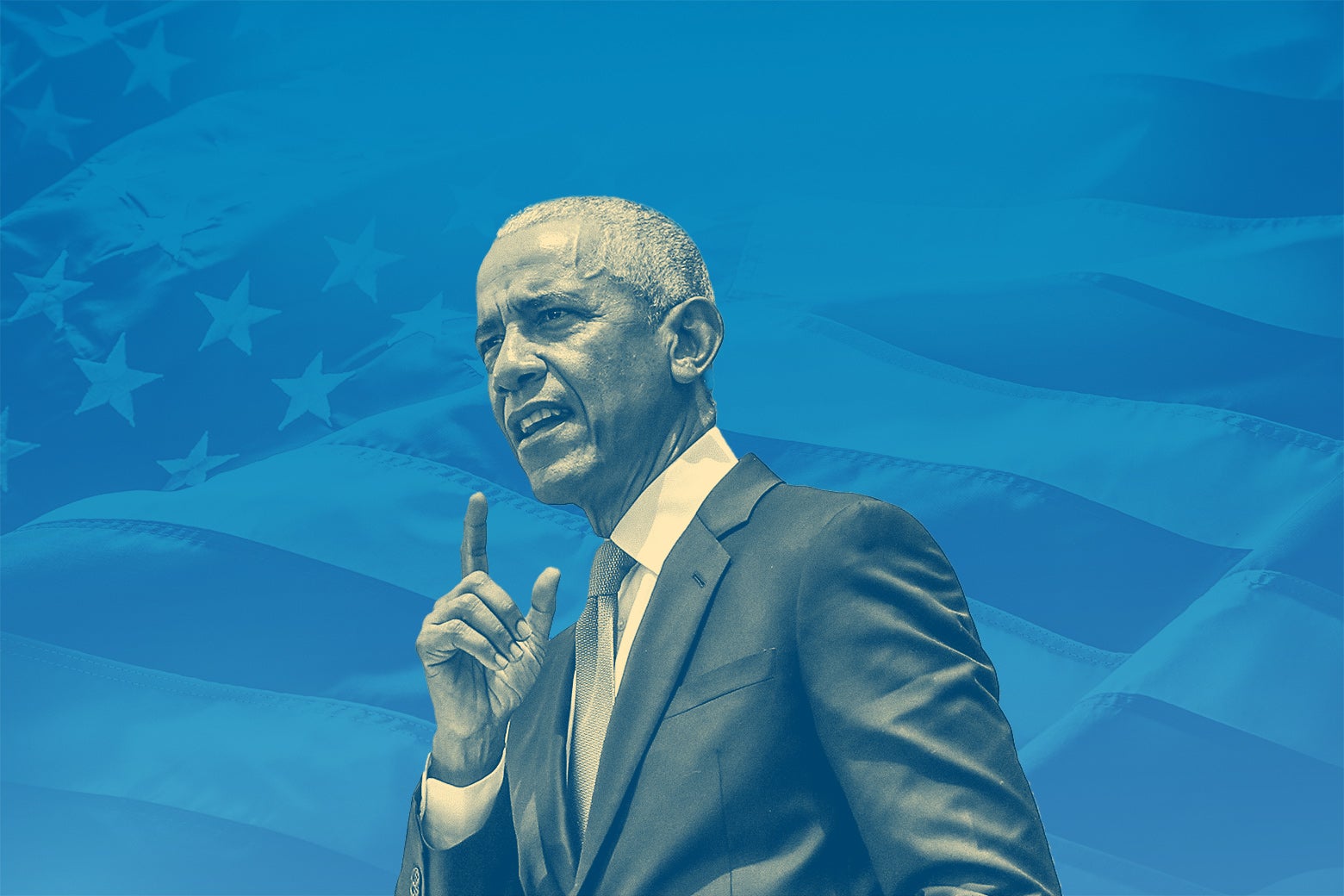
Politics The Problem With the “Next Obama” Democrats have found several stand-ins for the party’s last leader. But the strategy is flawed. Photo illustration by Slate. Photos by weyo/Adobe Stock and Win McNamee/Getty Images. Sign up for the Slatest to get the most insightful analysis, criticism, and advice out there, delivered to your inbox daily. The first time I remember hearing Barack Obama’s name was in late 2006 or early 2007. I was sitting in seventh grade social studies, where we were encouraged to discuss current events. “I think he’s going to run for president,” our teacher confided in a knowing yet slightly hushed tone, almost like she still couldn’t quite believe it. Back then, much of the excitement was bound up in the prospect of America having its first Black president, but Obama ultimately proved himself to be worthy of it. Two decades on, the energy he created has morphed into something decidedly more desperate. Obama is the only Democratic president this century to win reelection and remains one of the country’s most popular political figures. Which might explain why Democrats, looking ahead to congressional elections this fall and a 2028 presidential race whose stakes feel existential, keep looking for the former president’s spiritual successor: someone who can inspire, speak, and above all win, just like the real thing. All summer, voters, consultants, and pundits have repeatedly attached Obama’s name like a Homeric epithet to a bumper crop of young, talented, and mostly male candidates running across the country. It’s happened to Abdul El-Sayed, the party’s nominee for U.S. Senate in Michigan, whose self-confident swagger and immigrant-family story have invited the comparison. “It reminded me a lot of the Barack Obama bio,” Jon Favreau, Obama’s former speechwriter, recalled after seeing El-Sayed at a fundraiser. Then there’s James Talarico, the Texas state representative running for U.S. Senate whose winning primary campaign former New York Times columnist Charles Blow likened to Obama’s 2008 faceoff against Hillary Clinton. After Talarico’s campaign posted footage of the former president stumping with him at a taco shop this spring, the equivalencies flowed in. “I think you have what it takes to be the next Obama and Lord knows we need it!” one Facebook commenter wrote. The Obama parallel has similarly been lavished on two Democratic governors who look set to cruise to reelection this fall: Josh Shapiro of Pennsylvania, and Wes Moore of Maryland, who started fielding Obama analogies even before he became the state’s first Black governor. Pete Buttigieg, the former Biden transportation secretary who isn’t officially running for anything right now, has been getting the comparison for years. Even Graham Platner, the scruffy Maine oyster farmer, was winning Obama-esque praise before his Senate candidacy imploded. Jim Messina, Obama’s 2012 campaign manager, dubbed Platner’s victory speech on primary night a “masterclass” that recalled the 44th president. (A few weeks later, after an ex-girlfriend accused Platner of rape, Messina suggested Platner should “go jump in a Maine lake.”) Further south, Sen. Jon Ossoff, a Georgia Democrat who is up for reelection this fall, has been likened to the former president for viral speeches that are already earning him national attention and fueling 2028 chatter. The search for an Obama inheritor isn’t totally new. Ahead of the 2020 election, Joe Biden, Kamala Harris, and Cory Booker tussled over the former president’s legacy in what the Los Angeles Times perceptively dubbed “the Obama primary.” The search has taken on new proportions and greater urgency as Democrats once again seek to claw their way back to power after yet another Trump presidency. The question is: Even if they find their guy, is an Obama 2.0 what the party needs, now, or in 2028? To give Democrats their due, trying to re-create a popular two-term commander in chief in the aggregate doesn’t seem like the worst strategy in the world. After the Biden interregnum and Donald Trump’s return, nostalgia for better political times appears broadly felt: A January poll of a hypothetical 2028 third-term matchup against Trump found Obama ahead by double digits. (Neither man can legally be elected again.) Historical patterns are worth taking seriously, too. Every couple of decades, it seems, Democrats turn to a sunny, novel-seeming, relatively young man to resuscitate their party’s political fortunes. It happened with John F. Kennedy in 1960, Jimmy Carter in 1976, and Bill Clinton in 1992. And as Obama proved, lesser-known lawmakers with funny names can sometimes go on to make history. But there are a few reasons to wonder whether Democrats’ search for “the next Obama” has gotten a little out of hand—and might inadvertently lead the party even deeper into the political wilderness. For one thing, the comparison has become so common that it’s started to lose meaning, and power. The last few years of American politics are littered with Democrats hailed as the next Obama who ended up falling short. The late PBS anchor Gwen Ifill canonized Kamala Harris as “the female Barack Obama” back in 2009, but Harris’ two presidential campaigns both failed. A 2018 New Yorker article about the presidential prospects of Deval Patrick, the former Massachusetts governor, pronounced him “a kind of political heir to Barack Obama” and quoted former Obama advisers favorably comparing the two men. When Patrick did finally launch a 2020 campaign, it lasted just three months. Obama, of course, isn’t a ghost, and he has been talking up some of the same candidates others are likening to him. Obama called up El-Sayed last month and has publicly praised Talarico, New York Mayor Zohran Mamdani, and other promising young Democrats. Still, not even Obama’s Obamadar is perfect. In 2018, as Beto O’Rourke was weighing a national campaign, the former president was the one drawing comparisons between them. “The reason I was able to make a connection with a sizable portion of the country was because people had a sense that I said what I meant,” Obama said then, making clear that he felt O’Rourke shared that special touch. Former Obama aides reportedly called O’Rourke’s people to offer their help, remarking that the lanky Texan reminded them of their former boss. “He’s Barack Obama, but white,” one Democratic bundler told Politico. Judging by polling and fundraising, though, the rest of the country didn’t agree: O’Rourke ended up dropping out before a single primary vote was cast. That doesn’t mean Obama was wrong about their similarities. But it does suggest that giving party apparatchiks shivers of recognition isn’t enough. Another factor complicating things for the latest Obama mini-mes: Candidates themselves are starting to lean into the comparison. For them, giving off Obama vibes can be a convenient shortcut to national prominence, campaign contributions, and glowing press. But for the rest of us, it can be hard to tell whether someone is truly an Obama-caliber candidate or is just staring in the mirror a little too hard. El-Sayed, for example, used to shy away from the parallel. “There are a lot of things I disagree with President Obama on—in terms of both domestic and, certainly, international politics,” he told Vox during his 2018 run for Michigan governor. “I’m not him, and I have no intention of being him.” Last month, though, he struck a different tone. “I never saw myself in politics until I saw him give that 2004 speech on the DNC floor,” El-Sayed admiringly declared of the keynote address that propelled Obama to national stardom. El-Sayed has since doubled down, noting that Republicans have been highlighting his full name—Abdulrahman—just as they used to surround “Barack Hussein Obama” with scare quotes. (Trump, a leading proponent of the conspiracy theory that Obama was born in Africa, still does this.) Efforts to replicate the former president’s mien can also risk coming off like imitation—or, worse, parody. Shapiro’s cadence, inflection, and conspicuous use of the pregnant pause have long invited comparisons to Obama’s speaking style, not all of them positive. “It’s like if I tried to do a really bad impression of Barack Obama,” Vice President J.D. Vance has said. Shapiro is an electoral juggernaut—polls show him with an overwhelming lead in an otherwise purple state—so this might not matter much. But it has already become a punch line that could resurface if he runs for president. (“Barack Obama is the greatest orator of my lifetime,” Shapiro said when asked about the parallels in 2024, denying that he’d ever intentionally emulated the former president.) Seeing future standard-bearers through Obama-shaped glasses could also lead the party to some uncomfortable places. Since Trump’s return, candidates perceived as authentic, rough-hewn non-careerists have captured Democrats’ hearts. Obama sure has his charms, but he comes out of a different mold: the Harvard-educated lawyer who pictured himself in the Oval Office from an early age. Republicans seem to be realizing that an Obama redux can be spun into an insult—even as they also seem to be warily looking over their shoulders. When Fox News host Laura Ingraham declared Ossoff the Democrats’ “new Obama” in June, she did not mean it as a compliment. After a rally in which Ossoff made a knowing reference to Natalie Harp, a Trump White House aide with whom the president has a suspiciously close relationship, an administration spokesman blasted the freshman senator as “a cringeworthy, feminine theatre kid cosplaying as Barack Obama.” There are other downsides to the Obama-replication effort. Voters looking for a president often prize stereotypically masculine traits: Height, a deep voice, a healthy reverence for U.S. military might—all while still seeming chill enough to grab a beer with. Women can have all of those qualities, too, and political science research suggests female candidates often perform as well as or better than male ones. But it’s probably no coincidence that few women have cracked pundits’ list of Obama-like figures. Harris and Rep. Alexandria Ocasio-Cortez, whose rapid ascent one Democratic strategist has called “eerily similar” to Obama’s, may be the only exceptions. Then, of course, there’s the small matter of actually beating Republicans in elections. Voters and consultants looking for an Obama-esque standard-bearer risk over-indexing on certain qualities—an inspiring backstory, an exciting policy agenda, or a smooth jump shot—while underrating others that may resonate beyond die-hard Democrats. As a candidate, Obama had the rare ability to come off like a centrist to centrists and like a progressive to progressives. But he also practiced strategic moderation, publicly opposing same-sex marriage during his first presidential run while both supporting a pathway to citizenship for immigrants who lacked permanent legal status and cracking down on unauthorized border crossings. In this way, superficial Obama similarities can mask differences that may end up being determinative in the voting booth. El-Sayed has thrilled progressives by supporting Medicare for All and trading insults with Trump—which may also help explain why he’s one of the swing-state Democrats most in danger of losing in November. (Most polls show El-Sayed leading his Republican opponent relatively narrowly even as Democrats in other purple states—including Ossoff, Shapiro, and Roy Cooper in North Carolina—appear comfortably ahead.) El-Sayed has also tolerated controversy to a degree that Obama never did. Confronted during the 2008 campaign with his longtime pastor Jeremiah Wright’s inflammatory comments, Obama cut Wright off, condemned his remarks “in unequivocal terms,” and delivered a speech that transubstantiated the controversy into a public meditation on racism and patriotism. El-Sayed, meanwhile, has repeatedly resisted calls—including from other Democrats—to disavow Hasan Piker, a left-wing streamer who has said that “America deserved 9/11.” (Piker has apologized for that one and El-Sayed called it a “dumb statement,” but Republicans are still trying their darnedest to turn it into a general-election liability.) There’s also the fact that campaign tactics and political mores have evolved since Obama’s day. The former president has sometimes spiced things up since leaving office, dropping the encomiums to America’s better angels he dispensed when he was on the ballot. At the 2024 Democratic National Convention, Obama suggested that Trump’s “weird obsession with crowd sizes” might have something to do with his anatomy. Still, Ossoff’s recent dig at Harp, which uncorked a geyser of speculation that she and the president may be having an affair, was a notably un-Obama-like move. David Axelrod, the former president’s onetime chief strategist, called it “gratuitous and unnecessary.” But Ossoff’s remark also commanded attention, feeding a boomlet that helped bump up his standing in polls of the hypothetical 2028 presidential primary. If the high horse Obama successfully rode into the White House is truly dead, Democrats who pretend otherwise risk getting outflanked. Last, all the Obama comparisons in the world won’t help Democrats figure out whether his technocratic, center-left brand of institutionalism remains the governing approach the party should adopt the next time it holds power in Washington. Obama himself has acknowledged that politics has changed since he left. “If I were running today, I wouldn’t run the same race or have the same platform as I did in 2008,” he said in 2020. The next Democratic congressional majority and the next Democratic president will have to make choices about which issues to prioritize and how far to push them: climate or healthcare, incremental progress or sweeping overhaul, policy or institutional change. In a sense, this is just the latest rejoinder in an ongoing fight. The 2020 Democratic primary was riven by debates over whether to build on Obama’s incremental progress on healthcare or start afresh with something like Medicare for All. That time, the pro-Obama wing won the argument, but Trump’s return has even moderate Democrats wondering if it’s time to try the other path. “It showed me the need for institutional change,” Buttigieg recently told NOTUS of his time working for Biden. “Democrats can’t take us back to the early 2020s or the 2010s,” he added. “We shouldn’t try.” Other Democrats weighing presidential runs are looking even further back in time. “I’m an FDR Democrat,” Rep. Ro Khanna of California said this week in New Hampshire. “I’m a Democrat who believes that this party needs to do big things again.” Amid all the hagiography, Obama’s record warrants some scrutiny. Some of his achievements, most notably the Affordable Care Act, still stand. But his presidency didn’t come close to solving structural issues that still plague the party today, from a gerrymandered House to a Senate tilted toward Republican-dominated states. And in Obama’s choices and temperament—from not passing a more generous economic stimulus and not pressuring Ruth Bader Ginsburg to step down from the Supreme Court to privately anointing Hillary Clinton as his preferred successor in 2016—there’s a case to be made that the 44th president bears some responsibility for the paroxysms of the Trump years. So if not the next Obama, who should Democrats be looking for? To answer that, it’s worth going back to seventh grade social studies. Even as my teacher whispered about him excitedly, Obama was far from the consensus choice. Back then, Democrats had a different broadly successful two-term president to look back on. Hillary wasn’t Bill; her 2008 campaign took pains to emphasize their differences. But she was literally another Clinton, and as late as January 2008 commanded nearly double Obama’s support among Democratic primary voters. Yet those same voters ended up rejecting a Clintonian retread—and holding the White House for the next eight years. There’s a clear lesson there. Ultimately, trying to clone Obama is likely to be a fool’s errand. He’s a pretty singular figure. So rather than fixating on candidates who resemble him in mannerisms or policy, Democrats might instead try to find someone who can do what he did: Give them a new way to think about politics that was so transformative that the party is still pining for it nearly 20 years later. As Obama memorably put it once upon a time, “Change will not come if we wait for some other person or if we wait for some other time. We are the ones we’ve been waiting for.” Barack Obama Democrats Elections 2026 Midterms 2028 Campaign
Democrats Keep Looking for the “Next Obama.” They Should Do This Instead.
Full Article
Original Source
Read the full article at Slate →KhanList aggregates and links to publicly available news content. We do not host full articles from third-party sources. Always verify important information with original sources.