
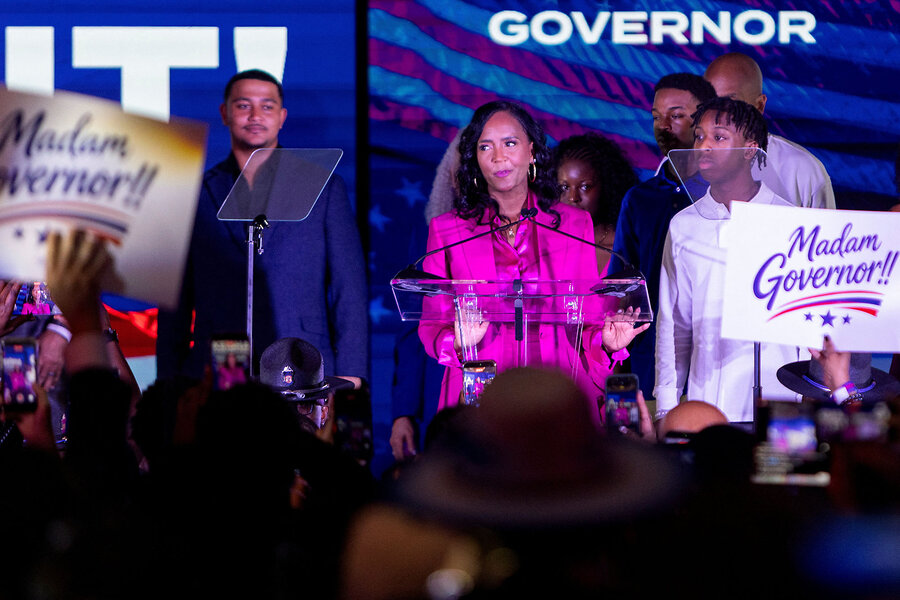
Washington | Nov. 04, 2026, 6:15 p.m. ET | 4 min read The blue wave that changed the political landscape in Washington this week also appears to have swept Democrats into a majority of governorships for the first time in decades.Democrats are expected to control at least 28 governorships in 2027, holding on to key swing states and flipping five states – Georgia, Iowa, Texas, Ohio, and Nevada – from Republican to Democratic.Experts say those election results could have numerous effects on the political landscape. They could alter how states respond to what they see as federal government intrusion into state affairs, especially regarding public safety. And, the strongly negative vote against President Donald Trump and his party could start the process of redefining what Republicans and Democrats actually stand for, rather than simply opposing each other. “This election was a full rebuke of the Trump administration,” says Saladin Ambar, a political scientist at Rutgers University and senior scholar at the Eagleton Institute’s Center on the American Governor. “You’d have to have your head in the sand to miss it.”Dr. Ambar expects state leaders will become more assertive in dealings with the federal government. It’s about states’ rights, he says.In his view, that means asserting independence from authoritarianism, including refusing to collaborate with immigration and deportation activities by Immigration and Customs Enforcement. “So you will see more assertiveness from the Democratic governors, and you’ll see it from Republicans, too.” Ashley Landis/APTexas Democratic gubernatorial candidate Gina Hinojosa arrives to speak to supporters at an election night event in Austin, Texas, Nov. 3, 2026. For citizens, governors are often beloved or harshly judged for how they carry out day-to-day governmental functions such as public safety, roads and bridges, schools, and public health. As a result, governor’s mansions are what Dr. Ambar calls a “nursery for presidential candidates,” with Presidents Jimmy Carter, Ronald Reagan, Bill Clinton, and George W. Bush being a few recent examples. The class of 2026 includes more than 14 Democratic governors, among them Texas’ first Latina governor, and New Mexico’s first Native American governor. Tuesday's winners also pushed the number of Black governors to a record five, including a Republican in Florida, and Georgia's first female state executive. Some could be examined for their potential to be presidential candidates in the future. Among current governors, Pennsylvania’s Josh Shapiro, who won reelection Tuesday, has signaled his intention to run in 2028, and Kentucky’s Andy Beshear and California’s Gavin Newsom have also been named as likely candidates. SOURCE: Associated Press | Jacob Turcotte/Staff The Democratic winners benefited from Republican governors’ ties to an unpopular president. Heading into the 2026 election, President Trump’s approval ratings were 36%, and while Mr. Trump’s name was not on any ballots, discontented voters punished the president’s party.While Republicans held on to the governorship of Florida, Democrats won races once thought to be solidly Republican.In Texas, voters replaced Republican Gov. Greg Abbott with Democratic state legislator Gina Hinojosa. Texas had not elected a Democrat to one of its statewide offices since 1994.Democrats ousted Republicans in the Deep South and the swing states of the Midwest. Former Atlanta Mayor Keisha Lance Bottoms defeated billionaire Rick Jackson in Georgia, while in Ohio, Democrat Amy Acton defeated biotech billionaire Vivek Ramaswamy. Carolyn Kaster/APOhio Democratic gubernatorial candidate Amy Acton raises her arms during an election night event Nov. 3, 2026, in Columbus, Ohio. Democratic victories in governorships came not because of a powerful unifying message, says Greg Love, a political scientist at the University of Mississippi.“The Democratic brand is not strong. It’s just a lot better than the Republican brand at the moment,” he says. What brought voters to the polls was a frustration that was “anti-incumbent and anti-Trump,” he says. “Trump is deeply unpopular, and Democrats turned that to their advantage,” Dr. Love says. “The question is, What does Trump do now? What do Republicans do now? What do Democrats do now?”Dr. Ambar points to a number of political shifts that have occurred in American politics. One was the realignment of the Republican Party in the mid-1960s to oppose the Civil Rights Act and other federal policies of desegregation. Another was the presidency of Bill Clinton, which abandoned the expensive social welfare programs of Lyndon B. Johnson and Franklin D. Roosevelt and adopted the pro-business policies of the right.“He said the era of big government is over, because the Democrats were in the wilderness,” Mr. Ambar says. “I think you will see some of that happening on the Republican side now.”Consider Ms. Hinojosa, he says, and what she means for the state of Texas. “How do you go forward in that state if you’re Republican, carrying the banner of MAGA?” Deepen your worldviewwith Monitor Highlights.Politics with respectGet political stories with respectful analysis.There‘s a world of new ideas in everyBooks newsletter.There‘s more to life, enrich yours withCulture & Learning weekly.Follow humanity‘s discoveries withScience & Nature stories in your inbox.Gain a spiritual perspectivefrom the stories in your inbox.Want to understand the deeper impact of critical events? Learn the Monitor‘s insight.Already a subscriber? Log in to hide ads. “Just as the Democrats had to adopt new ideas under Bill Clinton, the ground has shifted for Republicans, and redefined what it means to be conservative. That debate is taking place, now.”Staff writer Victoria Hoffmann contributed to this report from Boston. ALREADY A SUBSCRIBER? LoginReal news can be honest, hopeful, credible, constructive.The Christian Science Monitor was founded in 1908 to lift the standard of journalism and uplift humanity. We aim to “speak the truth in love.” Our goal is not to tell you what to think, but to give you the essential knowledge and understanding to come to your own intelligent conclusions. Join us in this mission by subscribing.
Democrats have a majority of governors. That could have political ripple effects.
Full Article
Original Source
Read the full article at Csmonitor →KhanList aggregates and links to publicly available news content. We do not host full articles from third-party sources. Always verify important information with original sources.