
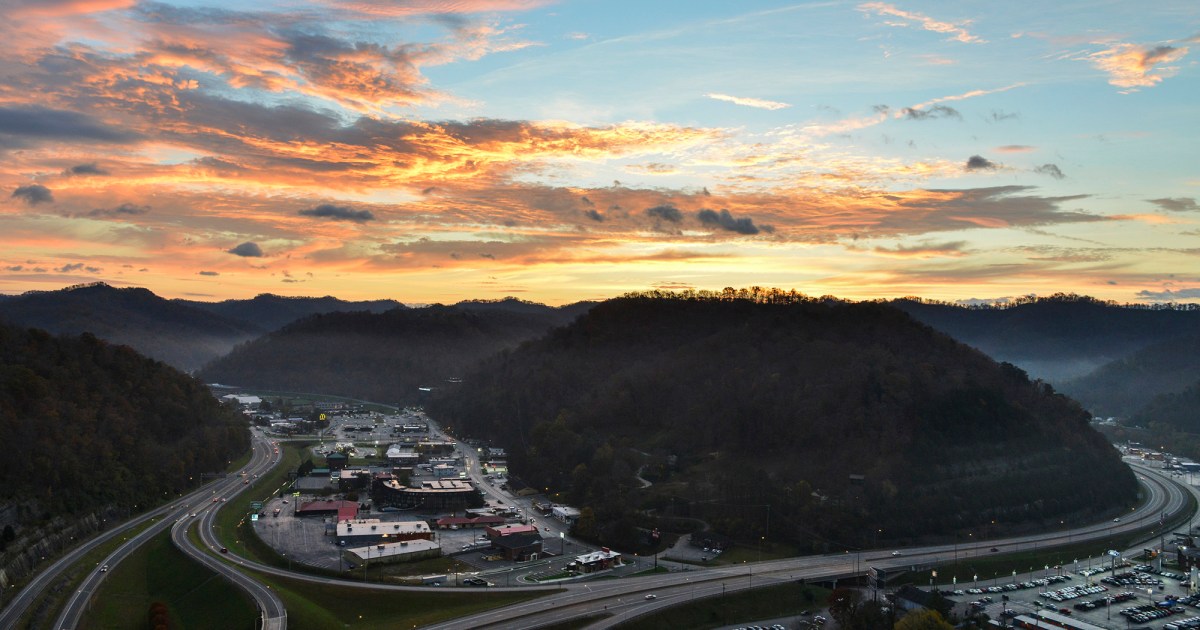
The town of Pikeville is woven into the valleys of eastern Kentucky coal country of Pike County.Jahi Chikwendiu/The Washington Post/Getty Get your news from a source that’s not owned and controlled by oligarchs. Sign up for the free Mother Jones Daily. Eastern Kentucky Democrats used to brag that when the 1972 results came in, Richard Nixon had won nearly everywhere except for Massachusetts and Floyd County. It’s been a long, long way down for Appalachian and rural Democrats since then. On Tuesday—as Dems made massive gains nearly everywhere in the country—they quietly lost the state House seat based in Floyd County, and with it, their very last rural representation in the Kentucky General Assembly. It won’t matter much for the political balance in the GOP-dominated legislature, but it is a telling bookend for one of the Democrats’ longest-lasting strongholds: counties like Floyd at the mountainous eastern end of the state, once reliant on coal mining and now beset by persistent poverty and population decline. Democrats’ midterm results were a bonanza nationally and in other parts of the Bluegrass State, headlined by Zach Dembo’s decisive victory in a congressional seat that was considered safely Republican until recently. Downballot, they picked up seven seats in the Kentucky state House and two in the state Senate—all in suburban areas, mostly around Louisville. But Republicans retained their so-called “super-duper majority” in both chambers, allowing them to easily override any vetoes issued by Democratic Gov. Andy Beshear. The GOP would have accomplished this regardless of the suburban results, for one reason: Even in a wave year, Democrats couldn’t win any of the more rural districts that cover most of the state. In Floyd County, the incumbent Democrat didn’t run for re-election. Democrats’ nominee, Johnny Ray Turner, had deep experience, having previously served 20 years in the state Senate—some of it while simultaneously serving home detention and probation after pleading guilty to “not willfully” participating in a scandal involving “the distribution of campaign checks payable to various persons for the purpose of inducing them to vote for Johnny Ray Turner” in the 2000 election. A brief aside: Back in 2020, Turner lost his state Senate seat to a similarly-named Republican, Johnnie Lloyd Turner. Neither Johnny Ray Turner nor Johnnie Lloyd Turner should be confused with former Sheriff John L. Turner of nearby Breathitt County, who was the ninth person to plead guilty or be convicted of vote-buying in a separate 2010 primary. Some of the last legislation Democrat Turner sponsored before losing his state Senate seat to Republican Turner included a pro-life “born alive” bill and a measure to tweak regulations on cleaning up coal waste heaps. But even his long track record wasn’t enough to win more than 40 percent of the vote this year, even in a district that voted for Beshear three times in statewide elections. Kentucky politicians have boasted of representing the whole breadth of the state, “from Paducah to Pikeville,” and Democrats (often conservative ones) used to rely on votes from some mountainous counties of Eastern Kentucky and farm-heavy areas of Western Kentucky. But as national forces came to dominate politics and Democrats elsewhere shifted left, the party has been eviscerated at both ends. US Senate candidate Charles Booker ran a progressive-populist campaign aimed at people “from the hood to the holler” and improved on his 2022 Senate performance, but he still lost 117 of Kentucky’s 120 counties. Now, for the first time in history, the Kentucky Democrats in the next General Assembly will all hail from in and around Louisville, Lexington, and Frankfort, and from the suburbs of Cincinnati. Beshear, whose personal popularity remains high, has long depended on support from Trump voters. But his rural successes have hardly boosted the rest of the party. Nearly all of his vetoes have been overridden, and he and Lieutenant Gov. Jacqueline Coleman are the only statewide elected Democrats. One Kentucky political commentator, reacting to last week’s results, wrote that Beshear “had an obligation to help rebuild his party at the legislative and local level, but he doesn’t seem to have done much of anything for it. Instead, he largely invested his political committee’s money in politicizing races for nonpartisan judgeships.” In response to that criticism and questions from Mother Jones, Nat Turner, the director of communications for the Kentucky Democratic Party, defended the governor’s efforts, saying his endorsements and fundraising helped Dembo and the nine Democrats who flipped seats in the General Assembly. “Governor Beshear is the leader of the Kentucky Democratic Party and is by far its largest fundraiser, raising over seven figures for the party this cycle,” Turner wrote. “With those resources, the party invested directly in mail and digital for state legislative candidates and was able to flip nine state legislative seats, including House and Senate leadership, and only lose one.” Kentucky Republicans have spouted triumphalist rhetoric across their decades-long romp to victory in rural Kentucky. When Democrats’ very last rural state senator switched parties last year, Republicans called it “the final chapter of Democratic dominance in eastern Kentucky.” After Democrats lost their majority in the state House in 2016, GOP Congressman James Comer—who represents a sprawling district based in the western part of the state—joked that he wouldn’t make fun of them, lest he be indicted for abuse of a corpse. Comer is widely expected to run for governor next year. He may face Coleman, or former Beshear adviser Rocky Adkins. When Adkins represented an Eastern Kentucky district in the state House, he cast pro-life and anti-gay marriage votes typical of rural Democrats at the time. But, facing a more liberal primary electorate next year, he has recently backpedaled, saying he and many Kentuckians have “evolved on those issues.” Coleman, too, once branded herself as a “pro-life compassionate Democrat” before gradually changing tune. Tuesday was a surprisingly strong night for one Democrat from central Appalachia—Richard Ojeda, who ran staunchly populist campaigns for Congress in West Virginia in 2018 and 2020 and more recently called Rep. Virginia Foxx “Satan’s meemaw.” He won a US House seat in a huge upset, but it wasn’t in the mountains. Ojeda had moved to North Carolina and won a district anchored in rapidly growing areas between Greensboro, Fayetteville, and Chapel Hill. Even on a strong night, neither Ojeda nor his party have much of a home in coalfields that Democrats once dominated.
Democrats Finally Lost Their Last State House Seat in Rural Kentucky
Full Article
Original Source
Read the full article at Motherjones →KhanList aggregates and links to publicly available news content. We do not host full articles from third-party sources. Always verify important information with original sources.