
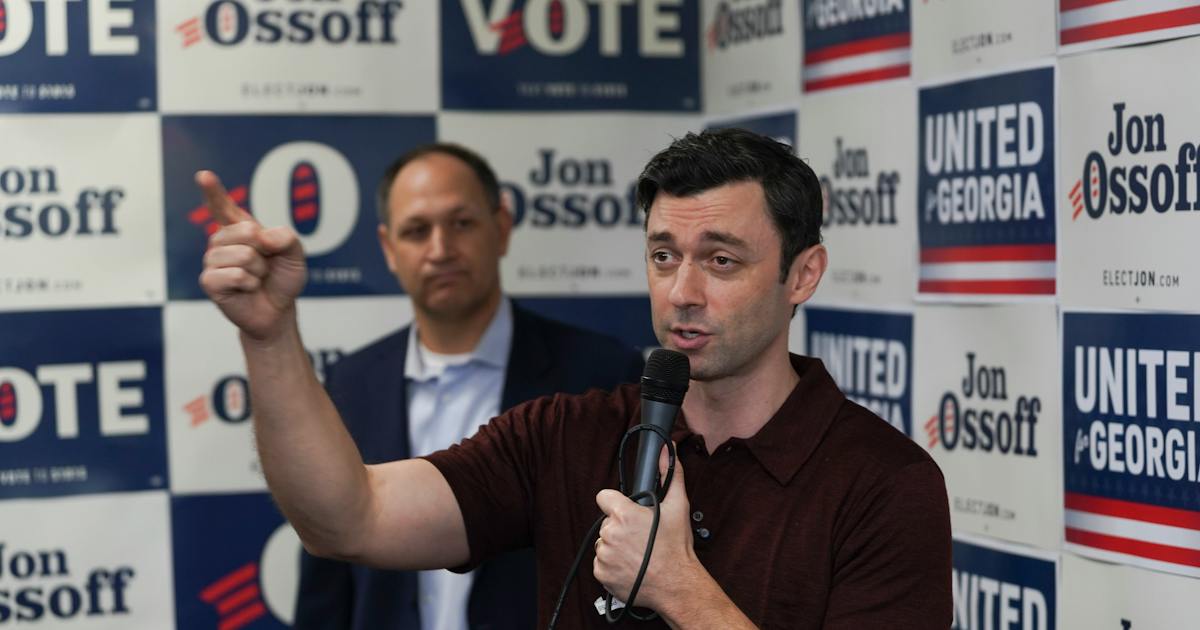
In recent weeks, I’ve been fortunate enough to observe two competing visions for Democratic senators should they retake the upper chamber in next month’s midterm elections. On the one hand, we have Senators Martin Heinrich and Sheldon Whitehouse, who announced at the end of September that they were teaming up with their Republican counterparts Mike Lee and Shelley Moore Capito on the Bipartisan American Affordability and Jobs Act of 2026, which the quartet believe will “reform the federal environmental review and permitting process.” Per their press release, “This groundbreaking agreement will deliver cheaper energy, more jobs, and responsible growth across the United States.”On the other hand, we have Senator Jon Ossoff, who has taken the debate stage twice in recent days to tell his Republican opponent to his face that he’s a racist scumbag.My paraphrasing here is more blunt than the rhetoric that Ossoff has been using, but only just. In the pair’s first debate, Ossoff threw daggers, accusing Representative Mike Collins of hiring “half the Third Reich to staff [his] congressional office,” adding, “If John Lewis were marching today from Selma to Montgomery, Mike Collins would be grabbing a billy club.” During Tuesday night’s debate, an embittered Collins tried to play the civility card, claiming that Ossoff’s incendiary statements about Collins’s very real embrace of white supremacy had led to death threats. Ossoff breezily brushed away the accusation and went back for more. Referring to Collins’s son-in-law, a white-nationalist influencer, Ossoff jabbed: “Can you commit for just three weeks to stop the production of neo-Nazi propaganda from your home?”This is like watching a fever finally break, and it’s not just Ossoff. In the Michigan Senate race, Abdul El-Sayed has gone at Mike Rogers with both barrels, repeatedly referring to the former congressman as weak and cowardly. In Maine … well, let’s just say that I wished Troy Jackson had a bit of that dog in him, but he doesn’t. Still, I can tell he’s trying, and his better moments against Senator Susan Collins, like telling her “You can’t eat road salt,” at least have a bit of a surly edge. At any rate, the rise of rude Democrats has got me believing in the potential cure for one of our greatest civic maladies: degenerative Senate brain, the very condition that leads a Sheldon Whitehouse or a Martin Heinrich to work with MAGA filth bent on desecrating the constitutional order.Right now, there should not be a bipartisan anything, unless it’s a negotiated agreement to mass-retire Republican lawmakers. As I’ve noted numerous times before, the GOP is essentially a criminal syndicate, aiding and backstopping a corrupt and self-dealing presidential administration. There can be no collaboration with Donald Trump and his goons on any level. So, no: I don’t want to see Democrats reaching for comity and accommodation. I don’t want collegiality. What I want to see is Democrats dogwalking their Republican opponents on live television. People like Ossoff are giving me faith that there are members of this party who are truly wedded to the notion of robust accountability, which is what the post-Trump era desperately needs.One thing that the years ahead can do without, however, is pundit and anthropomorphic smarm-fountain David Brooks, who is apparently not a fan of Ossoff’s sublime debating technique. This week, in an appearance on PBS Newshour, Brooks complained, “Jon Ossoff, my advice to him is, if you start calling your political opponents Nazis, maybe it’s time to shut up. That’s just not what we do here in this country.”Let’s take a look at the litany of things that we have been doing in this country that occasional TNR contributor Greg Greene compiled in response to Brooks’s call for toned-down rhetoric. The Trump administration is putting the finishing touches on a new prison for immigrant children and families. It has continued to murder people in the Caribbean. It has destroyed a girls’ school in Iran with a “double-tap” strike, killing 165 people. The shuttering of USAID has led to the needless deaths of hundreds of thousands of people. Just this week, Representative Ilhan Omar’s home was raided by federal agents in a trumped-up criminal probe into her citizenship. Then there’s the ICE violence, the criminalization of dissent, the abrogation of the media’s First Amendment rights, and the constant flow of white supremacist rhetoric from the Department of Homeland Security. All of that is to say that, contrary to Brooks, I don’t think Ossoff’s debate rhetoric really rates as a problem right now. Let me put it plainly: Civility is a con. It’s a tool of the status quo. It’s most often called for when the people who get mauled by the powerful try to vindicate their rights or their humanity. It’s a brand wielded by smarmy phonies; demagoguery dressed in the robe of a high priest. And as TNR contributor Nacona Nix explained at length, the liberal commitment to civility theater does a lot of real-world harm: It’s currently one of the primary vectors by which antisocial and undemocratic ideas get laundered into respectability. And while it may seem laudatory to wish for a day when there’s nothing but an abundance of highmindedness for all to share, the Trump era can’t be ended by a change in tone or temperament. We can’t nice our way to a better future. As Nix writes, “The task now is not to lower the temperature, but to raise the standard.”Democrats should embrace the rudeness and vitriol if for no other reason than because it’s fully what the GOP deserves. But they should also just watch Ossoff cook, because the man is straight-up running a debate clinic. He’s calm, composed, and fully committed to tearing his Republican opponent to shreds. I find it comforting to watch Collins disconsolately shuffling his papers and stumbling back to his talking points. That he looks like a hunted man on that stage alongside Ossoff makes my soul feel lighter. That’s how Trump’s enablers should feel. That should be an essential part of the midterm message: Hunting season is coming. When I hear Ossoff’s debate rhetoric, I hear nothing discordant. I hear the sound of standards being raised.With the midterm elections less than a month away, it would seem to be an absurd time to suffer a thought for the next election cycle and the challenges that any would-be Democratic presidential victor would have to tend to on day one. Unfortunately, sometimes current events intercede with a potent reminder of just how rough the road to recovery and post-Trump renewal will be. One such story broke this week in the pages of The New York Times, which detailed some of the Trumpian luminaries who have recently ascended to important positions at the Department of Justice’s Civil Rights Division, run by Trump acolyte Harmeet Dhillon. The piece wastes no time: In short order, we’re introduced to “a former prosecutor forced off a high-profile murder case for peeking at the defense team’s strategy documents,” a “onetime gambling executive” with a sideline in promulgating “conspiracy theories about the Las Vegas massacre in 2017,” and a “Florida activist” whose “activism” included being jailed for several weeks for “hacking a local election system.” The long and the short of it is that the agency, once stocked with skilled professionals, is now chock-full of people who ordinarily wouldn’t pass the smell test for public service. Somewhere, a pool is missing its cess, and they might want to check whether it ended up at the DOJ.Much has been made of the way the Trump administration, returning to power with Project 2025 as its guiding manifesto and Elon Musk as its chainsaw-wielder, went to war with the civil service in the hopes that it could be ground down by purging the dedicated civil servants who’d previously staffed whatever posts were relevant in keeping us free of cyclospora. This Times story is covering the other side of the equation: The full Trumpian takeover isn’t just about firing people en masse. Frankly, it’s not merely about placing people loyal to the cause in top positions. It’s about stationing borderline lycanthropes in powerful positions.Daniel Flickinger, who began working on the division’s education cases earlier this year, was forced out of his job at a Birmingham, Alabama, law firm in 2020 after suggesting—to the disgust of his bosses—that George Floyd was fortunate to have died in a “fentanyl- and methamphetamine-numbed strangulation” because “it meant being worshiped in a nationwide funeral.”Peter Feaman, a veteran lawyer from Florida hired in early 2025 as a senior counsel, has a history of far-right political statements. In a May 2021 post on social media, he accused the “diabolical” Democratic governor of Michigan, Gretchen Whitmer, of forcing citizens into getting the “mark of the beast” (a coronavirus shot).This isn’t going to be a temporary problem by any means. The idea that the Trumpers who’ve come to Washington might take their leave if and when the federal government comes under Democratic control is a hopeful notion, but I worry that some of the true believers aren’t just here visiting; they intend to stay. That’s certainly the sense that Health and Human Services Secretary Robert F. Kennedy Jr.—who’s gone to great lengths to stuff the agency under his control with all manner of cranks and quacks—strove to convey at last week’s MAHA Summit in Washington, D.C. As Mother Jones reported, Kennedy “proclaimed the changes he’s wrought to HHS are permanent, and praised his allies in the movement for helping to make them happen.” “Even if I got hit by a truck tonight,” he bragged, “HHS will never go back to what it was before.”When it comes to government agencies that have suffered the most from this Trumpian takeover, none are as complete or as concerning as the Department of Homeland Security. On its best days, DHS is a walled garden of cops all hotboxing themselves with reactionary politics. Under Trump, it’s essentially become a hive of outlandish herrenvolk propaganda, pumping neo-Nazi memes into the social media bloodstream—the better to recruit the sort of person who might want to inflict terror on the streets of American cities. As The New Republic’s Melissa Gira Grant documented, DHS’s tainted origin as a post-9/11 agency with a monomaniacal focus on Muslim extremism—and with a storied history of downplaying the threats of white nationalism—has only grown even more corrupted by the second coming of Trump. “We are doubling back around the same circular path,” Grant observed, “where agencies such as DHS downplay white nationalist violence, both potential and actual, while they draw recruits from those same ranks.”For a future Democratic president, the challenge of righting the ship of state will not simply be a matter of reviving the federal workforce and bringing competent professionals back to the perches they once occupied. It will be a matter of fumigation, as well—or, to use a better term, lustration, which Yale Law professor Dina Francesca Haynes, writing immediately after the first Trump administration, defined as “the process of vetting and removing from public service those who engage in or support extremism or seek to undermine democracy.”Lustration, Haynes explained, “has been carried out or proposed in many countries attempting to pull themselves from the wreckage of fascism, genocide, and nationalism.” As Haynes described, the idea is that for a country to successfully “move forward” from its authoritarian past, “it must rid itself of corrupt public servants by vetting them, and potentially dismissing from employment and cancelling pensions of those who harbor such deep bias that it would be impossible for them to fairly and impartially exercise the discretion they have been granted by virtue of their position in public service.”This is something that those of us at The New Republic have already begun considering as a necessary bridge back to a functioning democracy. In fact, as The New Republic’s Matt Ford pointed out as he gamed out what a future president could do to gut ICE, Trump himself has already provided the working blueprint for a quick and effective purge of any Trumpian fifth column that might remain gummed in the gears of government after the president leaves office. A future president can claim the same “vast powers to decide the fate of federal agencies,” including terminating employees, cutting funding, and transferring staff and programs to other agencies. Elsewhere, Ford also suggested that a future Democratic president make use of the power Trump claimed for himself to “reduce headcounts through a reduction in force, perhaps by firing every agent hired since 2024.” As Ford opined at the time, the administration’s “decision to drastically reduce hiring standards for incoming ICE agents would more than justify such a sweeping action.” That the DOJ’s Civil Rights Division is studded with people who shouldn’t be managing a Pizza Hut, let alone prosecuting civil rights offenders, suggests there is ample room to expand these principles of lustration throughout a Trump-tainted civil service.As I’ve said before, the right way to think about the Trump administration and its wholesale operations across the federal government is to accept the fact that it is essentially a criminal syndicate, dedicated to self-enrichment and political corruption. The next Democratic administration should have accountability on its mind, and a commitment to rooting out the Trumpian rot that’s infected the civic architecture of this great nation. It might be that the most useful thing the Trump administration has accomplished in its odious lifetime is to provide the playbook to right its wrongs and dismantle Trumpism permanently.This article first appeared in Power Mad, a weekly TNR newsletter authored by deputy editor Jason Linkins. Sign up here.This week, one of the most talked-about stories has been President Donald Trump’s decision to spend taxpayer money on campaign ads that the administration is misleadingly characterizing as “public service announcements.” The move is vintage Trump in that the ads are both staggeringly corrupt—the administration is spending $20 million of the Department of Homeland Security’s money on them, in violation of the Hatch Act—and propagandizing slop. One ad, which uses a song without the artist’s permission, has Trump asking people, “Love me.” Another warns of a “final battle.” So far, the administration has only spent a fraction of the money that’s been allocated to this endeavor, so you can count on seeing many more iterations of these fake PSAs, which Trump is said to be guiding.But rather than think of this as some kind of flex, or one more scandalous abuse of the public trust, I want to suggest that what these ads represent is desperation—an acknowledgment that if Trump’s goose isn’t cooked yet, the pot is at least boiling. I also think, if anything, this fusillade of propaganda will likely backfire.These ads haven’t generated good news for Trump; very few people outside of the administration and its obvious sycophants have tried to defend them. Moreover, the media seems resistant to give this story the “both sides” treatment. As with Trump’s 25-minute prime-time ramble last July, the political press seems wise to what’s going on. Of that aforementioned speech, TNR editor Michael Tomasky said, the overall reaction to the president’s attempt to shine us on “tells us that that power he had over people and institutions a year or 15 months ago has evanesced.” I think these PSAs do little else than advertise that fact.I am not sure that Republican lawmakers necessarily agree with that assessment, but their own appraisals range from avoidant to withering. As MS NOW reported this week, “even congressional Republicans are expressing concern that the ads may violate the laws governing PSAs.” Senate Majority Leader John Thune is quoted in the piece as saying that he didn’t mind the message of the ad but believed “it shouldn’t be paid for with taxpayer dollars.” That’s about the nicest thing any Republican who made their way into the story had to say about it, with Senator Mike Rounds saying, “It’s not something I would have done” and the outgoing Thom Tillis comparing it to Viktor Orbán. “I hate it,” said Tillis, bluntly. Trump’s midterm activities aren’t limited to these controversial ads. According to reports, the president is planning to spend 32 of the next 35 days on the road campaigning for Republicans. As Politico notes, many of his intended destinations suggest the GOP is in tremendous peril. Instead of swing states and traditionally competitive districts, Trump is visiting “bastions of conservatism” like Alabama, Oklahoma, Ohio, and Texas. He’s even going to trek out to Alaska, “a significant commitment of time and presidential resources that underscores how dire the situation is for Republicans.” As one GOP donor told Politico, “The problem is that the fires are everywhere right now.”The biggest question is whether Trump’s growing effort to further inject himself into the midterm cycle is going to help or hinder the electoral hopes of Republican lawmakers. In at least one contentious race, the Republican candidate is calling Trump an albatross. According to leaked audio obtained by The New York Times, Texas Senate candidate Ken Paxton told a room full of donors that Trump’s weird midterm convention in early September—which was held in Texas, in the hopes it would boost Paxton—had the opposite effect. “So to be honest with you, the numbers—when we did that convention—it dropped our numbers. Everybody’s numbers dropped. Right now, yeah, not good.” (As Lawfare editor Eric Columbus pointed out, it’s also not good “when your 12-person private fundraiser includes someone who hates you enough to leak damaging audio.”) The Paxton audio is a potent snapshot of some larger trends. All across the country, we’re seeing stories of GOP strongholds edging toward collapse as onetime Trump voters bear the weight of his administration’s incompetence. There are daily reminders that other Republicans are trying to create distance between the president and their campaigns, and even defying him on key matters. On Wednesday, in fact, West Virginia Senator Jim Justice broke with Trump on the matter dearest to the president’s heart—his mass deportation machine. “Maybe we’re doing something wrong here or there,” he said. You think?Over the course of the year, as Trump’s approvals hit new lows and began to decimate the GOP’s midterm ambitions, I’ve tried to figure out what Trump and his fellow Republicans could do to reverse or even just arrest those trends. For a brief mad moment, I thought that the negotiated Memorandum of Understanding between the U.S. and Iran might provide a springboard Trump could use to extricate himself from his crazy war. This didn’t come to fruition. The truth is, to save their bacon, Republicans would have to do things they are genetically incapable of doing: improve people’s lives and fix the economy. As I pointed out two weeks ago, Republicans—despite their misgivings about Trump—are still touting their One Big Beautiful Bill Act: a document that says the wealthiest among us deserve thousands of extra dollars, and the rest of us deserve some measure of pain.It’s all adding up to defeat. The Cook Political Report says a Democratic takeover of the House is a “done deal” and that winning the Senate is “very realistic.” The Quinnipiac generic poll of the House has Democrats opening up a 51 percent to 39 percent lead, which are bloodbath numbers. The only headwind Democrats face is that while voters seem willing to give them their vote this year, they’re not as ready to give them their affection. Still, you’d rather be the Democrats right now than the GOP, who like Vice President JD Vance have been left begging voters for a “second chance” without understanding that they’ve already received that second chance—and they’ve blown it.This article first appeared in Power Mad, a weekly TNR newsletter authored by deputy editor Jason Linkins. Sign up here.One of my many cataloged memories of the Trump era is from the run-up to the 2016 election, when one of my colleagues related to me what one of his sources in Brazil, fretful about Donald Trump’s rise, told him. “It’s OK for the world for Brazil to occasionally be a basket case nation,” he said. “But the thought of the U.S. becoming one is really disturbing.” This week, Trump addressed the U.N. General Assembly, cast in the role we once reserved for people like Mahmoud Ahmadinejad and Muammar Qaddafi: the batshit egomaniac dictator (only this time, with nukes). It seems to me that we’ve well and truly failed the basket case test. But a new poll has given me some fresh worries on this front—and a concern that maybe too many of us have developed a little taste for misrule.The survey was published this week by Liberal Currents and it sought to catch the mood of the Democratic electorate as Election Day looms. Much of what the poll found was downright anodyne: A plurality of respondents favor Kamala Harris as the presidential nominee in 2028; “economy, inflation & cost of living” wins as the respondents’ biggest issue they want a future Democratic president to tackle. But one result made me do a double take. Under the section, “Feelings about Trump leaving office,” respondents were asked, “If you woke up tomorrow morning and saw the following news headlines, how would you feel?”One of the choices, “To ‘safeguard the Constitution,’ a group of U.S. military leaders have removed President Donald Trump from power and assumed control of the United States” earned a net approval of 31 percent, with 59 percent approving and 28 percent saying no. That’s not good! Now the reason I’m not completely disassociating is because the ways respondents answered the other choices were more rational: Impeachment was by far the favored choice of removing the president, at 80 percent net sentiment, followed by removal via the Twenty-Fifth Amendment at 77 percent, and “dying peacefully in his sleep” at 40 percent. Assassination—by far the most immoral and dangerous way Trump could leave office, for all the reasons I lay out here—was the only choice with a negative sentiment, as it should have.Still, I’m sorry, but the approval number for a military junta taking over the United States is way, way too high. Folks, you do not want a military coup in the United States under any circumstances.Perhaps one reason this idea polls so well is that we’ve recently had a sample taste of what it’s like to be under unconstitutional leadership and it led to a desirable outcome. During the January 6, 2021, insurrection and for about a fortnight after, the United States was for all intents and purposes governed by a weird triumvirate: Nancy Pelosi, Mike Pence, and General Mark A. Milley. Trump was, during this time, meaningfully constrained from exercising some of his constitutional authority, while this troika took it up. It can be argued, of course, that this may have been for the best. This interregnum eventually yielded to the Biden administration and its comparative normalcy. But for many people, myself included, it was still fairly unsettling. In many places around the world, such takeovers end badly. This is perhaps why the basket case anecdote came flooding back in my memory banks, as Brazil’s history is demonstrative of why military coups d’état are a bad idea. If the Latin American nation is any guide, once you start having military takeovers, you tend to keep having them. As the Berlin Journal’s James N. Green recalls, “Since 1889, when the Brazilian army ousted Emperor Pedro II and established a republic, the armed forces initiated nine attempted takeovers, five of which were successful.” Brazilian history also teaches us that military takeovers can be very difficult to dislodge. “The last military intervention into Brazilian politics took place in 1964, with the explicit support of the U.S. government,” writes Green. “It led to a 21-year-long military dictatorship.”I feel it should be obvious to most that a Trump-ousting coup would be an incredibly combustible event that would shatter the political landscape and lead to widespread uproar that would be difficult to contain. As I’ve noted previously, the MAGA movement is steeped in conspiratorial thinking and bound in cultlike devotion to Trump. Martyring him is thus a very bad idea. A military-style coup d’état would likely reinflame the passions that led to the January 6 insurrection, and serve as rocket fuel for the growing number of people who TNR’s Matt Ford says claim “a purported Second Amendment right to murder civil servants and assassinate elected officials.”As TNR’s Tim Noah wrote earlier this week, one Trump-removal scenario that’s on the table comes down to the GOP’s long-term political thinking: Should Republicans get battered in the midterm elections, there could be a strong incentive to convince Trump to retire or quit and pass the torch early to Vice President JD Vance, so as to allow him two years to essentially run as an incumbent. If that’s the way it goes, so be it. Trump would, of course, have strong incentives to stay, as his becoming a private citizen again would immediately embroil him anew in any number of legal battles.Barring that, the constitutional methods of removal that most Democrats thankfully seem to favor are the better options—though it seems that impeachment is, for Democratic leadership anyway, off the table. Perhaps it would be impractical for a newly empowered Democratic Congress to try impeachment for a third time (though they say that’s “the charm”). Still, it’s worth remembering that Republican senators had two shots to end a derelict presidency—once immediately after he sicced a mob on them—and they failed in their duty to oust Trump and bar him from holding public office. In this way, impeachment should remain a salient issue in this autumn’s Senate races: All of the miseries we are experiencing right now would never have happened if enough Republican senators truly loved their country.It needs to be said that if Trump’s reign is to end prematurely—that is, before his stepping down on the next Inauguration Day—things won’t be peaches and cream. Even if it comes about through constitutional means, the U.S. will have to navigate a period of tumult. If we’re contemplating the end of the Trump presidency, rather than indulge in fantasies about a military coup, we should all contemplate how each of us, in our own way, might help reinforce the civic foundation and serve as good stewards of a nation of laws. Perhaps, as Noah writes, we’re within sight of Trump’s fall. We should not take such matters lightly, because if the fall is all that’s left, it matters a great deal.Last week, President Donald Trump announced that if Republicans prevail in this year’s midterm elections, he would provide everybody with a $5,000 dividend check. People reacted as if he’d said something crazy, like “Barack Obama was born in Kenya and is ineligible to be president of the United States”—by which I mean they dismissed his ravings as one more Trumpian oddity and not what it really was: the disqualifying lunacy of a corrupt jackass. A few brave souls gently raised concerns that this was tantamount to a bribe. Those who wanted to add something substantive to the conversation pointed out just how much this idea would cause inflation to spike. I don’t recall anyone saying the obvious thing: A $5,000 payoff would be an implicit admission that he and his party’s reckless policies wrecked the economy and spawned a nationwide affordability crisis.House Speaker Mike Johnson, whose flock of lawmakers would ostensibly be the people who would find this money—more than $1 trillion—and appropriate it, told Kristen Welker in an interview that the so-called “Trump dividend” would be something lawmakers would “process through Congress and talk through and debate and discuss.” That said, nothing is happening anytime soon, because Johnson is sending lawmakers home until the midterm elections so as to avoid having to vote on GOP Representative Thomas Massie’s proposed impeachment of Secretary of “War” Pete Hegseth, who, between psychosexual panic attacks about the masculinity of the soldiers in his presence, is currently getting the belt-to-ass treatment from Iran.So you might have to wait a while for your $5,000 check. But that doesn’t mean that the Trump dividend hasn’t already been paid out. To the contrary, the president and his congressional enablers have been handing out money left and right. They’ve made people very rich, in fact. It’s something that they’re quite good at doing—at least for a few.Once upon a time, Trump claimed that shared prosperity would come in the form of tariffs, which he believed would rake in such a large amount of revenue that the income tax could be abolished. This was insane in theory; in practice, Trump’s tariffs only followed the logic of the president’s ire—whatever nation was pissing him off that week would get tariffed. The Supreme Court eventually ruled that most of this nonsense was illegal, not that it diminished Trump’s yen for trade war.But it’s not all bad news. As ABC News reported last month, the administration has paid out $100 billion in tariff refunds. That ought to excite everyone. After all, the Tax Foundation estimates that the tariffs that the Supreme Court ruled to be illegal cost every household $700, so a reimbursement might be helpful in filling up your gas tank three or four times. But as ABC News notes, “most consumers—who paid higher prices from the tariffs—aren’t seeing that money go back into their pockets.” In some instances, firms have plans to repay some of that money to consumers. But in other cases, that money is being pocketed, with some corporations earmarking the money for “reinvestment” and others putting it toward offsetting the other high costs they face because of Trump’s handling of the economy and the Iran war. And for small businesses, these mini windfalls have arrived too late. Per ABC, one fortunate recipient of a $50,000 refund says “she was forced to cut staff and use her retirement savings to keep the business afloat” while waiting for her refund pittance. That’s wreckage the check won’t cover. All in all, Trump’s “Liberation Day” mainly liberated money from your pocket. Whether it makes its way back to you or remains in the coffers of corporations is anyone’s guess.Meanwhile, people seem to be forgetting that Republicans in Congress have already passed a measure that put $5,000 in Americans’ pockets—or to be more precise, $5,190 to Americans earning between $153,600 and $361,400. That law is called the One Big Beautiful Bill Act, which has been one big beautiful means of cementing income inequality across the country. As the Institute on Taxation and Economic Policy reports, the OBBBA “favors the richest taxpayers and provides working-class Americans with relatively small tax cuts that will in many cases be more than offset by the import taxes, or tariffs, imposed by President Trump.” The richest 1 percent got way more than five grand in this deal—their tax savings were in excess of $66,000. At the other end of the spectrum, the poorest 20 percent got a paltry 40 bucks. Don’t spend it all in one place! (Actually, many folks cannot because the same bill ended the Affordable Care Act subsidies they were using to purchase health insurance.)Republicans’ monomaniacal focus on re-enriching the already rich is doing much more than thieving money from your pocket. Wealth concentration is increasingly locking most of us out of the American dream. As a 2024 study from the Institute for Policy Studies and Popular Democracy found, wealth concentration is “supercharging existing problems of gentrification, homelessness, unaffordable rental housing, and out-of-reach homeownership.” Across the country, predatory billionaires are buying up single-family homes, keeping many of these properties vacant so as to “profit from real estate speculation,” and invading the short-term rental market to play the same tricks, thus keeping units at arm’s length from would-be renters. Trump and GOP lawmakers have enabled all of this through policies that have—as of Tax Day 2026—grown billionaire wealth 30.6 percent.If you’re like most people, you could use $5,000 right about now. As a recent memo from Americans for Tax Fairness noted, “Working Americans have had to pay more for health care, gas, and food while their paychecks have remained stagnant or fallen while [Trump has] been in office.” Meanwhile, as Republicans wiggle and dodge on the Trump dividend checks, they’re out in public touting the very bill that led to all of this widespread immiseration—and hiding the fact that when the Medicaid work requirements slated to be imposed after the midterms go into effect, an estimated seven million people won’t have health insurance anymore.Lots of people have gotten the Trump dividend: Trump himself, his family, billionaires, many corporations, even that weird Dick Tracy villain guy who broke the Reflecting Pool. But Trump’s long history of stiffing people should be more than enough to dissuade you from the belief that a check is coming your way if the GOP retains its majorities in Congress. If history is any guide, the Republicans would keep fleecing you. But the Trump dividends will continue to flow, and many people will keep getting richer. As they say, it’s a big club, and you’re not in it.This article first appeared in Power Mad, a weekly TNR newsletter authored by deputy editor Jason Linkins. Sign up here.
Democrats: Embrace Incivility!
Full Article
Original Source
Read the full article at Newrepublic →KhanList aggregates and links to publicly available news content. We do not host full articles from third-party sources. Always verify important information with original sources.