
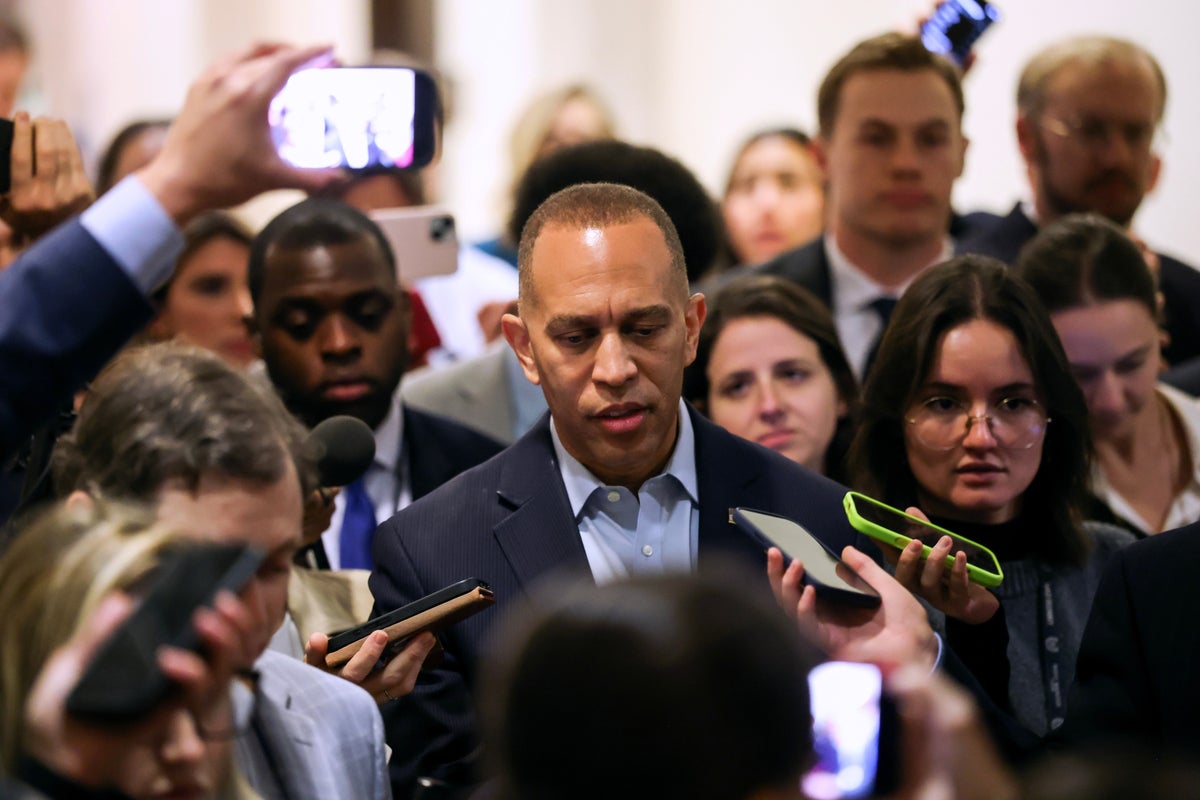
Democrats have laid out their “must-have” victories as they prepare to assume complete control of the US Congress next year.They are planning swift action on several issues during the early weeks of January to address the electorate's key priorities. Democrats across the House of Representatives and the Senate said their initial legislative focus would target rising consumer costs, healthcare affordability and public frustration surrounding the Iran war.The incoming majority also intends to confront widespread public dissatisfaction regarding ethics violations and political corruption, factors widely viewed as driving the nationwide defeat of Republicans.Asked about his primary legislative priorities for early January, Democratic Sen. Brian Schatz of Hawaii said on Thursday, "I can confidently say that we want to do a congressional stock trading ban."Newly elected members of Congress gather for a class photo at the US Capitol in Washington, DC, US, November 12, 2026 (Reuters)Lawmakers trading individual stocks has long drawn public anger across party lines, with critics pointing out that members of Congress draft policies behind closed doors that directly influence market values.House Democratic Leader Hakeem Jeffries, who is anticipated to serve as the next House speaker, outlined his early legislative ambitions for 2027 to reporters."We have to make sure that we're cleaning up the mess here in the Congress with the executive branch and at the Supreme Court and that should begin by prohibiting members of Congress from trading stocks," he said, listing the ban among his key objectives.Schatz, set to become the second-ranking Democrat when the new Congress convenes in early January, said Senate Democrats are still aligning their agenda with House party leadership.Internal divisions between party moderates and progressives surfaced on Thursday as progressive Sen. Chris Van Hollen of Maryland declared a challenge against the more moderate Sen. Chuck Schumer of New York for the top Democratic leadership position in the Senate. Schumer maintains he retains sufficient support to win the internal leadership vote scheduled for early next month.Democrats are seeking Republican support on select legislation in response to voters' desire for cross-party cooperation.Republican Senator Josh Hawley of Missouri said in an interview that he backs several cross-party proposals, including an increase in the federal minimum wage, restoring funding for rural hospitals, and prohibiting stock trading. "Absolutely. It's my bill that's currently pending" in the Senate, he said regarding the trading restrictions.Hawley has also partnered with progressive Democratic Sen. Elizabeth Warren of Massachusetts on legislation regulating pharmacy benefit managers, who act as intermediaries in the pharmaceutical supply chain and face criticism for driving up prescription drug costs.Democrats' intra-party tensions were on full display Thursday when Sen. Chris Van Hollen of Maryland announced that he will challenge Sen. Chuck Schumer for the party's top leadership job in the Senate (Reuters)Schatz contended that stock trading restrictions connected directly with voters who associated official corruption with their own rising living costs.Alongside trading restrictions, Schatz highlighted two additional priorities: bringing an end to the Iran war and restoring funds to Medicaid, the federal healthcare safety net for low-income and disabled Americans."How exactly we reverse the Medicaid cuts, that's yet to be settled on in terms of our techniques and our tactics," Schatz said.Projections indicate Democrats will hold a minimum of 255 House seats to 169 for Republicans, with 12 races remaining uncalled. The Senate margin will stand at least at 55-44, with a potential additional Democratic seat pending final counts in Alaska.Passing most legislation in the Senate requires a 60-vote threshold to overcome procedural hurdles.Consequently, Democrats would need to secure support from at least four Republicans, such as incumbents facing re-election in 2028 in states including Alaska, Indiana, Kansas, and Kentucky.Simultaneously, Democratic leadership must navigate legislative drafting carefully to safeguard their own vulnerable senators up for re-election in 2028 across states like Georgia, Arizona, Colorado, Ohio, and Nevada. These dynamics create potential friction, as initial expressions of cross-party alignment often prove difficult to maintain once formal statutory text is finalized.Should bipartisan agreement fall short, Democrats could utilize procedural mechanisms previously employed by Republicans to enact tax cuts aimed primarily at higher earners alongside reductions in social spending. That mechanism bypasses the standard 60-vote requirement in the Senate, enabling legislation to pass with a simple 51-vote majority.For Democratic Sen. Raphael Warnock of Georgia, facing re-election in 2028, primary goals include concluding the war in Iran, dismantling tariffs implemented by President Donald Trump, and reinstating expired healthcare subsidies."I start there as a way of stopping the bleeding and then we can lay out a vision going forward," he said in a hallway interview.
Democrats detail ‘must-have’ victories in 2027 after taking control of Congress
Full Article
Original Source
Read the full article at Independent →KhanList aggregates and links to publicly available news content. We do not host full articles from third-party sources. Always verify important information with original sources.