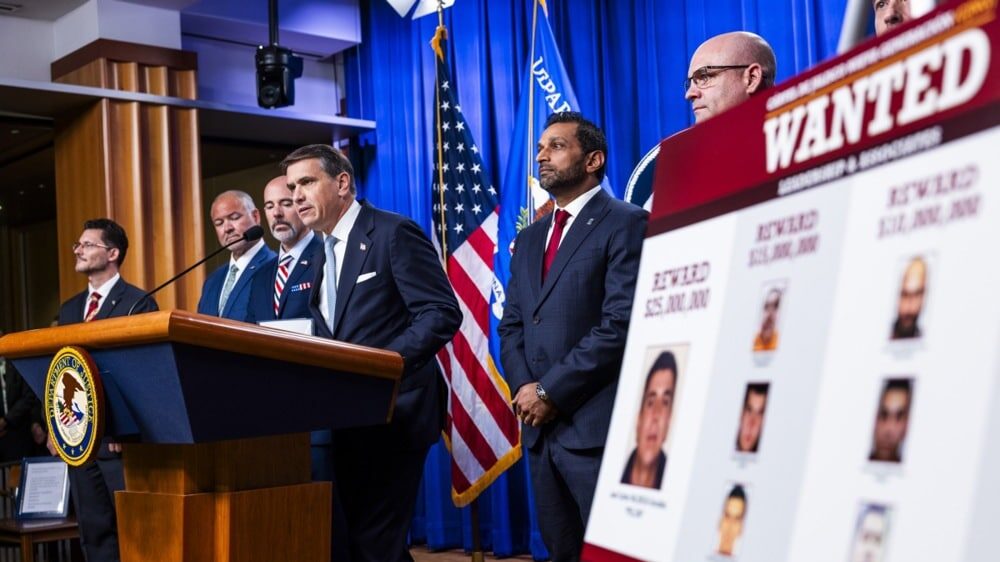
The US on Tuesday charged four members of Mexico's powerful Jalisco New Generation Cartel (CJNG) for attempting to purchase ammunition and weapons in the Czech Republic. The four men, who now face life in prison on drug and arms trafficking crimes among other charges, were arrested in Czechia last June, and two of them were extradited to the US on Friday last week. The other two are still in Czech custody, Justice Minister Jeronym Tejc confirmed, and could face months of additional extradition proceedings. According to the US State Department, the Mexican cartel wanted to buy weapons – including machines guns and grenade launchers – to “commit acts of violence against rival Mexican cartels, civilians, police officers and soldiers”, with the deal meant to go through in exchange for fentanyl and methamphetamine. It is unclear, however, who were the weapons suppliers in the transaction, and US authorities have not revealed their identity. BIRN has previously reported how Mexican cartels are already operating in Poland and Central Europe.In a significant U-turn, Prague city councillors this week approved the reinstatement of the Stalin Cultural Centre to the city’s so-called “market order”. This will enable the popular outdoor arts and community venue in Prague’s 7th district to continue operating as a commercial enterprise and de facto assure its survival. Pushed by the leftist Pirate Party, this week’s decision comes after months of speculation over the fate of the cultural centre – which derives its name from the mega-statue of the Soviet dictator that used to stand above it – after the city council’s vote to remove it from the market order in May, citing safety issues over the structure’s deteriorating state. Thousands of people had since signed a petition calling on local politicians to safeguard the space, seen as a key hub of Prague’s independent and alternative arts scene that organises concerts, debates and discussions, outdoor movie screenings and more, on top of being a highly popular meeting place to simply gather and have a drink throughout the year. Every week comes with news of how this year’s extreme high temperatures and lack of precipitation are creating what meteorologists are describing as Czechia’s worst drought on record. On Monday evening, for example, a fire broke out on the slopes of the Letna park, in the very heart of the capital. Spreading over a small area of 6 by 50 metres before being contained by firefighters, it was sparked by the extraordinarily dry conditions and facilitated by strong winds. Forest fires also broke out this week in the Trebic region in Moravia, and in Breclav close to the Slovak border. Meanwhile, rivers and waterways across the country are reaching historically low levels, exposing the “hunger stones” deposited along the Elbe to warn of exceptionally low water levels. Fishermen have already warned that this year’s catch might be exceptionally low as some smaller streams have completely dried out, forcing them to rescue fish from dying streams and relocate them to larger rivers. The ongoing drought is also taking its toll on the country’s boating industry – both commercial and leisure – with key waterways restricted to just a few navigable sections. Hlas-SD chairman and Slovak Interior Minister Matúš Šutaj Eštok during a press conference on the topic “Protection from abuse of the social system” on Friday, June 26, 2026 in Bratislava. PHOTO TASR – Martin Baumann Russia on the radar; Slovakia picks a fight with Brussels over same-sex marriage Slovakia’s Interior Ministry has been forced into an embarrassing retreat over speed cameras with suspected Russian links, a week after dismissing opposition warnings about their origin. The National Security Authority (NBU) confirmed on Tuesday that the two devices in question contain Russian components. The finding vindicates concerns raised by Progressive Slovakia (PS), the country’s strongest opposition party, which had warned that the cameras could pose a security risk. There were red flags from the start. Journalists found that the cameras closely resembled equipment made by the St Petersburg-based company Simicon. More strikingly, the measurement software listed in the Slovak certification had the same digital fingerprint as software used in a Russian CORDON speed camera. The ministry’s story has shifted ever since. It first insisted the cameras were not Russian, then conceded it could not prove their origin, before ordering IT supplier Soitron to remove the test devices. It now says two ministry employees will lose their jobs and cooperation with Soitron will end. Interior Minister Matus Sutaj Estok, of the governing Hlas party, has resisted calls to take political responsibility. “We were lied to,” he said on Thursday, blaming the Slovak Institute of Metrology, which certified the cameras. The institute says checking cybersecurity risks, supply chains or the origin of components is not its job. Soitron also denies misleading the state. Soitron obtained the devices from a Slovak distributor whose CEO had worked in Russia for many years and had previously imported similar equipment to Slovakia through another company. The ministry will not publish the NBU analysis, and it is unclear why the country’s security services failed to spot the potential problem before opposition politicians and journalists did. The General Prosecutor’s Office has now said it will examine the case. There was another controversy this week involving the Interior Ministry, and Interior Minister Sutaj Estok in particular. His ministry has refused to register same-sex marriages legally concluded abroad. Several Slovak same-sex couples applied in December to have their foreign marriage certificates entered into Slovakia’s special registry. After waiting eight months, they received an answer not from the registry, but directly from Sutaj Estok. He argued that registering the unions as marriages would conflict with Slovak law and the constitution, which has defined marriage as a union between a man and a woman since 2014. Among those affected are former diplomats Ivan Novotny and his husband Metod Spacek. They argue that the minister intervened in a procedure that should have been handled by the registry and are now preparing an administrative lawsuit. At the heart of the dispute is a 2025 ruling by the Court of Justice of the European Union involving a Polish-German same-sex couple. The court ruled that an EU country cannot refuse to recognise a same-sex marriage legally concluded in another member state if doing so interferes with rights guaranteed under EU law, particularly freedom of movement and residence. The ruling does not require member states to introduce same-sex marriage into their domestic law. The European Commission has reminded Slovakia that EU law, as interpreted by the EU’s top court, takes precedence over national law and that member states are required to implement its judgments. It told the SME daily that it would continue to monitor the situation and could use the tools at its disposal if needed. The ministry argues that EU law may require Slovakia to recognise same-sex marriages for specific purposes, but does not oblige the country to enter them in its registry as marriages with the same legal status as marriages recognised under Slovak law. Novotny, Spacek and other couples dispute that interpretation. Their planned legal challenge could now put that question before the Slovak courts. The area of the LNG Terminal named after President Lech Kaczynski in Swinoujscie, Poland, 27 April 2022. EPA/Marcin Bielecki Poland beefs up defence of key infrastructure against hybrid threats; Starlink discrimination Poland is preparing its energy system for possible Russian sabotage or provocation as security concerns intensify across NATO’s eastern flank. The response increasingly treats energy security as part of national defence. State-controlled energy firm Orlen is drawing up contingency options for gas supplies should existing routes be disrupted, while Gaz-System has tightened monitoring of infrastructure linked to the Swinoujscie LNG terminal and the Baltic Pipe. Together, the two routes account for around 80 per cent of Polish gas imports. Military involvement is also expanding. Since July, soldiers have been helping protect an electricity connection with Ukraine that plays a role in supporting the war-damaged Ukrainian grid. Poland’s grid operator expects similar cooperation around other sensitive infrastructure in the east of the country. The threat is not limited to physical attacks. Polskie Elektrownie Jadrowe, the company building Poland’s first nuclear plant, has reported forged documents intended to confuse people involved in the project. The material was traced to somewhere “east of Poland”, and Polish security services are investigating. Poland’s moves come as Lithuania, Latvia and Estonia take similar precautions amid intelligence warnings that Moscow could use Ukrainian-made drones in a staged incident and blame Kyiv. A Baltic intelligence official told Reuters that Russian intelligence services may be considering a false-flag attack on infrastructure in the region, aimed less at physical damage than at creating political confusion inside NATO. Poland has threatened to reconsider tens of millions of dollars in annual payments to Elon Musk’s SpaceX after Starlink excluded Polish customers from its European roaming zone, prompting accusations of discriminatory treatment. From August 17, existing Polish subscribers to Starlink Roam will face tighter rules when using the satellite internet service abroad. While customers registered in dozens of other European countries can travel within the region under the same roaming terms, Polish accounts are being treated as Poland-only. Users travelling abroad may have to report their trip, undergo identity checks and, after 30 days, switch to a more expensive plan. Digital Affairs Minister Krzysztof Gawkowski said he had asked SpaceX to urgently restore equal conditions, arguing that Polish customers should not be treated as “second-tier”. Foreign Minister Radoslaw Sikorski went further, addressing Musk directly on X: “Hey, Elon Musk, big man, stop discriminating Polish users of Starlink or we might re-think paying you $50 million p.a. for your services”. The remark also revived an earlier public feud between the two men. Last year, after Sikorski challenged Musk over his comments about the importance of Starlink to Ukraine, Musk told the Polish minister to “be quiet, small man”. The financial threat carries particular weight because Poland is one of Ukraine’s biggest Starlink backers. Warsaw funds connectivity for tens of thousands of terminals used in Ukraine, spending around $50 million a year. SpaceX has not publicly explained why Poland was left outside its European roaming region. Former Hungarian PM Viktor Orban (C), alongside Fidesz MP Zsolt Nemeth (L) and President of the Hungarian National Council of Transylvania Laszlo Tokes (R), attends the 35th Tusványos Summer University and Student Camp in Baile Tusnad, Transylvania, Romania, 25 July 2026. EPA/Nandor Veres Future of Orban’s summer camp in doubt; Hungary builds riverbed sill to raise Danube An interview appearing on the independent news site Valasz Online this week sparked a debate about the future of former prime minister Viktor Orban’s iconic summer camp in the Romanian town of Baile Tusnad (Tusnadfurdo) and its chances of survival after his Fidesz party’s landslide defeat in the April election. One of the Tusvanyos Summer University and Student Camp’s co-founders, Tibor T. Toro, said in a stunningly self-critical interview that the event in Transylvania had become a Fidesz-only forum and urged it to find a way back to its original purpose as a forum for political dialogue and debate, which would involve the participation of other parties such as the now-governing Tisza. But many believe such self-reflection probably comes too late for the event. Originally launched as a forum for Hungarian, Romanian and ethnic Hungarian politicians to discuss political and cultural issues, it turned into a stage for Orban to share his often-controversial worldviews. It was the place where Orban spoke about Hungarians not being a mixed-race people and where he first described Hungary under his rule as an “illiberal state”. Veteran Fidesz politician and chairman of the Foreign Affairs Committee Zsolt Nemeth – another of the festival founders – called for a national minimum in minority policy during a speech in parliament this week and pleaded for a dedicated sum of money for Hungarian minorities living beyond Hungary’s borders in the annual budget. PM Peter Magyar was quick to respond, accusing Nemeth of sitting idly by while Orban labelled opposition politicians, the independent media and judges as “bugs”. Technology Minister Zoltan Tanacs wrote on Facebook that the Tusvanyos camp could certainly be organised next year, but using Fidesz’s own money that it had amassed over the past decade and a half. Tusvanyos has largely been financed through the Pro Minoritate Foundation, which received hundreds of millions of forints in taxpayer money via the Bethlen Gabor Fund. Tanacs added that if Tusvanyos remains a stage for Fidesz, it will become irrelevant. Nemeth assured participants at this year’s gathering in July that there would be a Tusvanyos 2027, though he didn’t explain how it would be financed. To tackle the Danube river’s critically low water levels, the government has decided to build a riverbed sill to raise the river level near Paks, home to Hungary’s only nuclear power plant. The plant has had to reduce operations to a single turbine due to the low water levels. Output was raised to two turbines this week, but with no significant rainfall in sight, the government is bracing for another near-emergency situation over the weekend. PM Magyar held a government meeting in Paks and announced the construction of the riverbed sill – a submerged dam-like structure – as well as the possible sinking of two ships to help raise the level of the river. Construction involving military units has already started. A decision on whether to sink the two 80-metre-long vessels will come on Friday, depending on water levels. The solution to build a riverbed sill emerged after discussions with engineers and hydrology experts, and will involve placing up to 150,000 cubic metres of pebble stones on the riverbed. This would raise the water level enough to ensure the safe operation of the Paks nuclear power plant, while avoiding creating a dangerous rise in water levels during periods of high water or flooding. The emergency measures are expected to cost around 6 billion forints (16.5 million euros), far less than the economic hit from a full shutdown of the Paks nuclear power plant, which could amount to 50 billion forints. Magyar noted that the water levels of the Danube are historically low for August and little improvement is expected in the autumn. Magyar also took a shot at the previous government for failing to prepare adequately for such an emergency and of sweeping the issue under the rug, despite the Danube’s water levels having steadily declined since 2010.
Democracy Digest: US Charges Mexican Cartel Members over Czech Weapons Deal
Full Article
Original Source
Read the full article at Balkaninsight →KhanList aggregates and links to publicly available news content. We do not host full articles from third-party sources. Always verify important information with original sources.