
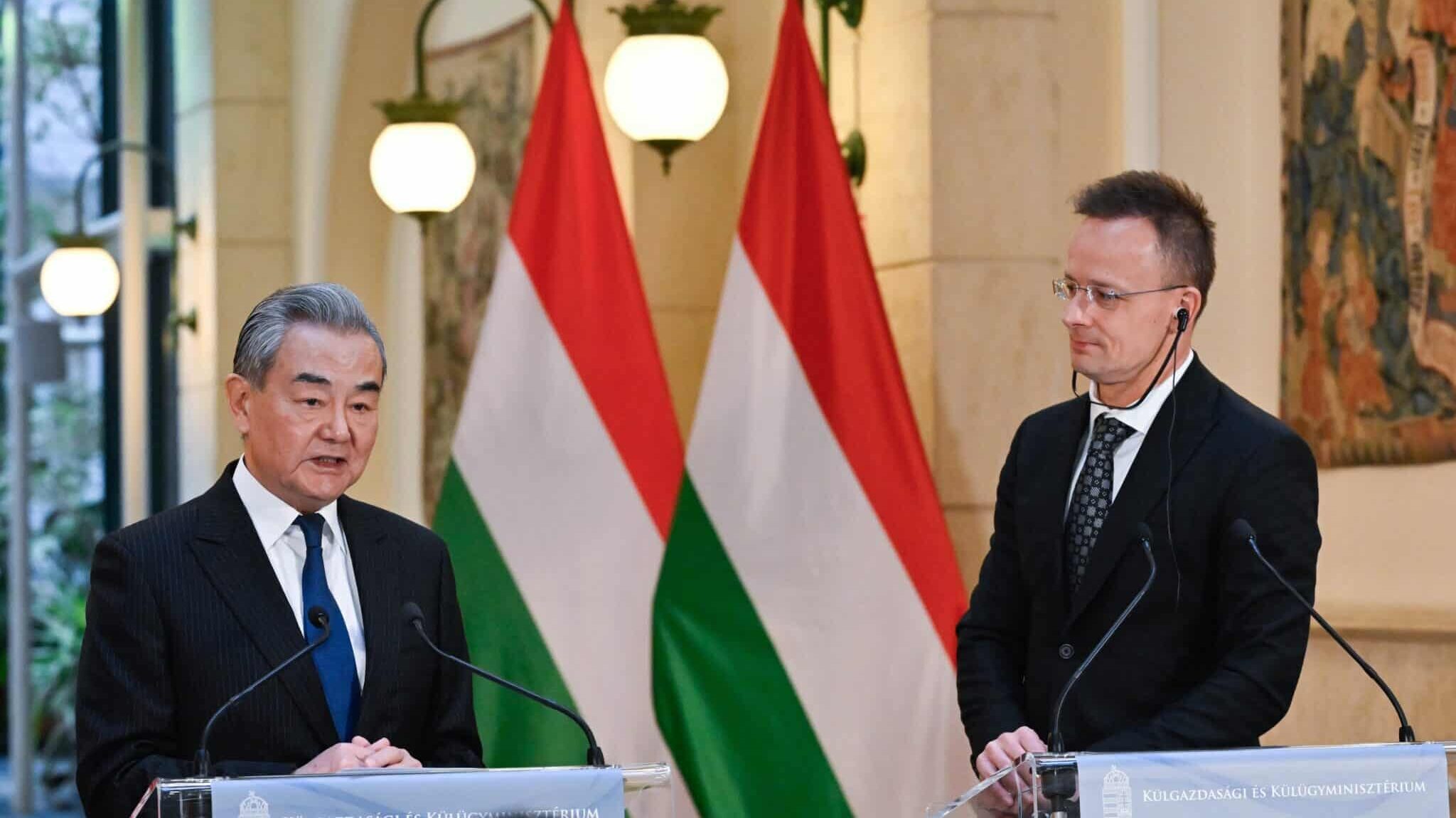
Hungary's former minister of foreign affairs and trade, Peter Szijjarto, announced this week that he is stepping down as an MP and switching to the private sector. The Fidesz politician, who was accused of leaking details of EU discussions to his Russian ally Sergei Lavrov, will join the Chinese carmaker BYD, where he will be responsible for external relations and new business development. Szijjarto will take up a global position and won’t be involved in the company's Hungarian operations, BYD later clarified. Szijjarto’s new job has raised eyebrows. PM Peter Magyar called him "an outright lobbyist for BYD", referring to the billions of forints in Hungarian taxpayer money that the Chinese company has received in investment support over the past decade. “Now even Fidesz voters may realise whose interests Szijjarto really represented in government,” Magyar posted. BYD has been present in Hungary for more than ten years. It first established a bus manufacturing plant in Komarom, supported with almost 1 billion forints (about 3 million euros) in state subsidies. It then opened a battery factory in Fot, which received almost the same in government support. Finally, the company decided to build its first passenger car factory in the EU in Szeged, a project backed by about 100 billion forints in public funding, and chose Budapest as the location of its European HQ. Szijjarto’s departure reportedly surprised even some of his Fidesz party colleagues, although he is said to have discussed the move with his former boss and party chairman Viktor Orban. The announcement followed the resignation of Fidesz's parliamentary group leader, Gergely Gulyas, who stepped down on Monday after parliament adopted a constitutional amendment limiting MPs to a maximum of 12 years in office. Gulyas said he would not be eligible for re-election in 2030 and so wanted to make way for a new generation. "The party is not in good shape; at certain points it is even chaotic," Fidesz spokesman Bertalan Havasi admitted to hvg.hu. While his party is facing growing internal turmoil, Orban has opted to attend the FIFA World Cup in the US.Hungary this week formally joined the European Public Prosecutor’s Office (EPPO). The move was announced in mid-June, but it required formal approval from the European Commission before becoming official. The accession was one of the Tisza party’s key campaign promises and is expected to strengthen the fight against corruption in a country that ranks among the worst performers in the EU. There are high expectations in Hungarian society that former rank-and-file Fidesz politicians and businessmen with close ties to the former government could face prosecution. However, few concrete cases have emerged so far. Hungary must now nominate three prosecutors to the EPPO, from which the Council of the EU is expected to select the prosecutor responsible for overseeing the office’s operations in Hungary. The EPPO can officially begin its work in the country 20 days after that person takes office. Anti-corruption whistleblowers told BIRN that the EPPO could provide effective support to Hungary’s tax authority, police and prosecution service. However, its mandate is limited: it can only investigate corruption cases involving EU funds related to offences committed after 2021.MEP Milan Uhrík poses in the European Parliament (EP) building on November 26, 2024 in Strasbourg. PHOTO TASR – Jakub Kotian Russia links alleged Moscow drone plot to Slovakia; Uhrik tops trust rankings Russia’s Federal Security Service (FSB) said it has prevented an attempted drone attack near Moscow and claimed that the operation’s logistics route began in Bratislava. According to the FSB, Ukraine’s Security Service (SBU) planned to transport 35 drones equipped with explosives from Slovakia through Poland and Belarus into Russia. Russian authorities alleged that the shipment was disguised as an import of Spanish ceramic tiles. The FSB claimed that the drones were technically prepared in Kyiv before being moved to Russia, where they were allegedly stored in a rented hangar near planned targets, including military facilities and personnel. The case has drawn attention to Albert Vasiliev, known as Kyivstoner, a Ukrainian-American rapper and blogger who lives in Bratislava. Russian investigators have presented him as a link in the alleged logistics chain. Vasiliev has denied any involvement. Russian authorities also claimed that two Moldovan citizens and a former Wagner mercenary were involved in preparing the operation. The FSB said the alleged plot ended during an intervention in which one suspect was killed after resisting arrest, and another was detained. The allegations have not been independently verified. Milan Uhrik, leader of the far-right Republika party and a member of the European Parliament, has emerged as the most trusted party leader in Slovakia, according to a new Focus poll conducted for web360tka.sk. Uhrik received the trust of 31 per cent of respondents, placing him ahead of PM Robert Fico, who received 28 per cent, and Progressive Slovakia leader Michal Simecka, who recorded 25 per cent. President Peter Pellegrini remained the most trusted political figure overall, with 40 per cent of respondents expressing trust in him. The poll, conducted June 22-29 among 1,027 respondents, shows that Uhrik’s rating has been rising since the beginning of 2024. Despite his ranking, 60 per cent of respondents said they did not trust him. Fico’s distrust rating stood at 71 per cent, while Simecka’s increased to 72 per cent, according to the survey. No politician included in the poll achieved a positive trust balance, with distrust exceeding trust ratings for all figures surveyed. Motorist party honorary president Filip Turek attends a parliamentary session during a no-confidence vote for the Czech government, in Prague, Czech Republic, 03 February 2026. EPA/MARTIN DIVISEK Motorists’ leader under fire after Prague car crash; EU court rejects Czech NGO lawsuit Filip Turek – honorary president of the junior coalition party Motorists for Themselves, a former racing driver, and government plenipotentiary for the Green Deal – is once again making the headlines this week for all the wrong reasons after getting into a car accident in Prague’s city centre on Monday afternoon. Shortly after noon at a busy intersection, Turek’s car, which he was driving himself, collided with an ambulance in a crash recorded on multiple CCTV cameras. The ambulance ended up overturned on tram tracks, and its driver – who was the only one inside – was injured in the collision. Police are still investigating the exact circumstances of the accident, while road and traffic experts have been doing the rounds on Czech media to weigh in on who was to blame and on whether Turek, who came out unharmed, broke the rules. At the centre of multiple controversies, the MP announced he had temporarily vacated his post as government envoy for climate change pending the outcome of the police investigation, while opposition politicians urged him to permanently resign from both his parliamentary and government mandates. President Petr Pavel – who was famously locked in a months-long battle with the ruling coalition over his refusal to appoint Turek as a minister earlier this year – said the Motorists’ figurehead should step down if police found he was responsible for the crash. According to Josef Mlejnek, political scientist at Charles University in Prague, the case is bound to hurt the Motorists’ already battered reputation in the eyes of the public, but is unlikely to fundamentally shake the unity of the three-party ruling coalition. The General Court of the ECJ – the lower of its two chambers – yesterday rejected a lawsuit brought by Czech transparency watchdog Kverulant against the European Parliament for refusing to release detailed accounts of MEPs travel expenses and daily allowances. The Prague-based non-profit had taken the EU Parliament to court after the legislative body only partially addressed its request for precise information and figures about the salaries, travel allowances and other benefits received by Czech MEPs between 2019 and 2023. Kverulant had argued that this information was of public interest and necessary to determine whether Czechia’s European lawmakers used public money in a responsible way in line with their mandate and obligations towards voters. In Wednesday’s ruling, judges accepted the general goals pursued by the Czech watchdog, “namely ensuring oversight of European Union funds and informing the public”, but eventually sided with the EU Parliament’s rationale by arguing that Kverulant had failed to explain why releasing this information was necessary or provide concrete evidence of alleged irregularities. Describing itself as “very unpleasantly surprised” by the ruling, Kverulant said it had hoped the lawsuit would show that “the transparency so often proclaimed in EU documents would eventually prevail over institutional arrogance”. The NGO also described as “particularly painful” being ordered by the court to cover the EU Parliament’s own legal representation costs. Ukrainian President Volodymyr Zelensky (R) and Polish PM Donald Tusk (L) attend a press conference after their meeting at the Mariinskyi Palace in Kyiv, Ukraine, 05 February 2026. EPA/PAWEL SUPERNAK Poland left out of missile defence coalition; fresh anti-Ukrainian abuse sparks warning Poland was not among the founding members of a new European coalition to develop protection against ballistic missile threats, announced this week by nine European countries and Ukraine. The Anti-Ballistic Missile Coalition aims to jointly develop capabilities against ballistic missile threats while coordinating research, industrial cooperation and procurement. Its founding members are Denmark, France, Germany, Italy, the Netherlands, Norway, Spain, Sweden, the UK and Ukraine, although the declaration stresses that the format remains open to additional participants. Onet reported, citing unnamed government sources, that Ukraine opposed Poland’s participation following recent tensions in bilateral relations over historical issues. Neither Kyiv nor Warsaw has confirmed that account publicly. Foreign Minister Radoslaw Sikorski dismissed suggestions that Poland had been excluded, arguing the initiative was primarily an industrial project rather than a political alliance. “The format is open,” he said, adding that Polish defence companies would be able to join if they decided to participate. PM Donald Tusk similarly said Polish firms were analysing the proposal. Poland’s absence from the initiative does not mean it is falling behind on missile defence; Warsaw is already building one of Europe’s most advanced integrated air-defence systems, the “Wisla” program, built around US Patriot technology. The episode thus highlights a broader strategic debate. While much of Europe is accelerating efforts to develop jointly owned defence capabilities in response to doubts about the long-term reliability of US security guarantees, Poland has continued to bet on close defence ties with Washington. A 54-year-old man has been arrested after verbally abusing two 11-year-old Ukrainian girls on a bus in the southern city of Bielsko-Biala, in an incident that has reignited concerns about hostility towards Ukrainians in Poland. A video shared on social media showed the man shouting insults at the girls and telling them to “go back to Ukraine” because they were speaking Ukrainian. Police identified and detained the suspect within hours despite no formal complaint being filed. Interior Minister Marcin Kierwinski said there would be “absolutely no tolerance” for attacks motivated by nationality. Ministry spokeswoman Karolina Galecka noted that such attacks “are occurring increasingly often”. PM Tusk described the incident as “disgusting” and “proof that incitement has fatal consequences”, calling on politicians to stop using inflammatory rhetoric. The attack came at a sensitive moment in Polish-Ukrainian relations, just days after commemorations marking the anniversary of the 1943 Volhynia massacres, which have once again brought historical tensions to the fore and fuelled anti-Ukrainian sentiment online, even as Poland remains one of Ukraine’s closest allies.
Democracy Digest: Revolving Door Politics in Hungary as Szijjarto Joins China’s BYD
Full Article
Original Source
Read the full article at Balkaninsight →KhanList aggregates and links to publicly available news content. We do not host full articles from third-party sources. Always verify important information with original sources.