
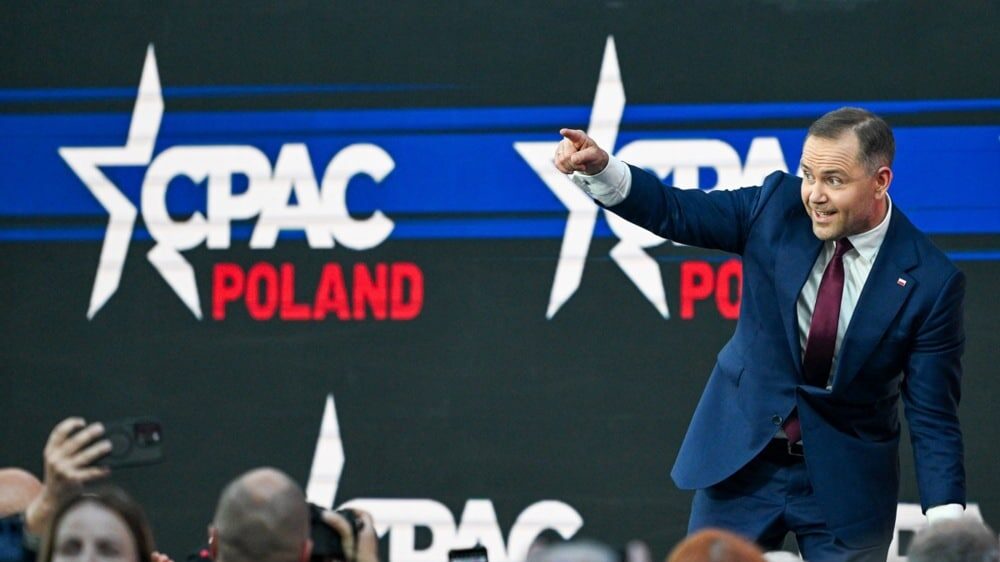
One of Central Europe’s biggest cryptocurrency scandals of recent years has entered a potentially explosive new phase. The affair surrounding the collapsed exchange Zondacrypto, which erupted in April, now threatens to reach deeper into Polish politics, with its former chief Przemyslaw Kral reportedly cooperating with prosecutors and potentially providing evidence about the company’s extensive financial links to the country’s political right. Zondacrypto collapsed amid allegations that large sums entrusted by clients had been misappropriated; prosecutors estimate investor losses at a minimum of 2.4 billion zloty (550 million euros). The affair quickly acquired a political dimension. Before its downfall, the company channelled substantial sums into conservative media, organisations and events, including the CPAC conference held in Poland days before the 2025 presidential runoff, where Karol Nawrocki was a headline speaker. BIRN reported in May on questions that those connections – combined with Nawrocki’s subsequent vetoes of legislation tightening oversight of the crypto sector – were raising for the president. This week, Prosecutor General Waldemar Zurek announced a “breakthrough” in the investigation. Prosecutors said they are examining possible offences connected to Zondacrypto’s financing of a foundation linked to former justice minister Zbigniew Ziobro, another associated with Confederation MP Przemyslaw Wipler, conservative broadcaster TV Republika, CPAC and Polish Olympic Committee head Radoslaw Piesiewicz. Most politically significant, however, is Kral himself. According to Onet, Kral is negotiating cooperation terms that could substantially reduce his sentence. The outlet says he could also document Zondacrypto’s financial dealings with political, media and other organisations on the right. With parliamentary elections due in 2027, his testimony could turn a sprawling financial scandal into a damaging stream of revelations for PiS, Confederation and figures around Nawrocki. Reports are emerging about nervousness inside PiS over who could be next implicated.As Poland pushes for a permanent seat at the G20 table, it received two very different assessments of its economic standing this week. S&P Dow Jones Indices, which produces stock-market benchmarks used by investors around the world, reclassified Poland from an emerging market to a developed one, effective September 2027. The move is an important symbolic marker of how far Poland’s economy and capital markets have come, though domestic analysts said its immediate effect on investment flows may be modest. Finance Minister Andrzej Domanski hailed it as “another confirmation of Poland’s growing position”, noting that the country is currently the EU’s fastest-growing large economy. Yet Fitch, one of the world’s three major credit-rating agencies, offered a sobering counterpoint. It kept Poland at ‘A-’ with a negative outlook, warning that the country lacks a convincing plan to rein in its large deficit and rising public debt ahead of the 2027 election. Fitch forecasts a deficit of 6.9% of GDP this year and debt reaching 72.7% by 2028. It also said conflict between the government and President Nawrocki, including his frequent vetoes, is making economic reforms harder to implement.A girl during the symbolic planting of three linden trees on the occasion of the 35th anniversary of Ukraine’s independence in Prešov on Monday, August 24, 2026. PHOTO TASR – František Iván Slovakia foils arson plot on Ukrainian drone factory; Fico pulls plug on transaction tax Slovak police foiled an alleged arson attack on a Ukrainian drone factory located near Presov, in what appears to be one of the first serious sabotage plots targeting Slovakia’s growing defence industry. The target was Skyeton, which produces sophisticated surveillance and reconnaissance drones at its plant in eastern Slovakia; Skyeton’s Slovak plant does not export its drones eastwards. Police, acting on information from the civilian SIS and Military Intelligence, arrested three men – reportedly two Latvians and a Ukrainian – who they say were preparing the attack “on commission”. One was detained in Germany. The suspects had allegedly gathered petrol mixed with polystyrene, commonly known as napalm, as well as tools, phones, an action camera and a hand-drawn plan. Some 70 employees could have been inside the plant, where equipment is worth tens of millions of euros. Who commissioned the attack remains the big unanswered question. An anti-war group whose name references George Orwell’s novel 1984 purportedly claimed responsibility for the planned attack in a letter sent to Dennik N. Skyeton itself pointed towards Russia, saying Moscow had repeatedly tried to destroy its facilities in Ukraine and damage its reputation. The company said the Slovak plot showed Ukrainian defence manufacturers had become “a real thorn in their side”. The Russian connection has not been established by investigators, however. Slovak police have so far made no public attribution. The case is sensitive given mounting concerns over suspected Russian sabotage operations elsewhere in Europe. A Slovak pro-Russian influencer had filmed himself outside the Skyeton plant weeks earlier and called it a “legitimate target of the Russian army”. There is no evidence his video was connected to the alleged plot. Deputy Speaker Tibor Gaspar of the ruling Smer party echoed the influencer’s view in a recent interview. In other news, PM Robert Fico announced that Slovakia would scrap its controversial transaction tax from January 2027, reversing course on one of his government’s main measures to restore the public finances. Fico said he had instructed Finance Minister Ladislav Kamenicky to prepare the necessary legislation. The announcement came as something of a surprise. Only last year, Fico described the tax as effectively impossible to abolish because the government needed the revenue for its fiscal consolidation. The tax, introduced in April 2025 and inspired by a similar levy in Hungary, quickly became a headache for the government. Businesses complained that it penalised ordinary payments to suppliers and employees, encouraged a return to cash and made Slovakia a less attractive place to do business. Criticism eventually spread to Fico’s own coalition. Andrej Danko’s nationalist SNS party, which originally voted for the tax, later pushed to water it down, while politicians from the other coalition party, Hlas, also began calling for changes. The bigger problem was that the tax did not bring in as much money as Kamenicky had hoped. Initial estimates spoke of around 700 million euros a year. In its first year, the state collected only 340 million euros, and official forecasts suggest this year’s target will also be missed. That leaves one rather important question unanswered: where will the government find the missing hundreds of millions? Fico did not say. Instead, he predicted that abolishing the tax would lead to unusually strong economic growth. Slovakia’s independent fiscal watchdog is more cautious, estimating the benefit at 0.1-0.15 percentage point. A giant sculpture of a hand with the fingernails painted in the colors of Ukraine, created by artist Jan ‘Slove’ Slovencik, makes a rude gesture towards the Russian embassy in Prague, Czech Republic, 24 August 2022. EPA-EFE/MARTIN DIVISEK Czech spy agency warns over Russia, China; presidential veto on budget reform overridden In its annual report for 2025 published on Wednesday, Czechia’s main counter-intelligence agency the Security Information Service (BIS) warned about the persistent threat posed by single, individual agents recruited by Russia for sabotage actions in Czechia and elsewhere in the EU and NATO. “They are often inexperienced amateurs and at the same time people of lower social status or with a criminal background,” BIS cautioned as it laid out the profile of potential recruits. “The main motivation is the prospect of receiving a financial reward.” Despite the lack of professionalism involved in the process, BIS further warned that such a way of operating makes it more difficult to identify possible perpetrators and/or targets. The annual report also stated that the country has faced multiple cyberattacks from both Russian and Chinese state-backed actors in the past year, with the Czech diplomatic network a primary target. “These banal attacks against Czech entities have happened repeatedly since the start of the Russian invasion of Ukraine in 2022,” the report said. More specifically on China, Czechia’s counterintelligence has directly accused Beijing of targeting Czech academics to obtain sensitive information and push its narratives. “Under the pretext of interest in establishing professional cooperation and with the promise of a financial reward, the Chinese side offers the approached academics cooperation, usually consisting of writing analyses on a given topic corresponding to Chinese political interests,” BIS wrote, adding that Chinese intelligence operatives have been working in Czechia for years, mainly under journalistic or diplomatic cover. With all 104 lawmakers from the three-party ruling coalition voting together, parliament’s lower house this week overrode President Petr Pavel’s veto on the government’s bill to reform budgetary rules. With talks about the 2027 budget high on the political agenda this month, the vote was widely expected and allows the government to push through looser and more flexible public expenditure rules in the future – including to increase spending for defence and security based on the evaluation of the cabinet’s own State Security Council. Echoing the arguments of Pavel to explain his veto, opposition lawmakers accused the government of fiscal irresponsibility and of further pushing the state debt to new highs to the detriment of future generations. “It is theft of the future of our children. You’re leading our country into a wall,” claimed Jan Skopecek of the right-wing ODS party. Finance Minister Alena Schillerova dismissed the accusations, hitting back at the former government of Petr Fiala for what she described as compiling a misleading budget with inflated revenues and understated spending. Then-Hungarian Minister of Foreign Affairs and Trade Peter Szijjarto speaks at the opening panel discussion titled ‘Central Europe and the Western Balkans in the New Geopolitical Era’ during the Budapest Balkans Forum at the Kempinski Hotel Corvinus in Budapest, Hungary, 09 March 2026. EPA/LAJOS SOOS Nominated head of recovery agency plays down quick results; Szijjarto may face charges Political scientist Anna Unger was nominated by parliament’s Justice and Constitutional Affairs Committee to head up Hungary’s new Asset Recovery and Protection Office, which will be responsible for recovering state money and assets allegedly stolen during the 16 years when the previous government was in power. Unger, an outspoken university lecturer, was one of three candidates along with Transparency International Hungary’s legal director, Miklos Ligeti, and Canadian-Hungarian Nicolas Sarvari, a crisis manager working on international state asset recovery. Unger was an ardent critic of the Fidesz government during its time in office but, for many, her selection came as a surprise, as most had tipped Ligeti – an accomplished legal expert and leading figure in the anti-corruption fight over the past decade – as the ideal candidate. Unger has already warned against having too high expectations regarding immediate results. Although there has been speculation that tens (or even hundreds) of billions of forints could be recovered, she said that individual cases could take years. “Six years are enough to uncover what happened, but not for court verdicts,” she said, dampening expectations of swift retribution. She said one of the office’s first tasks would be to “make Hungarians understand what happened in the last years”, and name those who should be held responsible for either working for or assisting the corrupt system. “This was more than corruption; this was feudalism,” she said at her hearing. Unger still needs the backing of a two-thirds majority in a parliament vote on Friday. The Ministry of Foreign Affairs and Trade this week filed a complaint in a high-profile case involving the purchase of ventilators under the previous government. The ministry, then led by Peter Szijjarto, ordered 17,000 ventilators for 300 billion forints (825 million euros) in 2020. Most were never used and were later donated to African countries, while around 12,000 are reportedly stuck in storage, which has cost a further 2.3 billion forints so far. The ministry told independent news site 24.hu that apparently there had been no strategy behind the government’s procurements and no professional standards were followed. A preliminary investigation indicates the products were highly overpriced and that some did not meet necessary quality standards. Several companies that acted as intermediaries between the Chinese producers and Hungarian ministries and healthcare institutions earned exorbitant fees and then quickly disappeared from the market. This could be one of the first concrete cases of financial mismanagement and the alleged plundering of state money to result in prosecution and be heard in court. Fidesz spokesperson Bertalan Havasi defended the purchases, saying they had served to protect the Hungarian people and deserved praise rather than criticism. Szijjarto has since joined Chinese carmaker BYD, where he is responsible for international markets. The career change has raised questions about whether he had previously helped secure favourable treatment for Chinese investors in Hungary.
Democracy Digest: Crypto Scandal Returns to Haunt Poland’s Right Ahead of Election Year
Full Article
Original Source
Read the full article at Balkaninsight →KhanList aggregates and links to publicly available news content. We do not host full articles from third-party sources. Always verify important information with original sources.