
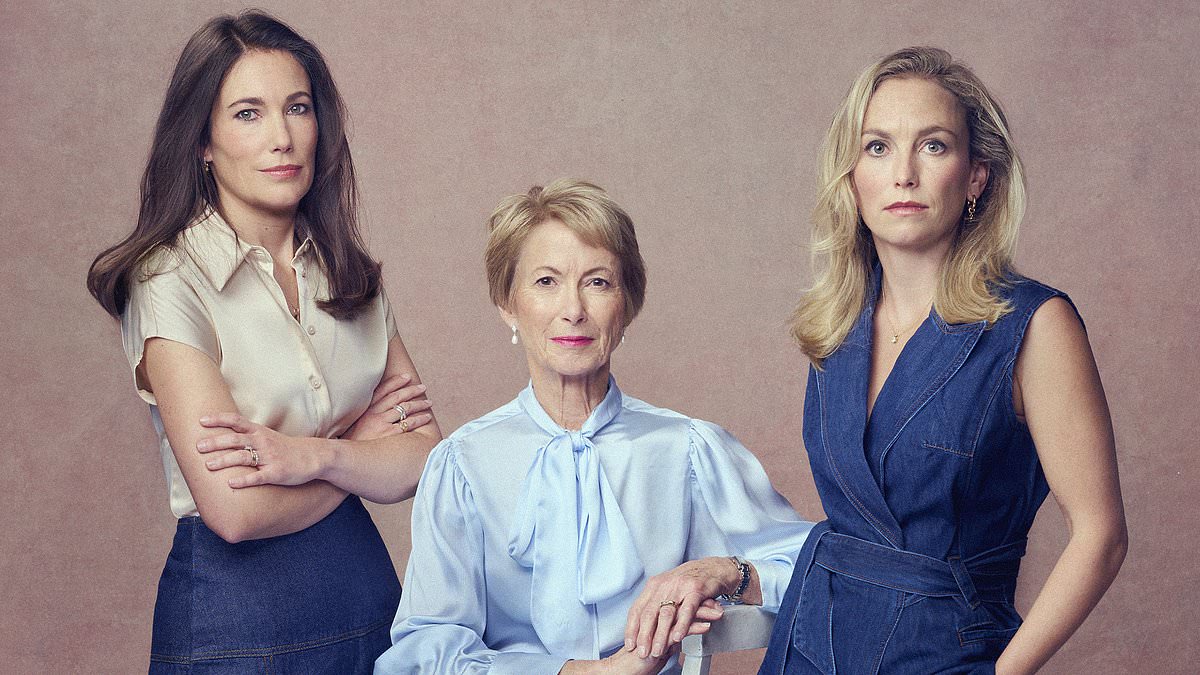
My husband Bob and I were approaching the moment we had been working towards for our whole lives.Our eldest daughter Laura was heading off to study biomedical sciences at Oxford University, while our youngest Claire was about to take her GCSEs.Our five-bedroom home in Claygate, Surrey, was a comfortable, happy space. Bob was a partner at a law firm, while I, then 51, worked part-time as a physiotherapist. Retirement was just peeking over the horizon. Bob, then 58, and I would talk about the fabulous adventures we would have when we stopped working – the holidays, the relaxation time and, hopefully, the promise of grandchildren.Life was happy. And even better times, we felt, were ahead. Today, I look back with disbelief that things could have ever been so simple. A year later, in 2008, Bob’s behaviour began to change. Always so capable, so dependable, he became unpredictable, seemed depressed and distant – yet he brushed off my concerns.I later realised our finances were in deep trouble, after Bob had made some bad financial decisions. But he had absolutely no idea that this disaster was barrelling down the track – until it was too late.It soon transpired that our circumstances were so bad we would have to sell our treasured family home to pay off the debts. It was devastating for us all. Angela’s bond with her daughters Laura, left, and Claire, right, is stronger since her husband Bob’s illness We moved to a smaller semi-detached house in Thames Ditton, which was in a state of disrepair and needed completely renovating. But it was me who had to sort it all out. Bob wouldn’t engage at all, which was frustrating. I also upped my hours, and took on a second job, adding private clients to my NHS role, working six days a week to keep us afloat.As we went through this process, with all the emotions and trauma that it involved, Bob’s personality continued, slowly, inexorably, to change. My wonderful Mr Dependable was becoming someone different – restless, erratic, unsympathetic.It was a further two years, in 2012, before Bob was finally diagnosed with a rare form of dementia, called frontotemporal dementia, or FTD. It was only when Laura, deep in her studies, came across a description of FTD in early 2011 and realised the symptoms matched her father’s that we were able to point doctors in the right direction.He was just 64 when he was finally diagnosed. It was so young – for him, for me, and our daughters, still on the cusp of adult life. I’m not a teary person but it’s fair to say I did weep to see the man my husband was becoming – and all while I was still in my 50s. I wouldn’t be human if I hadn’t felt cross with him over the years for his behaviour. So in some ways it was a relief to finally know what was going on with Bob. Equally, though, the realisation that he had a condition which would erode his personality and which no medication could cure or soothe, was a terrible one.Today Bob is 78. His memory is poor, his awareness of the world child-like. In many ways he’s like a three-year-old boy – exuberant, uncontrollable, endlessly moving.In April 2023, he moved into a care home in East Molesey, two miles from my home. The cost is around £1,900 a week, with the majority funded by social services. These days when he sees me, he shrieks with joy, ‘Oh, my wife!’However, any lucidity is fleeting. He doesn’t know his three young grandchildren, despite meeting them many times. He wouldn’t even remember what he ate for lunch that day.Bob’s rare form of dementia robbed me not only of the delightful man I wanted to spend the rest of my life with, and my daughters of their beloved father, and, later, their own children of their grandfather – but also took our position in life, our hopes, dreams and financial stability.Today, aged 71, I feel in limbo, like I am both widowed and single. I grieve for Bob as he was and yet I know there will be more grief.FTD affects around 30,000 people in Britain and tends to hit in middle age – it’s estimated that around 60 per cent of people first display symptoms between 45 and 65, whereas Alzheimer’s normally takes hold around 70 to 80.Often, it’s dismissed by unknowing GPs as a midlife crisis, depression or, for women, the menopause.While Alzheimer’s – which has around 600,000 sufferers in Britain – is associated with confusion, forgetfulness and memory loss, FTD is characterised by personality changes, behavioural problems and, for some, problems with speech. Actor Bruce Willis, who was diagnosed with FTD aged 67, has the latter symptom.Some experts have said dementia needs to be treated more like cancer – as an umbrella condition with a greater awareness of the wide range of variants, which have different symptoms.I couldn’t agree more. The condition needs more research and, while I am lucky to receive support from a monthly group that meets locally, other families like mine coping with rare dementia diagnoses do not. So I welcome news that the Daily Mail has launched the Dementia Carers Together appeal with Alzheimer’s Society and the Mail Force charity to fund a pioneering support network for those who look after loved ones with dementia.I was 31 when I first met Bob, 38, when playing tennis with friends in 1986. Sociable and lively, he was full of fun. We married the following year. I gave up my job as a physiotherapist when Laura came along in 1989, and life ticked along beautifully. It was a traditional marriage – I managed home and children, while he went to work and managed the family income. His weekends were spent with us, family time. He mowed the lawn, and polished the children’s shoes on a Sunday night.Bob had done well for himself – he had got a Master’s degree, and had gone on to write a seven-edition series on property law, which was well read across his industry.Little wonder, then, that he was always so interested in the girls’ education. When Laura got into Oxford in 2007 he cried with joy. However, four years later, when Claire managed the same feat, he just about managed to say well done to her. Such was the change in him by then. Eventually, he had to leave his job as partner of his law firm and afterwards bounced between a few jobs at other legal firms.As his symptoms became more pronounced, I started getting calls from his employers asking where he was. He would be due in meetings but had gone walkabout.When he was diagnosed, he lost his job. You obviously can’t have lawyers with a neurodegenerative condition. But he refused to accept he had any form of dementia whatsoever – he denied it to the doctor and to us, which was frustrating to say the least.His charming nature persisted through everything. He could sustain conversation for a minute or two, just long enough to convince someone he was mentally OK. Indeed, part of the reason his diagnosis was so protracted was the fact that he put on such a good show – he would wear a suit to the GP for his appointments.At first, he remained at home while I continued working. While he was able to leave the house alone, I felt constantly panicked and tracked him on his phone.Often, I felt like I was going mad. He would ask every five minutes – no exaggeration – what I was doing or if anyone was coming over. He started whooping at high volume all hours of the day and night.He became obsessed with the sitcom Miranda and would watch every episode endlessly – probably around 300 times each – but only in ten-minute spurts before becoming bored.His sleep became fractured, and he compulsively searched the house for sweet foods, which is apparently common in FTD sufferers. I was forever on edge, and found it so hard to leave the house. I forced myself to keep up tennis but found myself constantly tracking him as we played.I can’t tell you how hard it was – is – to see such a loving man transformed into a ceaselessly restless figure who lacked all empathy. I used to wonder if, say, I had a black eye, if he would even notice. Needless to say, my marriage became a lonely place.Eventually I gave up my job to care for him full time in 2017, when I was 62, which had obvious financial and emotional consequences for us. I began to budget for everything.Because I was under 65, I could claim a carer’s allowance, but it was nothing compared to what our wages had been. At that point Bob attended a day centre twice a week and loved it. It also gave me a bit of respite. Unfortunately he was asked to leave because his behaviour – continually energetic – was disturbing the others.Eventually, I started to bend under the strain. After six years of caring for him myself, I decided Bob would be better off in a home. I was guilty about him leaving – what wife wouldn’t be? – but I knew it would be better for him and me. He, thankfully, was quite accepting of it.I can see why patients often go through family breakdowns or divorce if they have FTD and don’t receive a diagnosis in time. I, though, was never prepared to give up on Bob. I made my vows, and I am sticking to them. But still, I feel alone. That said, I would never consider trying to meet someone else. I have my hands full enough with Bob.I go to see him three times a week and stay for a few hours. I try to stay positive. Very early in the diagnosis, I got Bob to agree to donate his brain to science and I’ve done the same, via King’s College London. Our brain cells will aid researchers. I also give a talk once a year to psychology students at University College London, to give them insight into what it’s like to live with someone with a neurological condition. I’ve been told it’s the favourite lecture of the year.It’s an awful thing to say but it will be a sort of relief when Bob dies, for him and for us, although he shows zero signs of physical decline. My life and my children’s lives – not to mention my beloved Bob’s – have been utterly changed by this awful disease.Bob and Angela’s daughter Laura, 37 – a property fund manager from Surrey – adds:Dad would have been such a wonderful grandfather. He and Mum would have been the perfect grandparenting duo: she would have been cooking the kids’ tea, while he would’ve been the entertainer. Now she has to try to do both.Dad can’t remember who his grandchildren are – I have two sons, six and three, while my younger sister Claire, 34, has one, aged one – which is very sad, because he was such a lovely dad.I was just 19 and Claire 15 when Dad was diagnosed. It was so young to effectively lose him. Losing the family home, too, was disconcerting at that time.Our lives flipped from being daughters to parents – asking him if he had been to the loo or could he put on his seatbelt. He would often go for a walk in his socks, having forgotten to put his shoes on, and even on Christmas Day the police brought him home because he had wandered off.I was always close to Dad, and chose my career partly because I loved talking to him about his work. So often I will be doing something at work and wish I could share it with him – but now he couldn’t care less.We are so lucky that Mum cared for him so well – but there’s no denying it took an enormous toll on her.It sounds awful, but today she is our priority because a) we know Dad is cared for in the home and b) he’s largely unaware and disengaged even if we are there. Our spare time is mostly spent with Mum, rather than constantly visiting Dad. She is essentially a widow, and we treat her like that.Our experience has only made the bond between the three of us stronger. Although Dad’s form of FTD is, thankfully, not genetic (some types of FTD are), it goes to show that none of us know what is around the corner.When we see people working excessively hard, or putting things off for retirement, we know it’s something we’re not likely to do. After all, poor Dad never enjoyed the fruits of all his years of hard work.As told to Maureen Brookbanks Dementia Carers TogetherDementia Carers Together is raising money to fund new courses across the UK to give tens of thousands of struggling unpaid dementia carers vital emotional and practical support. For further information, visit dailymail.com/dementiaHow you can donateOnline: Click here.By Text: To donate £10, text CARER to 70115. To donate £20, text LOVE to 70115. To donate £30, text HEART to 70115. Texts will cost your donation amount plus your network charge.By phone: Call 0300 1234577. Standard charges may apply.By cheque: Send cheques made payable to Mail Force Charity to:Dementia Carers Together, 42 Phoenix Court, Hawkins Road, Colchester CO2 8JY READ MORE: As the Mail launches landmark campaign for dementia carers, TV news veteran and sufferer Alastair Stewart says: 'I'm at the point where I wonder if life is worth living... I only exist because of Sal' Iceland food chain backs dementia campaign with a cool £50,000 donation SARAH VINE: It was a blessed relief when my dementia stricken father finally died Help us back UK's dementia carers: Daily Mail launches major appeal to fund vital new support network 'The despair in her eyes was unbelievable': In heartbreaking detail, a husband recounts how his wife's Alzheimer's diagnosis devastated both of their livesDementia carers' postcode lottery: As Mail launches landmark fundraising appeal, heartbreaking figures reveal how looking after loved ones hits families' quality of life differently around the UK
Dementia struck my husband at 59. I wept to see the man my wonderful Mr Dependable was turning into
Full Article
Original Source
Read the full article at Dailymail →KhanList aggregates and links to publicly available news content. We do not host full articles from third-party sources. Always verify important information with original sources.