
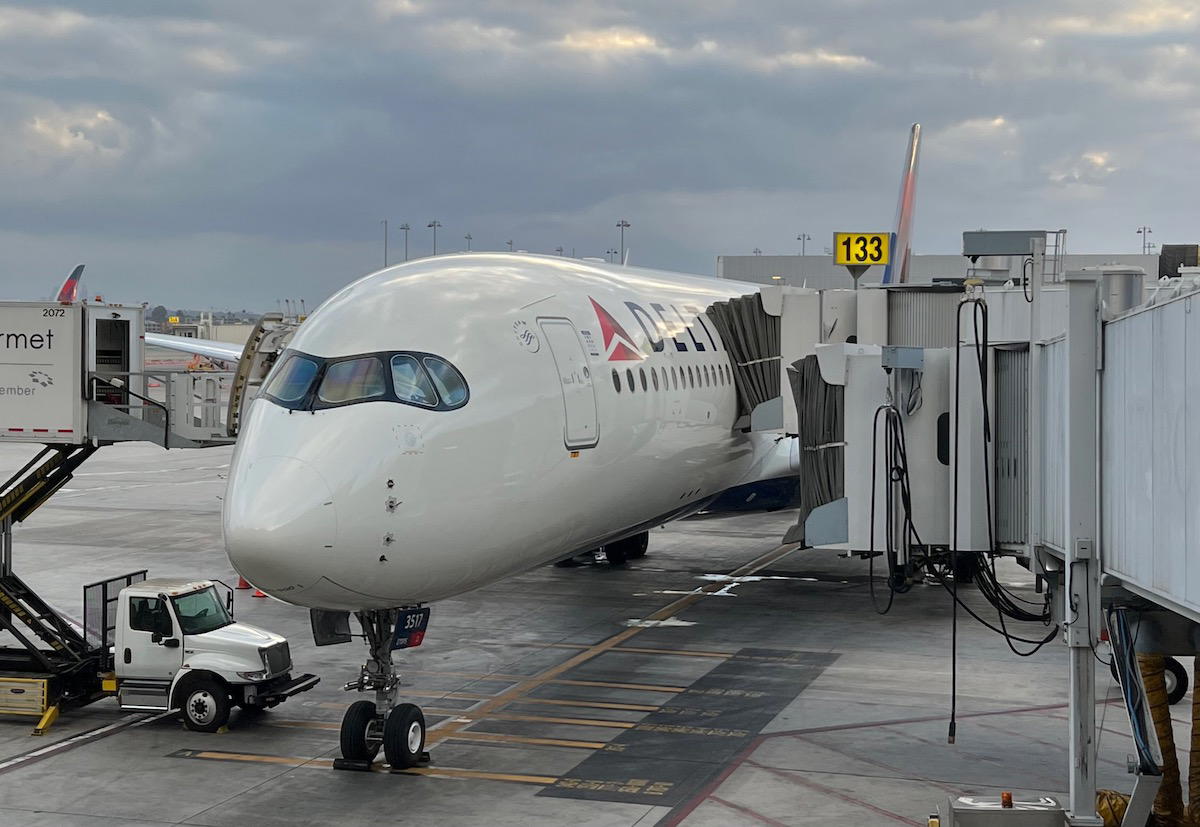
In early 2023, Delta Air Lines started introducing free inflight Wi-Fi for SkyMiles members, in partnership with T-Mobile. While the airline was a decade behind JetBlue, this was pretty revolutionary among the “big three” US carriers. Unfortunately the actual rollout of free Wi-Fi didn’t go as fast as planned, and kept getting delayed. There’s now a positive update, as Delta has shared that the rollout of free Wi-Fi is almost complete, and this latest update is particularly good for long haul travelers. Delta now has free Wi-Fi on nearly 1,300 aircraftCongrats to Delta, but this “advantage” won’t last longBottom line Delta now has free Wi-Fi on nearly 1,300 aircraft In February 2023, Delta started slowly rolling out free Wi-Fi for SkyMiles members. This came as part of a project where Delta began installing Viasat Wi-Fi on a vast majority of aircraft, but obviously that doesn’t happen overnight. So while Delta did a pretty good job of getting free Wi-Fi live on domestic flights, the rollout on long haul flights has been excruciatingly slow. That has left many Delta travelers frustrated, since some long haul flights have had huge coverage gaps. That brings us to the positive news — Delta has now announced that free Wi-Fi is available on nearly 1,300 aircraft, operating roughly 95% of flights. The latest progress here is that free Wi-Fi is now available on Asia-Pacific routes, possible thanks to Viasat’s new satellites, which should boost coverage and bandwidth. Delta is now promising full fleet connectivity by early 2027, as coverage extends to remaining Boeing 717s and Delta Connection Embraer regional jets, which are the only fleet types not consistently offering free Wi-Fi. Delta claims that it now offers free connectivity across its full international network, and calls itself the only global carrier to offer that. I don’t understand how the airline can make those claims, because: Carriers like Singapore Airlines offer free Wi-Fi to loyalty programs members on all flights; but I guess to Delta, maybe the “globe” is everything within several thousand miles of Atlanta? Delta is imprecisely using the term “international” here, since regional jets also operate some international flights, no? Presumably the airline means long haul… Here’s how Ranjan Goswami, Delta’s Chief Marketing and Product Officer, described this latest development: “We know how important connectivity is for travelers who want to stay connected wherever they fly, whether you’re traveling for business, reconnecting with family or setting out on a long-awaited trip. Bringing free global Wi-Fi across our international network is an important milestone in making the Delta experience more consistent and connected, especially on some of our longest journeys.” Delta now claims to offer free Wi-Fi on all international flights Congrats to Delta, but this “advantage” won’t last long It’s great to see Delta getting close to wrapping up its free Wi-Fi rollout project. A four year rollout for free Wi-Fi sure is a long timeline. That’s especially true when you consider we were promised free Wi-Fi on all long haul flights by the end of 2024, when the real timeline ended up being nearly two years later. Admittedly these delays have largely been outside of Delta’s control, given that they’re reliant on upgraded technology. In early 2027, there’s perhaps a brief period where Delta can do a victory lap, and point out how it’s the only one of the “big three” US carriers to offer free Wi-Fi on all flights. However, that will go from a major advantage to a major disadvantage pretty quickly, as Delta and United essentially trade spots on connectivity. United is in the process of rolling out Starlink Wi-Fi. So far nearly half of planes have Starlink, and the plan is for the project to be completed by the end of 2027. The same is true for Southwest, but I understand Delta wants to compare itself to “global” carriers (just not those outside the US). Say what you will about Elon Musk (and I have a lot to say, trust me!), but Starlink is in a different league than Viasat when it comes to speeds. While Delta plans to introduce Amazon Leo, which should compete with Starlink, that will only be available in 2028 at the earliest, and Delta has only committed to installing this on 500 aircraft, well under half of its fleet. As many will be aware, this has obviously caused quite the controversy in recent times, especially with comments reportedly made by Delta CEO Ed Bastian. Here’s what I actually find to be most interesting about Delta’s latest announcement. Historically, we’ve heard airlines offering Viasat Wi-Fi describe it as “fast.” I get how that was maybe accurate back in 2013, when the alternative was systems like OnAir, offering speed that made dial up look lightning fast by comparison. But nowadays there’s no denying that the average Viasat connection on a plane is anything but high speed. I think it’s noteworthy how Delta’s 2023 announcement about rolling out free Wi-Fi used the word “fast” seven times, while it’s barely mentioned in this announcement. At the very bottom, there is mention of how this “Wi-Fi provides SkyMiles Members with fast, free connectivity,” but that’s it. So I commend Delta for its (increasing?) honesty here. Delta’s free Wi-Fi rollout took four years, best case scenario Bottom line Delta has announced that its free Wi-Fi rollout is now 95% complete, as the airline has free connectivity on nearly 1,300 aircraft. The expectation is that the remaining planes (Boeing 717s and select Delta Connection Embraer jets) will have free connectivity by early 2027. The latest update is that Delta now has free Wi-Fi on Asia-Pacific routes, which was without a doubt the biggest gap the carrier had when it came to connectivity. That’s great news, and Delta now claims to have free Wi-Fi on all international flights. What do you make of Delta’s Wi-Fi rollout progress?
Delta’s Free Wi-Fi Rollout Is 95% Complete, But Its Edge Over United Won’t Last Long
Full Article
Original Source
Read the full article at Onemileatatime →KhanList aggregates and links to publicly available news content. We do not host full articles from third-party sources. Always verify important information with original sources.