
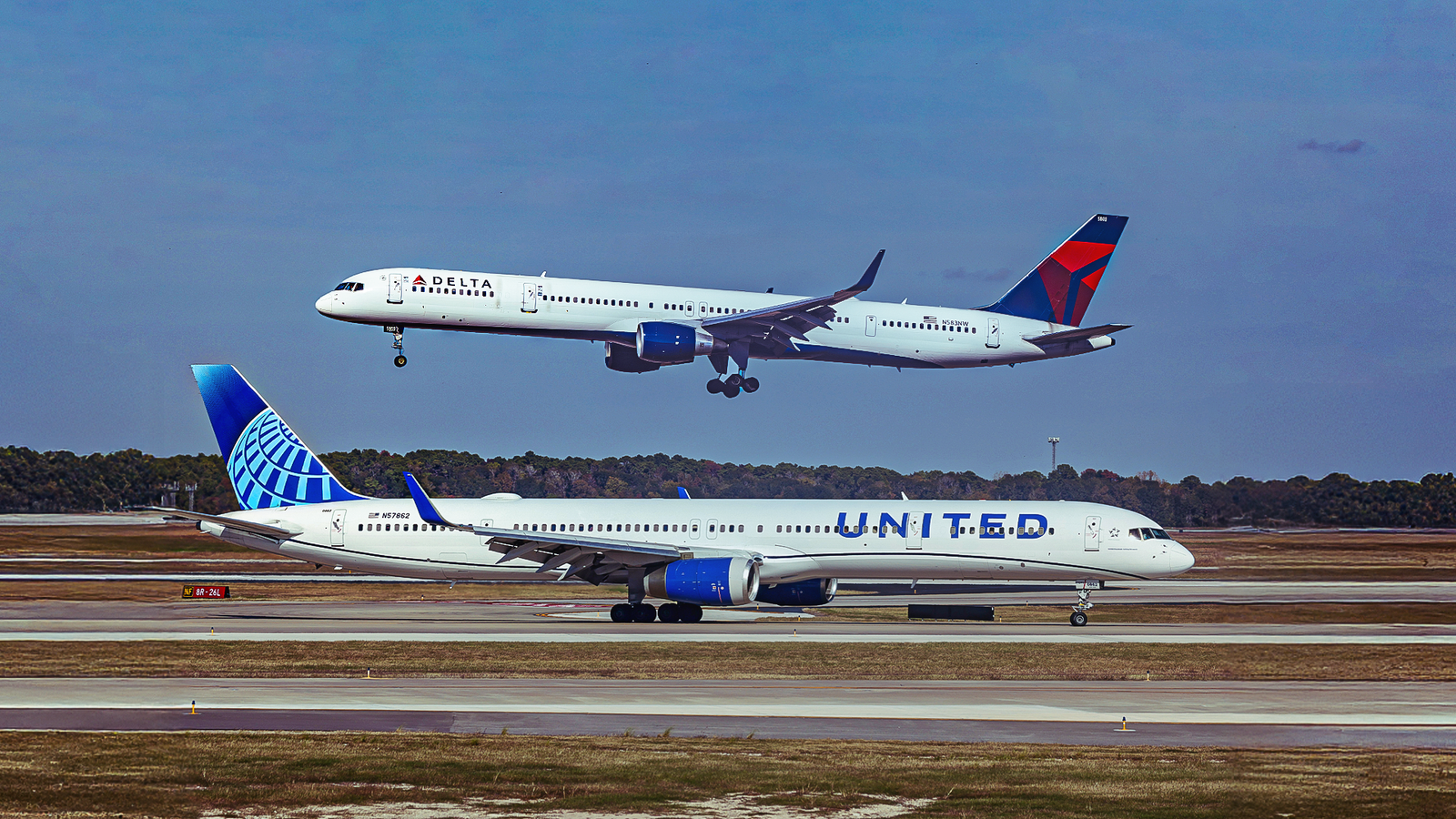
Published Nov 26, 2026, 3:01 PM EST Based in the UK, Josh is a keen writer with a degree in Military History. Having worked previously as a financial journalist, he has covered the aviation industry extensively, reporting on airlines' results and monthly passenger statistics in the aftermath of the pandemic, alongside the likes of regulation around sustainable fuels, and the prospects for hydrogen-powered commercial flight. He joins Simple Flying with a lifelong love of all things aviation. Boeing 757-300s make up a notable portion of both Delta Air Lines’ and United Airlines’ fleets today. Interestingly, neither ever actively set out to purchase this Boeing narrowbody model — or flying pencil, as it is nicknamed — directly from the manufacturer. Instead, their introduction in each case came about as the by-product of corporate dealings with fellow operators. Either way, both US legacy carriers have kept 757-300s on their books, taking advantage of the type’s unique blend of size, capacity, and range. Realistically, such characteristics are yet to be matched by any single suitable replacement, meaning both Delta and United have been left with progressively aging flying pencil fleets without an obvious successor. So, with the 757-300 set to remain a feature at both for some time yet, which airlines’ models are older? Both United And Delta Have Championed Boeing 757-300 Since Respective Mergers Although it is close, United’s 757-300 fleet is older than Delta’s on average. It is also the larger of the two, standing at 21 examples versus Delta’s 16. This places the duo as the two largest operators of the type, after Boeing, which produced only 55 of the models during a relatively short stint between 1998 and 2004. The irony, as mentioned, is that neither United nor Delta actually purchased any variants from Boeing. Rather, each has become the respective largest and second-largest 757-300 operator because of mergers. In United’s case, the 21 aircraft came under its control following its integration with Continental Airlines, through which their airline operations were unified in 2012. Continental confirmed an order for 15 of the jets in 2001 through a deal estimated at $1.2 billion in list price at the time. Nine of these ultimately made their way to the carrier before it converted the rest of the order to Boeing 737-800s. The remaining 12 were later taken from ATA American Trans Air’s fleet after its collapse in 2009. Boeing 757-300 specifications, from the manufacturer: Typical capacity (two-class) 243 passengers Max capacity 279 seats Length 178 feet, 7 inches (54.5 meters) Wingspan 124 feet, 10 inches (38.05 meters) Max takeoff weight 270,000 pounds (122,449 kg) Max range 3,395 nautical miles (6,287 km) Engines Two Rolls-Royce RB211 / Two Pratt & Whitney PW2000 Similarly, Delta’s 16 757-300s originally flew for Northwest Airlines before the two companies’ operations were integrated in 2010. Northwest initially penned a deal with Boeing in 2001 for 18 of the aircraft, along with two Boeing 747-400s, at a combined list price of $1.75 billion. Following the 9/11 attacks, the order was trimmed to 16. At United, all of the 757-300s Delta received as part of its merger remain in operation today. United Airlines’ Boeing 757-300s Each of United’s 757-300s shares a common internal configuration, housing space for 234 passengers split between two distinct classes. Some 24 United First options make up the front of the cabin. A further 54 United Economy Plus, located primarily directly behind the first class section, alongside 156 United Economy seats fill the remainder of the cabin. According to the carrier, its first class 757-300 offerings measure 38 inches (96 centimeters) in pitch and 20.4 inches (52 centimeters) in width. United Economy Plus — an extra-legroom economy, rather than a standalone premium product — aboard its 757-300s offers 34-38 inches (86-96 centimeters) of pitch, versus 30-31 inches (76-78 centimeters) in standard United Economy. Each economy option spans up to 17.3 inches (44 centimeters) in width, though the latter can be as narrow as 16.3 inches (41 centimeters). United Airlines Boeing 757-300 Cabin Specifications, from the airline: Class United First United Economy Plus United Economy Number of seats 24 54 156 Configuration 2-2 3-3 3-3 Seat pitch 38 inches (96 centimeters) 34-38 inches (86 -96 centimeters) 30-31 inches (76-78 centimeters) Seat width 20.4 inches (52 centimeters) 17.3 inches (44 centimeters) 16.3-17.3 inches (41-44 centimeters) Seat-back entertainment No No No WiFi Yes Yes Yes Power outlets Yes Yes Yes USB ports No No No These 757-300s previously had 213 seats onboard — 24 first and 189 economy — before United carried out retrofits from 2018. This came as part of an effort to install slimline seats across its wider fleet, beginning with its Airbus A320 family aircraft in 2012. Under the move, United removed seat-back screens from the Boeing models, instead opting to offer passengers connectivity to its WiFi-enabled personal device inflight entertainment system. All told, the overall offering is not too dissimilar to that on Delta's 757-300s. Delta Air Lines’ Boeing 757-300s Credit: Delta Air Lines Each of Delta’s 757-300s also seats 234 passengers, again split between two distinct classes. Similar to United’s models, 24 of these are premium Delta First products. Fewer economy extra — or Delta Comfort in this case — options are available, though, accounting for 38 of the spaces. That leaves additional room for standard Delta Main offerings, which total 172 of the jets’ seats. As for which airline affords passengers more space on the 757-300, it is a tight contest. Delta First widths of 20.9 inches (53 centimeters) just about trump United’s comparable product, though pitch as low as 37 inches (94 centimeters) can leave marginally more legroom for first-class flyers on the latter. Widths in economy and extra are the same on both, with United Plus potentially offering more pitch than the 33-34 inches (83-86 centimeters) of the Delta Comfort option. Delta Air Lines Boeing 757-300 Cabin Specifications, from the airline: Class Delta First Delta Comfort Delta Main Number of seats 24 38 172 Configuration 2-2 3-3 3-3 Seat pitch 37-38 inches (94-97 centimeters) 33-34 inches (83-86 centimeters) 30-31 inches (76-79 centimeters) Seat width 20.9 inches (53 centimeters) 17.3 inches (44 centimeters) 17.3 inches (44 centimeters) Seat-back entertainment Yes Yes Yes WiFi Yes Yes Yes Power outlets Yes Yes Yes USB ports Yes Yes Yes Where Delta does arguably have a slight edge is amenities. Alongside onboard WiFi and power outlets, which are both available on United’s 757-300s, Delta’s jets also include seat-back entertainment systems and USB ports, per the carrier. Alongside this, Delta took to refurbishing its 757-300s more recently than United, kicking off interior upgrades in 2024. That is, despite the fleet's relatively old age. United’s 757-300 Fleet Larger And Older Than Delta’s As with any 757-300 flying today, airlines have to keep an eye on aging, given the final model rolled off Boeing’s Renton, Washington, production line back in 2004. This particular model, registered N56859, was originally delivered to Continental and now represents the youngest example among United’s ranks. Overall, however, United’s 757-300s are slightly older on average than Delta’s. According to data from Ch-aviation, the former’s span is 22.65 to 25.42 years old and averages around 24.3. While that means United has both younger and older specific models than Delta, the latter’s range of 23.15 to 24.77-year-old 757-300s averages approximately 23.8 and is marginally younger in comparison as a whole. United Airlines and Delta Air Lines’ Boeing 757-300 fleets, from Ch-aviation: United Airlines Delta Air Lines Registration Status Age (years) Registration Status Age (years) N73860 Active 25.42 N581NW Active 24.77 N75861 Active 25.33 N582NW Maintenance 24.47 N57862 Active 25.29 N583NW Active 24.21 N57863 Active 25.24 N584NW Active 24.15 N57864 Active 25.16 N585NW Active 24.11 N75851 Active 25 N586NW Active 24.05 N57852 Active 24.88 N587NW Active 24 N75853 Active 24.88 N588NW Active 23.88 N75854 Active 24.85 N589NW Active 23.86 N77865 Active 24.78 N590NW Active 23.75 N78866 Maintenance 24.7 N591NW Active 23.61 N77867 Active 24.68 N592NW Active 23.45 N57868 Active 24.32 N593NW Active 23.38 N57869 Active 24.26 N594NW Maintenance 23.3 N57870 Maintenance 23.55 N595NW Active 23.23 N77871 Active 23.48 N596NW Active 23.15 N57855 Active 23.07 N74856 Active 22.94 N57857 Active 22.87 N75858 Active 22.71 N56859 Active 22.65 Average age 24.3 Average age 23.8 *As of time of writing in late November 2026 Again, it is close, which is somewhat unsurprising given the variant’s production run spanned just six years or so. Either way, with the airframes at each carrier nearing or hovering around the typical lifespan of commercial narrowbodies, one cannot be blamed for wondering about retirement plans. The reality, however, is that neither carrier has yet definitively indicated when this might happen. Both Delta And United Also Significant Boeing 757-200 Operators Credit: Delta Air Lines So far, only smaller Boeing 757-200s have been dropped by either carrier in efforts to phase out aging 757 family planes. Such variants continue to make up the majority of each fleet for the time being, though both United and Delta were early adopters of the far more popular variant. Delta received its first in 1984, the year after launch customer Eastern Air Lines debuted the 757-200 commercially. Some 189 models were ultimately operated by Delta over the ensuing years, of which 70 at an average age of 28.4 remain in service, according to Planespotters.net figures. United’s initial 757-200 was delivered not too long after its rival’s in 1988, marking the first of 139 to fly under its colors. Just 40 of these remain today, with these slightly older than Delta’s on the whole, at an average of 29.8 years. With a longer range of roughly 3,900 nautical miles (7,220 km), the 757-200 was no doubt more successful than its stretched counterpart. Boeing built in excess of 900 airframes designed to typically house 189 passengers, for context. The ever-improving range of newer, similarly sized narrowbodies — like those in the Airbus A321 family — has increasingly offered airlines viable alternatives, nonetheless, opening the door for retirements in turn. Unfortunately for the likes of Delta and United, the same does not go for the specialist, higher-capacity 757-300, which continues to fill a niche. Delta & United’s Boeing 757-300s Set For Years Of Further Service That has placed the 757-300 in an almost indispensable position, which it still holds today regardless of age. Though Delta and United did not initially swoop in for the variant directly from Boeing, the flying pencil has proven a key tool for serving their high-density domestic routes between hubs, busy leisure destinations, and so on. Not least is its substantial capacity versus rival narrowbodies—a trait that is yet to be replicated by a successor. For this reason, Delta and United have not just put off retiring the jets, but have actively put resources toward keeping them flying longer. Delta continues to carry out retrofits after kicking off the process in 2024, for instance, while United is poised to overhaul its own 757-300s imminently, according to reports.
Delta Air Lines Vs. United Airlines: Which Carrier’s Boeing 757-300s Are Older?
Full Article
Original Source
Read the full article at Simpleflying →KhanList aggregates and links to publicly available news content. We do not host full articles from third-party sources. Always verify important information with original sources.