
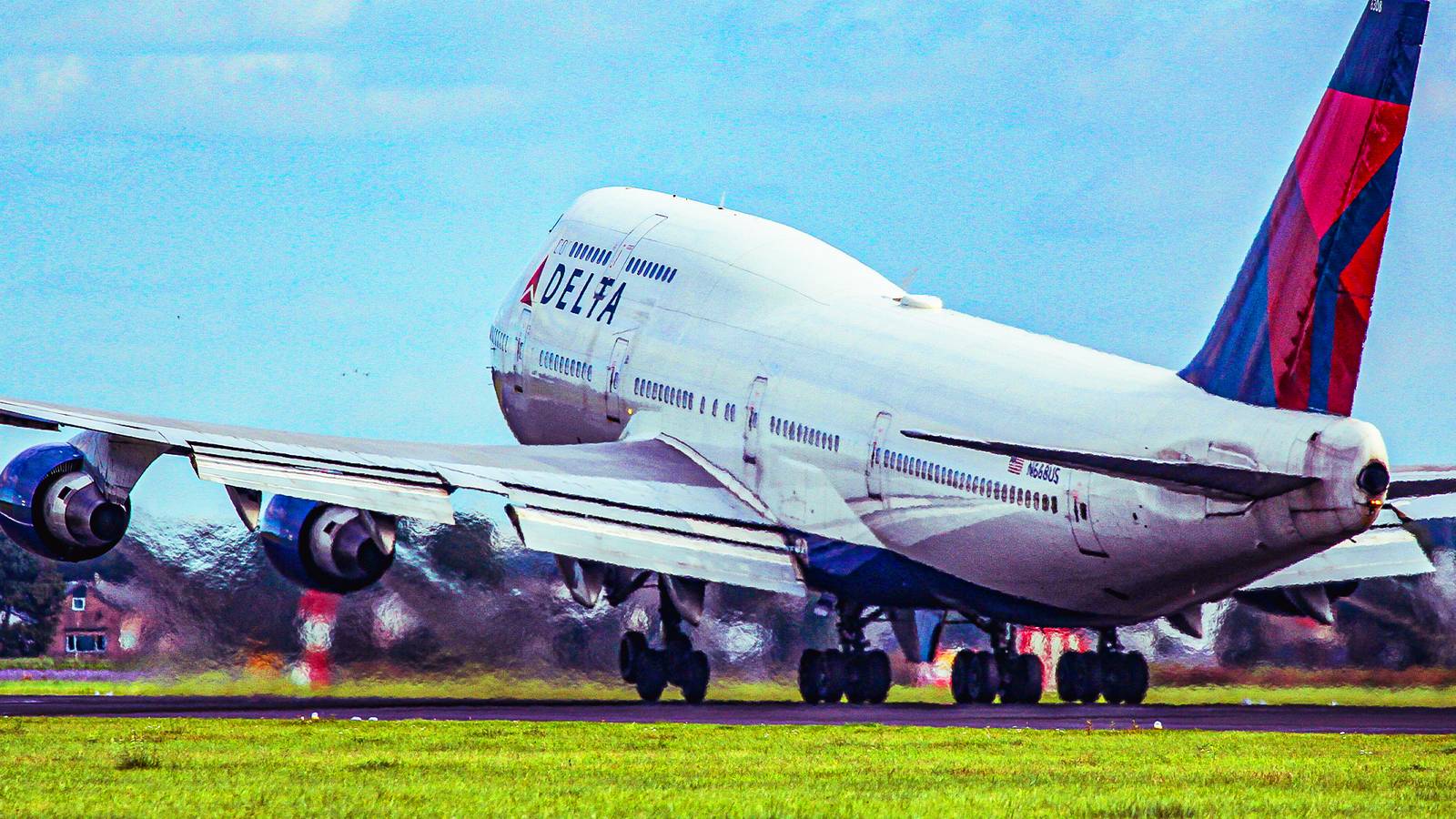
Delta Air Lines first started operating the Boeing 747 in 1970, the same year the aircraft was introduced. The carrier grew its fleet of 747s to five aircraft, but it operated the Queen of the Skies for far less time than its rivals. Delta was optimistic about what the aircraft could bring to American aviation, but it soon found the jet too large to operate its routes efficiently. Delta may have turned its back on the 747 in 1977, but over three decades later it would not have a choice. In 2010, the carrier merged with Northwest Airlines to create the world's largest airline at the time. Northwest was a key 747 operator, so some of the jumbos transferred into Delta's new merged fleet. It took a few years before Delta could shed all of these aircraft. The Queen Of The Skies Joins The Delta Fleet "The 747 is totally unlike any other aircraft, piston or jet. A triumph of American technology, the 747 will bring to our passengers a standard of comfort and convenience no longer limited by the size of an aircraft cabin." This is what former Delta SVP of Marketing TM Miller said of what he expected the Boeing 747-100 to bring to US aviation. The first 747 entered Delta's fleet in September 1970. It was registered N9896 and named 'Georgia Belle.' Four more units (N9897, N9898, N9899, and N9900) arrived in November 1971. They had the serial numbers 82, 94, 155, and 159, which marked them as being within the first 200 747s built. Delta used these aircraft to connect its major destinations in the US, such as Chicago, Detroit, Miami, New York, and San Francisco. The airline also used the jet as part of its Delta/Pan Am European interchange. These transatlantic destinations included London and Frankfurt. Delta's 747-100 had many unique features that it hoped would attract premium passengers. For instance, the Delta Museum writes that the 747 "offered the world's first flying penthouse apartment located above the First Class cabin and adjacent to the First Class lounge." The unit had seats for six passengers and was staffed by a flight attendant. The jet was also the first Delta aircraft with overhead luggage bins, replacing the open racks on older aircraft. Each passenger also had access to a personal audio system with seven channels, playing a mixture of classical and pop music. An Aircraft Too Big For Delta's Network Delta acquired the 747-100 hoping it would bring unmatched size and passenger comfort to its network. Yet, the airline found that its size was actually too large for the demand available on its network. Despite the aircraft's high capacity, it routinely flew with just 100 or 200 passengers onboard when being used for domestic trunk routes. Therefore, ticket sales could not offset the aircraft's incredibly high operating costs. Greater profitability could be gained with efficient twinjet aircraft, which serves as an interesting precursor to why quadjets are now largely obsolete. The table below shows the specifications for the 747-100, using data from Delta Museum. They give context to the aircraft's considerable size. Maximum takeoff weight 680,000 lbs (308,000 kg) Range 6,000 miles (9,700 km) Seats 370 (66 first class including the penthouse and 304 in economy class) Length 231 feet 4 inches (70.5 m) Wingspan 195 feet 8 inches (60 m) Height 63 feet 5 inches (19.3 m) Powerplant 4 x Pratt & Whitney JT9D-1 producing 164,000 lbf (730 kN) First scheduled service October 25, 1970 (Atlanta-Dallas-Los Angeles) In September 1974, Delta began to trade its 747s back to Boeing, with the final flight occurring on April 23, 1977. This left the Lockheed L-1011 as Delta's only widebody aircraft, a position it held until the first Delta Boeing 767 arrived in 1982. These smaller widebody jets had much lower operating costs, an appropriate capacity for the level of demand domestically, and were cheaper to maintain. Although Delta has long since retired the L-1011, 57 767s remain in service according to Planespotters.net. The Final 747 Service Captain Beverly Dickerson, who had the most flying time of any Delta pilot at the time, took the controls of Delta's last 747-100 flight. After 36 years of service, Dickerson would also retire with this journey from Atlanta to Dallas to Los Angeles. Dickerson also flew Delta's first scheduled 747 service. The final service also included the cream of Delta's cabin crew at the time. It was staffed entirely by those who had previously worked as Passenger Service Supervisors aboard 747s. Marlene Curtiss took the PSS role for the final 747 flight. The table below shows the top ten airlines by 747-100 deliveries according to Boeing data. Customer Total Deliveries Pan Am 33 United Airlines 22 British Airways 18 Air France 16 American Airlines 16 TWA 15 Northwest Airlines 10 Japan Airlines 8 Air Canada 5 Delta Air Lines 5 Delta estimated that the aircraft flew 15,220 hours, making 13,548 takeoffs and landings in the airline's service. This aircraft was also the first Delta 747 seen in Europe as part of the Delta-Pan Am European interchange. The wife of Captain Norman Topshe, who was a retired Delta 747 captain, wrote a poem titled Adieu to the 747 in memory of the retired aircraft. It concludes: "And so with fond memories and much appreciation, we bid you farewell - safe future destinations." A Merger With Northwest Airlines Delta thought that it had turned its back on the 747, going from strength to strength with the 767, and other widebody jets like the Airbus A310, McDonnell Douglas MD-11, and Boeing 777. However, decades later, it would have the 747 back in its fleet via a merger with Northwest Airlines. The airlines officially completed the deal in October 2008, and integration was completed by January 2010. This created the world's largest airline at the time, operating a total of 786 aircraft and with a collective value of $17.7 billion. The merger followed hard times for both carriers. In 2005, Northwest Airlines filed for Chapter 11 bankruptcy protection, a move also completed by Delta. Aircraft Number in Fleet Boeing 747-400 16 Boeing 747-200 20 McDonnell Douglas DC-10 32 Boeing 757 55 Boeing 727 20 Airbus A320 75 Airbus A319 43 McDonnell Douglas DC-9 169 Avro RJ-85 36 Bombardier CRJ 36 Saab 340 92 Both of the carriers were members of the SkyTeam alliance, making them compatible partners. The table below shows the Northwest Airlines fleet in 2002, as published in World Traveler Magazine. This fleet would have been highly similar to the one operated during the merger. However, the merger was not a silver bullet for the airline's struggles. The global financial crisis also created an incredibly challenging environment for the new airline. In the opening years, it was forced to cut staff and services, reduce capacity, and sell off facilities. The new airline also had to reckon with Northwest Airlines' sizable fleet, which lacked commonality and included jets that were not compatible with Delta's operations, such as the 16 747-400s. The 747 Comes Back To Delta The newly merged airline flew 67,000 times with the 747-400 from 2009 to 2017. The peak year in terms of usage was 2013, which saw 11,300 flights and 4.3 million seats available. The aircraft operated 18 nonstop routes. Tokyo Narita Airport (NRT) was a significant destination, with the 747 helping to establish the airline's mini-hub there. Other destinations included Ben Gurion International Airport (TLV), Amsterdam Airport Schiphol (AMS), and Paris Charles de Gaulle Airport (CDG). The 747 managed to achieve this second lease of life because the Airbus A350 and Boeing 787 remained years away from their first deliveries. Furthermore, while the 747 had higher fuel burn, its greater capacity meant it could outperform the Boeing 777 in some markets. Northwest Airlines' infrastructure also allowed the airline to keep using the jets. Delta gained experienced 747 crews, simulators, spare parts inventory, and maintenance personnel. Dismantling this system while the merger was ongoing would have caused more harm than good. Delta's Second 747 Retirement Delta flew its final 747 for the last time in February 2018, when flight DL9771 touched down in Marana, Arizona, for storage and cannibalization. The 213-minute journey from Arizona marked the final time in almost 50 years that Americans could buy a 747 ticket from a US airline. CNN reported that when the 747 rolled down its last taxiway, flight attendant Stephanie Nielson said that “We’d like to welcome you to the boneyard. Now we say farewell to the queen, the last queen; it’s her last voyage, her last touchdown.” Along with the jet, senior Delta captain Paul Gallaher made his final flight. Gallaher had flown with Northwest Airlines since 1983 and had been a 747 captain for 18 years. His final command had been the day before, flying a charter with his friend Stephen Hanlon for the Clemson Tigers football team. The pair had known and worked with each other for over 30 years.
Delta Air Lines Thought It Said Goodbye To Queen Of The Skies Until It Had No Choice But To Fly It Again 31 Years Later
Full Article
Original Source
Read the full article at Simpleflying →KhanList aggregates and links to publicly available news content. We do not host full articles from third-party sources. Always verify important information with original sources.