
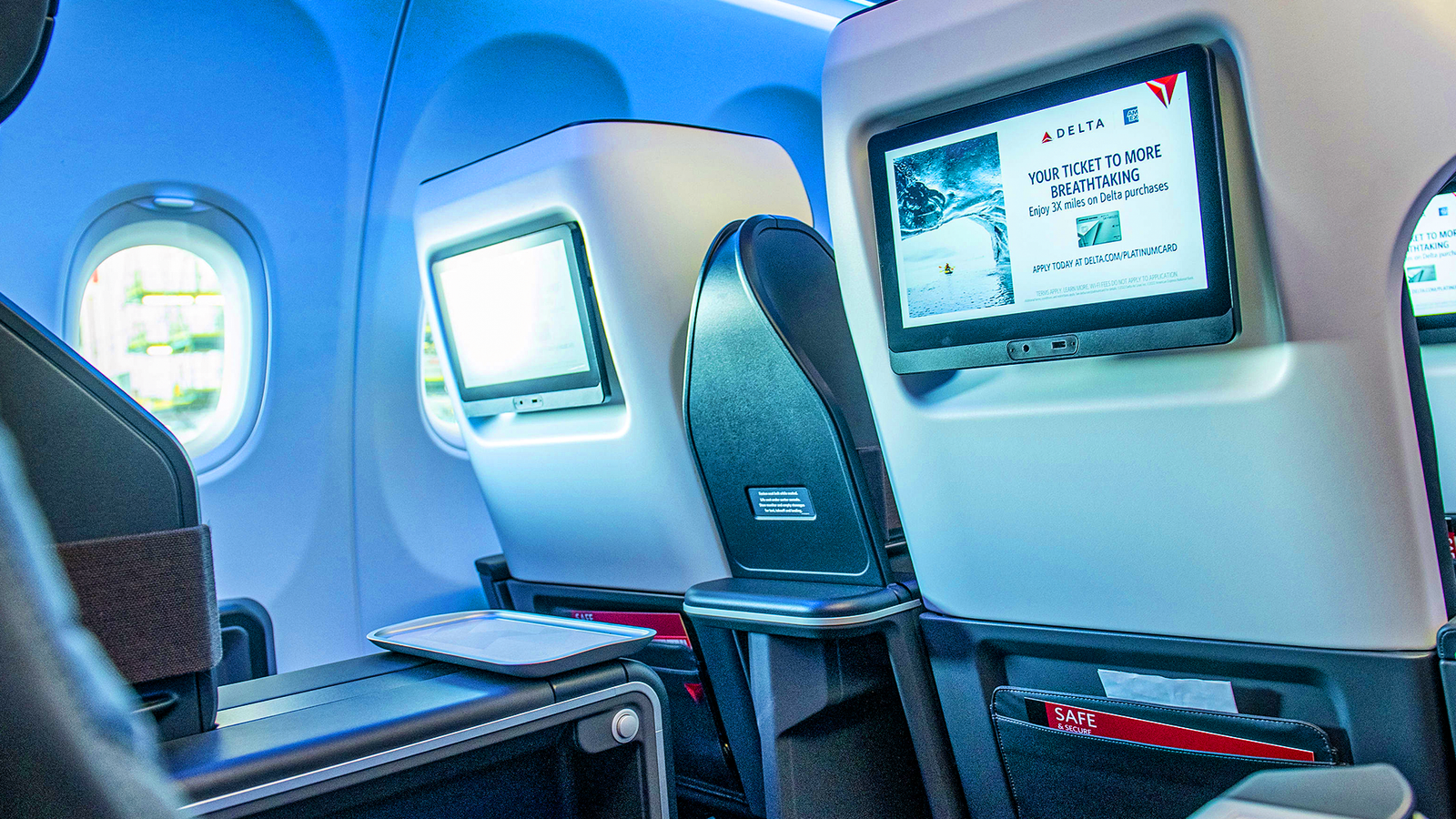
Published Oct 28, 2026, 10:54 AM EDT Brandon's passion for aviation started at a young age. He became involved in the flight simulator and VATSIM communities, which sparked his interest in aviation and eventually led him to earn his private pilot license. Outside of work, he continues to build flight hours, explore new airports, and stay involved in the aviation community. Delta Air Lines has more than 165,000 seatback screens across its global fleet, which it describes as the most of any US carrier. The figure counts hardware. Delta Sync seatback, the personalized interface that greets SkyMiles members by name and feeds them tailored recommendations and real-time connecting flight information, is a software layer running on top of some of those screens. It reaches more than 470 of nearly 1,000 aircraft in the mainline connected fleet. The WiFi side has moved faster. Delta has equipped nearly 1,300 aircraft with free WiFi, more than 95% of the fleet, and completing trans-Pacific coverage means the airline now offers it across six continents. Regional and Boeing 717 installations finish by early 2027. Behind that sits a three-stage satellite program: additional Viasat-3 capacity through the F2 and F3 assets, the Hughes Fusion hybrid architecture combining geostationary and low-Earth-orbit networks, and Amazon Leo connectivity arriving from 2028. What The 165,000 Figure Actually Covers Credit: Delta Air Lines Delta Air Lines has more than 165,000 seatback screens across its global fleet, which the carrier describes as the most of any US-based airline. That figure counts hardware. It measures how many physical displays are installed across the aircraft Delta operates. Delta Sync seatback is something different. Delta describes it as elevating its industry-leading seatback screens to make them feel more like smart TVs, offering tailored recommendations, expanded day-of-travel features, and a smarter, more intuitive interface designed around each customer. The screens themselves are not replaced. What changes is the interface running on them and the data feeding it, which comes from a passenger's SkyMiles account. Delta presents the two as parts of a single platform. Delta Sync is the airline's connected travel platform, unlocked through SkyMiles membership, and it brings together two complementary experiences. Delta Sync WiFi delivers connectivity to personal devices through the login page. Delta Sync seatback delivers a personalized interface on the screen. Delta's own FAQ addresses the confusion directly, stating that Delta Sync is the broader connected onboard experience, with the WiFi element covering personal devices while the seatback element brings personalized entertainment and trip information to equipped aircraft. That last word carries the weight, because the number of equipped aircraft is considerably smaller than the number of screens. The Personalized Version Reaches 470 Aircraft Credit: Kirk Fisher | Shutterstock Delta Sync seatback is available on more than 470 aircraft, according to Delta's media kit updated on October 21, 2026, bringing personalized recommendations, real-time trip updates and entertainment together on the seatback screen. For comparison, nearly 1,300 Delta aircraft carry free WiFi, representing more than 95% of the fleet. The personalized seatback experience sits on a substantially smaller portion of the aircraft than the connectivity does. What those aircraft deliver is a different interface rather than different content. SkyMiles members access a refreshed interface and smart TV-style features, including personalized recommendations, the ability to resume select content and save favorites. Logged-in members also receive real-time day-of-travel information on the screen, including updates related to connecting flights and other relevant trip details. Delta describes the platform as connecting SkyMiles membership with the in-flight experience to deliver more relevant entertainment, information, and offers both in the air and beyond the flight. Access requires an account. Customers unlock Delta Sync seatback by following on-screen prompts to connect their SkyMiles account using the Delta app or an available identity-verification option. SkyMiles membership is free. Delta states that customers who choose not to join may purchase WiFi access where available, but that personalized Delta Sync experiences require SkyMiles membership. The airline also notes that product features, partner offers, and availability may vary by aircraft, route, and market, which applies to the seatback experience as much as to the WiFi. The WiFi Side Is Nearly Finished Credit: Delta Air Lines Delta has equipped nearly 1,300 aircraft with fast, free WiFi, representing more than 95% of its fleet. Trans-Pacific coverage completed the global picture. Delta's media kit states that with connectivity now live across its trans-Pacific routes, the airline offers free WiFi across its global network spanning six continents. Coverage extends across the domestic network and international routes to Europe, Israel, West Africa, Latin America, South Africa and the Asia-Pacific region. The connection runs for the full flight. On WiFi-enabled flights, SkyMiles members can connect on multiple devices from the time boarding doors close until gate arrival, making it possible to stream, browse, message, or work throughout. Members log in with SkyMiles credentials through the DeltaWiFi.com portal, and Delta confirms VPNs are permitted provided the user signs in to the portal page before enabling one. What remains is the regional and Boeing 717 fleets. Delta reports that streaming-capable connectivity is rolling out across Delta Connection and 717 aircraft, with installations slated for completion by early 2027. Domestic coverage is described as available across the mainline fleet and continuing to expand across regional aircraft as modifications are completed. Delta says it works with multiple satellite connectivity partners to match the right technology to each aircraft and route network, and that it is focused on improving the consistency and dependability of today's service while investing in the next generation of onboard connectivity. That second objective is a separate program running alongside the remaining installations. The Satellite Roadmap Behind The Promise Credit: Amazon | Simple Flying Delta has laid out a three-stage plan for improving connectivity rather than simply extending it. In the near term, the airline is integrating additional Viasat satellite capacity to improve capacity, speed, stability, and consistency in parts of the network. The specific assets are F2 and F3, which Delta describes as Viasat-3 satellite assets intended to provide additional capacity and coverage. F2 supports the Americas and portions of the Atlantic. F3 supports Pacific coverage. Delta says it has already seen meaningful performance improvements on aircraft when connected to F2, and expects those benefits to increase as more traffic is migrated onto the new capacity. The second stage changes the architecture. Delta describes Hughes Fusion as an award-winning hybrid network architecture designed to simultaneously use two satellite networks, geostationary and low-Earth-orbit, an approach intended to provide greater flexibility and redundancy while supporting improved speed and lower latency. Deployment is moving steadily on the 717 fleet, with additional installations planned on new delivery aircraft. Delta says it will share broader timing and customer-experience details as installation and performance validation progress. The third stage is Amazon Leo. Delta plans to begin bringing Leo connectivity to aircraft starting in 2028, subject to technical, certification, and deployment milestones. The airline frames the selection in terms of the overall experience rather than any single attribute, citing performance, reliability, global coverage, flexibility, economics, and how the technology can support a broader digital experience. Delta states that it believes the long-term partnership will provide high-bandwidth connectivity while creating opportunities to bring Amazon's broad ecosystem of entertainment and digital services to the skies, which ties the satellite roadmap back to the Delta Sync platform. What Delta Admits Still Does Not Work Credit: odecam | Shutterstock Delta's own FAQ is unusually candid about the limits of what it has built. Asked how fast its WiFi is, the airline states that speed and consistency can vary by aircraft, route, geography, customer demand, and satellite capacity. It goes further: "There are still some pockets where performance is less consistent, particularly in certain high-demand or capacity-constrained regions." That is a carrier with 1,300 connected aircraft acknowledging that connecting them was not the same as making them all work equally well. The caveat appears repeatedly rather than once. On streaming, Delta says performance can vary by how many customers are connected at a given time. On why WiFi feels slower on some flights, it lists aircraft, route, geography, satellite coverage, weather, network demand and simultaneous users. The honest version of Delta's position is that satellite connectivity remains a shared resource, and a full cabin of passengers streaming video on a long-haul route in a congested region will not match the experience of a lightly loaded domestic flight. The Viasat capacity additions and Hughes Fusion deployment are responses to exactly that problem. The product disclaimers carry the same qualification. Delta notes that product features, partner offers and availability may vary by aircraft, route and market, which applies across the partnerships with T-Mobile, Paramount+, YouTube, Crunchyroll, FOX One, DraftKings, Sport 24, The New York Times, The Wall Street Journal and American Express. A passenger who sees a partner offer on one flight may not find it on the next. Taken together with 470 aircraft out of nearly 1,300 carrying the personalized seatback experience, the picture is of a platform Delta has built at genuine scale and is still assembling. The 165,000 screens are real. What runs on them depends on which aircraft shows up at the gate.
Delta Air Lines Has 165,000 Seatback Screens, But The Personalized SkyMiles Version Reaches Only 45% Of The Fleet
Full Article
Original Source
Read the full article at Simpleflying →KhanList aggregates and links to publicly available news content. We do not host full articles from third-party sources. Always verify important information with original sources.