
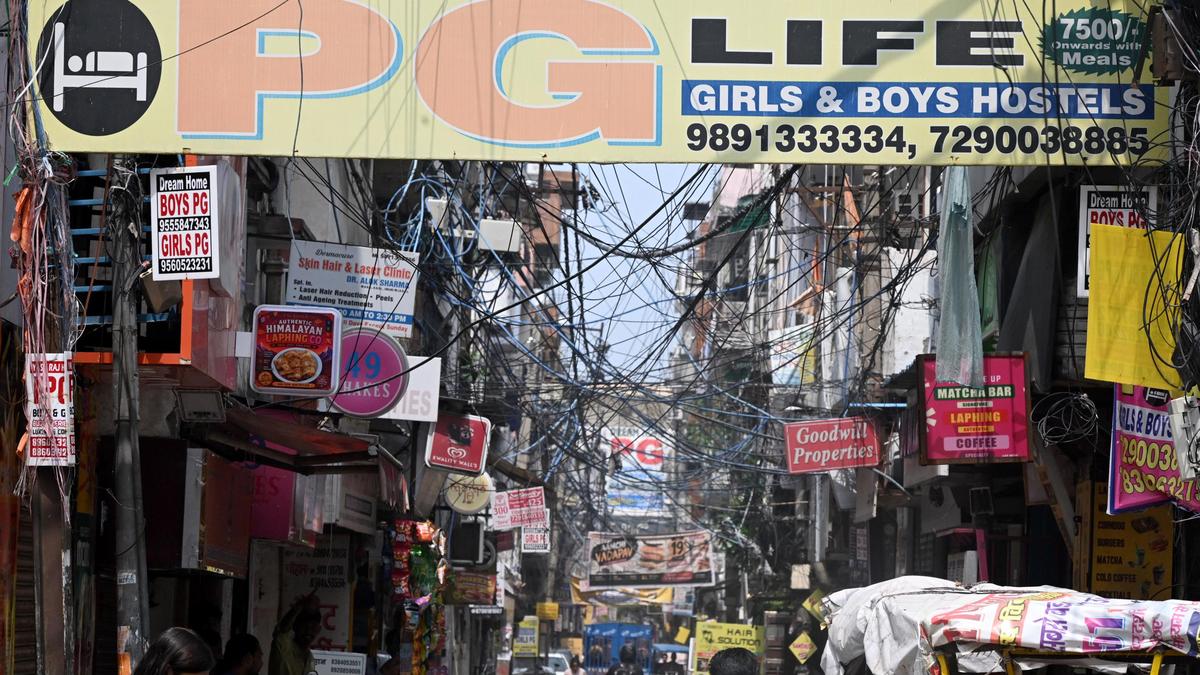
The collapse of a five-storey building housing students in Satya Niketan on Sunday has brought renewed scrutiny to the cramped living spaces and the compromises students make in the absence of affordable hostel accommodation.In Delhi’s student hubs, narrow lanes, ageing buildings pressed against each other, dangling electricity and cable wires, and rooms carved out wherever space permits have become a familiar reality. For thousands of outstation students arriving in the Capital each year, these converted houses and tightly packed buildings are often the only affordable options, with a bed in a shared room costing anywhere from ₹12,000 to over ₹24,000 a month.Near Delhi University’s (DU) South Campus, Satya Niketan is a maze of small shops, property dealers, old buildings and newer constructions connected by uneven roads.Unnayan, who moved to Delhi last month, lives about 100 metres from the collapsed building. He paid ₹14,000 this month, including the security deposit, for a bed on the fifth floor, where he no longer wants to live.“I chose the fifth floor and have to go up and down the stairs because the lower floors were more expensive. A bed on the second floor cost ₹17,000, and the first floor was even more expensive,” he said.Common themeAt the other end of the city, in Jawahar Nagar near DU’s North Campus, a narrow lane is choked with parked vehicles on both sides, leaving little room for pedestrians. Small shops are wedged between residential buildings, while a web of electricity and cable wires hangs overhead.Rakhi, a native of Haryana and a first-year Bcom student at Daulat Ram College, pointed to a ground-plus-five-storey building where she has been living for a month.“I pay ₹17,000 for a bed and food, which is pathetic. Electricity is an additional cost,” she said.With no hostel available, Rakhi began looking for a paying guest (PG) accommodation when the academic session started. Her first room, on a lower floor, cost ₹14,000 for double-sharing but was, she said, “not liveable at all”.“The rooms are very cramped. There is barely any ventilation. The rent is too high, but at least this is a room I can somehow survive in,” she said.A 10-minute scooter ride away, Nehru Nagar appears to narrow further with every turn. Buildings rise to five floors, their tiny entrances leading to uneven staircases and corridors punctuated by air conditioners jutting out from walls.Riddhima (name changed on request), a final-year DU student, has spent four years in one such PG.“The place is not ideal to live in, with no ventilation or space even to walk, but this was the best I could find,” she said. Other PGs nearby offer essentially the same arrangement, a bed in a shared room, for ₹17,000 to ₹20,000.Less than a kilometre away, Kamla Nagar is another student hub where almost every other building houses a PG.Tanya, a second-year DU student, pays ₹12,000 for a bed in a double-sharing room. The room has no window or ventilator, forcing her to keep the air conditioner running to make it bearable.“Otherwise, it gets very suffocating,” she said.Across Delhi’s student colonies, space has become a premium that students are paying dearly for, even when it amounts to little more than a bed squeezed into an ageing building.
Delhi’s student hubs: soaring rents, ageing buildings and little room to breathe
Full Article
Original Source
Read the full article at Thehindu →KhanList aggregates and links to publicly available news content. We do not host full articles from third-party sources. Always verify important information with original sources.